Tuesday, July 26, 2022

Painting (another) Kitbashed Chaos Champion / On the new Army Painter Speedpaints

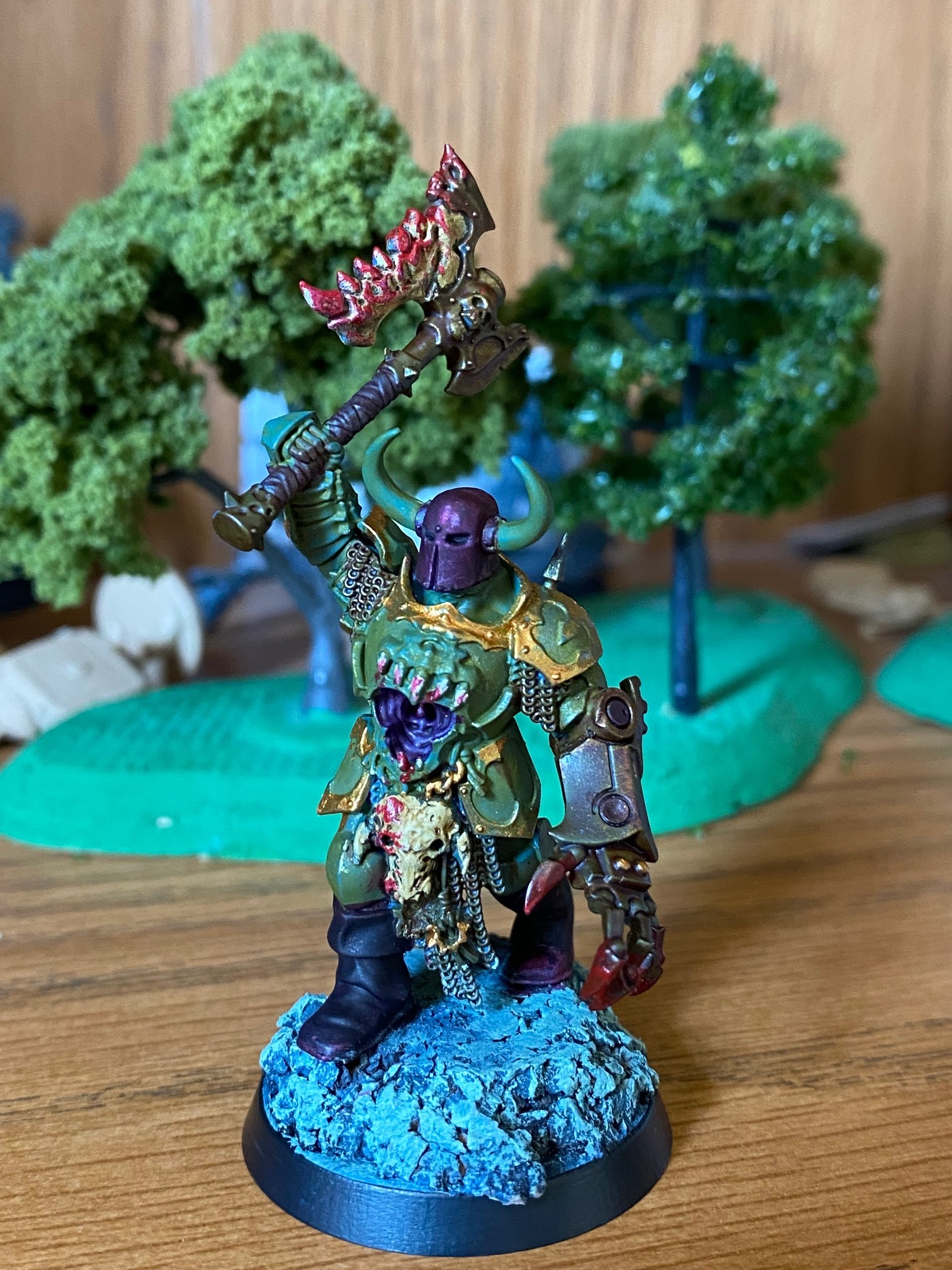
 This past weekend, I carved out some time to attack the 'unpainted' pile. Exhibit A is an interestingly kitbashed Warhammer Chaos champion. I bought this fella second-hand last year as part of an army of Chaos figures that draw heavily on kitbashing with (for example) Stormcast Eternal parts or even bits from 40k. This particular specimen combines a 'Nurgle'-style mutated maw-in-the-tummy with a very sci-fantasy-leaning mechanical claw arm (I'm *still* not sure where the arm comes from; something Necron, maybe?). 

I fancy myself an advanced Beginner painter, or maybe a Mega-Noob Intermediate painter, or something in there. Despite a few missed strokes I'm quite happy with this guy's overall appearance.


This was also an early opportunity to try out the new-ish Army Painter Speedpaint collection, a recent splurge. It seems these speedpaints are taking the mini-painting world by storm, so I have been eager to try my hand at them. The paint-job featured here combines several types of paint. When I acquired the figure, it was already wearing a sort of minimalist blue and gray coat of paint. 


To proceed, I first drybrushed with silver...


...and then got to work, laying down (mostly) speedpaints supplemented by 'regular', metallic, and blood-effect paints for some specific local touches. 


I decided to go for a hint that the guy used his bloody axe to pulp something, used the bloody claw to pick it up, and then fed part of it to the bloody maw in his midriff.
Ah, Chaos champions! No table manners at all. 


One thing that really strikes me is the impact of the undercoat color when using these translucent speedpaints. The green on this champion is 'Malignant Green' (the 'Nurgle' color), but it came out very dark on top of the blue basecoat. The mechanical claw is painted with Stone Golem, and I think it makes a very nice 'dull bronze' look - but it is exactly the same speedpaint color used to paint the bare, white bases on these 'just tabletop ready' sci-fi grunts from Reaper Bones!


...Slapping out three of these Reaper Bones grunts, including pre-work with silver touches here and there, took about 40 minutes total (!). This stuff is great for batch processing units. 

Although I can see that the Speedpaints require their own skillset, I'm quite pleased after my initial trials. 


Thursday, July 21, 2022

Old but (Fairly) Good: AC4, The Book of Marvelous Magic

 I recently picked up a .pdf copy of AC4, The Book of Marvelous Magic [affiliate link], by Mentzer & Gygax (1985). Although I vaguely remember inheriting a print copy of this book as a teenager, this is not a resource that seems to command much attention nowadays in the OSR-ish blogosphere. Although there are some good reasons for the book's present obscurity, there's enough genuine usefulness between the covers that AC4's fairly inexpensive availability on DTRPG deserves more notice. 
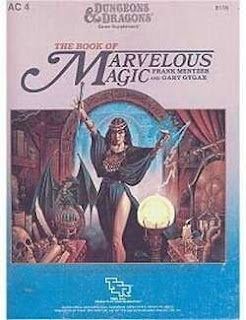


So, what is it? AC4 is a collection of magic items, not spells or other magic abilities. It contains "all the miscellaneous magic items that appeared in the Basic, Expert, and Companion Sets" - along with an additional 500 new items. The book is pitched as suitable for both D&D (that is, BECMI) and AD&D; an appendix states that "The D&D and AD&D games are actually different games" - then describes D&D as flexible and open to what we now call hacking, with AD&D too complex to make house-rules prudent. Harrumph. I will return below to the question of using these magic items across different rule-systems.

The book is arranged alphabetically by item type. Refreshingly (depending on one's perspective), this is very far from a list of standard dungeon-crawling items with arcane abilities slapped on. No, this feels more like an array of magical items from folklore fantasy literature, with spools, thimbles, masts, anchors, kettles, and strings concealing their mysterious powers. 

I would group the book's items into several categories. To be clear, some of these are (to me) useless rubbish, so it's the latter categories that really catch my eye:

+ Placeholder references to earlier published material. Ya know, like these:

BAG
Bag of Devouring: See D&D Basic Set.
Bag of Holding: See D&D Basic Set. 

In other words, these entries don't contribute anything, except that they're integrated with new stuff on the book's random-roll treasure tables. 

+ Joke material, often with a long-past shelf life:

The book opens right on this note with the "Alternate World Gate", which could be cool, except that they are a variety of items that port in characters from other 1980s TSR games, like Top Secret, Gamma World, Boot Hill, and Gangbusters

Advisory: puns are also present. 

+ Cursed items. Well, at least we're getting to material that might actually contribute something new in-game. Historically, I have tended to avoid seeding hoards with cursed items - partly because I don't love 'gotcha' games with my players, and especially because I didn't have great mechanical ways to incorporate cursed treasure without making treasure identification a risky drag. (That has now changed with my house-ruled simple 1d6 treasure identification rules, which I find fun, easy, useful, and still respecting of player agency and risk/reward judgments). So, now I'm more willing to incorporate cursed items here and there. There are a LOT of them in this book. Probably far too many, to be honest - and they tend to be sneaky little things that look and initially act just like one of the already-obscure helpful magic items first published here in AC4 (I suspect this means TSR expected, or wanted, players to buy and comb through this GM resource, becoming familiar with the loot they could gain, so that they'd genuinely worry about whether they'd just found a "Cymbal of Crashing" or a cursed "Cymbal of Symbols"). 

Now, look: up to this point, I've been wasting your time in the interests of an honest, comprehensive overview/review. It's the final category that makes this thing worth your attention:

+ Quirky, genuinely useful new magic items. I like that these tend to affect the game's 'fictional positioning', if you will, rather than just slapping some +2s on everything. The items' applicability to the narrative rather than the mechanics makes this book a handy and fairly system-neutral resource. I'm currently running two campaigns: one in the very light EZd6, the other in Pathfinder 2e. I can use AC4 equally well in either campaign! I'm not kidding; here's a magic item that will appear in the dungeon my PF2e players are now raiding:

ARMCHAIR
Armchair #2: Armchair of Relaxing. When sat upon, this item vanishes along with its user, and travels to the Outer Plane. The user is instantly put to sleep and has no saving throw. The armchair reappears in 1 turn and awakens and releases its user; it bestows magical rest, as if its user had a full night's sleep during that period on the Outer Plane. The chair functions once per day.

In use, I'll be making this something a bit more period-suitable than an 'armchair', but the players will have reason to wonder why the BBEG has two separate beds in their bedchamber, and they have been warned by a covert ally 'not to let the leader go to bed.' This requires basically no conversion to run in PF2e. 

Here are a few other magic items that piqued my interest. 

Brooch, Lunar: This piece of jewelry bears the likeness of a crescent moon. If worn by a spell caster, it bestows additional power to any light or continual light spell cast. The light from either spell causes any and all lycanthropes in the area of effect to assume animal form (no saving throw). They remain as animals until they leave the lighted area. The lunar brooch has no command word and operates continuously while worn. 

Fork of Travel: This copper-colored fork may be placed at any intersection, and it will point (on command) toward either the most dangerous, safest, shortest, or longest route, as desired by the user. It may be used three times per day. For answers about distance, the destination must be known and named.

Fishing Gong: This gong has a rune inscribed in its center that reads "Bass." A read magic spell is needed to translate it. If taken aboard a vessel and rung over any body of water that contains fish, the sound causes one fish weighing 1-100 pounds to leap out of the water and into the vessel, landing next to the user of the gong. After cleaning and cooking, each 5 pounds of live fish can be used to feed one person for one day. The gong can be used three times a day. 

September Horn: This horn appears and functions as a horn of plenty. However, except for the horn itself, it also causes all magical items worn or carried to vanish. The items are not destroyed, but merely return to the user's home. The September Horn can be used once per day at most. [Is this a cursed item, or a really useful tool? That depends on the PC's context!]

Nail of Building: If this nail is the first nail used in building a wooden structure made entirely of ordinary wood and nails, the magic nail may be removed after the structure is complete. This removal causes the entire structure to disappear! The nail can then be easily carried about, and when the user wishes to re-create the structure at any given location, one command word causes it to re-appear. The nail then becomes nonmagical. [I really like that this is a one-shot item. If you plan ahead, you can bring your own defensive stockade for that showdown in the dungeon - but only once!].


All in all, AC4 The Book of Marvelous Magic sags from too much chaff, but it also offers many inspiring and fun items that your players can exploit with some creative thinking. At a higher price, this might be a stretch to recommend, but the .pdf is fairly priced at $4.99 on DTRPG.com - and during their ongoing July sale, it's down to $3.74 (affiliate link). If you have a weather eye out for new magic items, this could be worth consulting. 


Thursday, June 2, 2022

The Merovingian Sandbox (continued): the CIVITAS-centered campaign setting

We’re back! Let’s continue my recent discussion of early Merovingian society as an alternative template for a lower-prep ‘vanilla’ fantasy sandbox setting. I’ve suggested at least four ways that Merovingian Gaul is well-suited for that role:

  • it’s a post-collapse points-of-light setting, but with dials for ‘brighter lights’ if you want them
  • greater organic social mobility than later feudal European societies; better-suited for classic PC career trajectories
  • political-social geography that scales up excellently as you build a campaign through play
  • a reusable sandbox - cultural-political assumptions that support effective re-use of the same living campaign world in new campaigns
What that earlier post introduced, this post will flesh out in more detail. Please note that I won’t offer here a comprehensive survey of Merovingian history or society. The comments chain for this series’ initial post offers a number of text/resource recommendations for those who want to dig deeper. That’s partly to preserve my own time, but it also will keep the most widely game-able content front and center in this discussion. As I wrote recently, I won’t be terribly offended to learn about any anachronisms in your elf-game application of these ideas! Just recently, I’ve been running myself through a bit of solo Ironsworn in my own personal example Merovingian sandbox…which is good fun…and I certainly (and deliberately) include some elements that I know perfectly well don’t really belong in 6th-century Gaul. Play on!

Again, my aim is not to perfect historical accuracy in your games, but to inspire you with social-political structures that can make play more coherent and satisfying - while offering a refreshing alternative to the 5,000,003 extant ‘fake feudal’ settings already out there.

Sounds good? Let’s dive in.


THE CIVITAS - YOUR MAIN BUILDING-BLOCK


Today's post will focus on the late Roman and Merovingian-style civitas (to be explained momentarily!). I think that putting this institution at the heart of setting design can make campaigns more interesting and easier to run. To unpack what I'm talking about, we need to get a little technical and discuss the geographical organization of space in late antique and early Merovingian society. 

At the lowest level, the countryside was divided up into pagi (singular pagus) - rural districts (the word is related to modern French le pays, 'country, region' and thus English 'peasant'; our English word "pagan" comes from Latin paganus, "someone who lives out in the countryside" - in other words, "a rustic, a redneck, a hick" - the term 'pagan' reflects ancient urban prejudices, the urban focus of many early Christian communities, and the slower Christianization of the rural population). Out in the pagi, you'd find your little villages, your land-owner estates and various farms, your shrines both ruined and current, maybe an isolated monastery here and there, your mines, various workshops, etc. 

But even though the pagi formed the lowest level of geographic 'building block', it was the next step up that really was fundamental for social organization. 

Multiple pagi together formed the territory of a civitas (plural civitates) - a "city" (sort of; the word is related to Spanish ciudad and English 'city'). A civitas was a city - an urban central space - but it was more than that; the term also encompassed the entire territory surrounding the 'city'. If you're familiar with the large counties and county seats of the western United States, they provide a useful mental analogy: a whole lot of fairly open space administered from a central location. The key thing to understand is that there was a difference between 'urban' and 'rural' space, but the entire thing was the civitas. In many cases, the territorial outlines of civitates still reflected in part the territories of old Iron Age Gallic tribes/polities from before the Roman conquest centuries earlier. So you can translate 'civitas' as 'city' but there's some cause for seeing it as related to tribe, nation, or district (though each such translation would have its own limits or problems too). 

For example, around the year 311 CE - back in late Roman times, prior to Merovingian rule - a resident of the Aeduan civitas (around Autun in modern Burgundy) gave a formal speech to the emperor Constantine, and asked rhetorically: "for which gens [race/people/clan/nation] in all the world should ask to be placed before the Aeduans in love of the Roman name?" As that flowery question attests, a separate identification with one's local territorial name was understood as important, centuries after the Roman conquest, and was perfectly compatible with loyalty to the Roman state. 

The pattern continued into Merovingian times. Here's a key point: for descendants of the Gallo-Roman population living under Merovingian rule, the civitas was a primary focus of identity. To put that more simply, if someone asked you "who are your people?" your answer usually would name your civitas. Yes, you might identify as a Roman (or as a Frank), you might be Christian, but your geographic allegiance was tied to your local 'city'. 

In the wake of the "fall of the western Roman Empire" and the fragmentation of many economic, social, and administrative networks, the centrality of the local civitas provided a measure of continuity despite the collapse. One often reads that "the medieval church inherited and filled the vacuum left by Roman government in the West," but that statement is fairly misleading. Surviving written sources were mostly written by and/or kept by churchmen, so (surprise!) they tend to reflect ecclesiastical or monastic interests. But the glue holding society together owed much to the continuation of local government within the civitates. In fact, as often as not it was the church's own adaptation to late Roman civic and provincial structures that made it a useful part of local administration! (I'll return later to the important roles bishops played within civitates). 

Even as long-range networks suffered profound (but not total) disruption, even as violence swept across much of Gaul, life in many civitates continued apace. The centrality of the civitas meant that peasants still dealt with local landowners, local families still sought advantageous marriages within local social networks, local administrators still collected taxes (and the continuance of taxation into Merovingian times now looks more important than it did to scholars generations ago). It was, now, less likely (though not impossible) for locals to interact with travelers from afar; but they still interacted routinely with fellows from across the same 'city' territory. So you can almost think of the civitas as a kind of cellular organismic structure, keeping life in motion, even when isolated from other communities - like a self-sufficient (if less complex) single-celled organism. 

And that's why the city/civitas is the basic building block for a Merovingian sandbox: just as every complex living organism is made up of discrete cells, kingdoms and large territorial units were made up of, and relied heavily on, individual civitates

Compared to older Roman bureaucratic institutions, Merovingian top-down administration was pretty laughable (though only in comparison; again, modern scholarship has developed more sympathy and respect for 6th-century government). When kings or princes held territory, what that meant functionally was controlling the appointment of administrators at the civitas level, and controlling access to the tax revenues and military recruitment from across a civitas' lands. This isn't too dissimilar from later feudal relationships ("I've little effective bureaucracy, so you send me troops and $$$ when I need them") but there was a key difference: power certainly was personal, but the focus of royal-local relationships retained a wider collective/communal aspect. 

So, if you were a king and you wanted more power and wealth, you wanted more civitates. You could (and some did) launch destructive raids for plunder into neighboring territories, but that wasn't a great long-term solution. What you really wanted was to secure effective control over the tax proceeds of an entire civitas. To do so, you probably needed to start a war, but a scorched-earth war of total conquest would be ... kind of stupid, since it would destroy the very resources you were trying to annex. Better to fight directly against the army of your opponent (or just murder/threaten them) and wrest control of a fairly intact civitas when done. Alternately, you could use intrigue: find some way to subvert those in office at a neighboring civitas, and get them to open the gates to your troops. Bloodless and enriching. 

Who were those office-holders? Rulers typically appointed a Count to oversee a civitas. Above a Count, a Duke might be given authority over a region, consisting of a group of multiple civitates. Altogether, these would make up your kingdom. But there was just one "Merovingian realm" - one of the more curious aspects of Merovingian history is the profound fragmentation of Merovingian territory across "Francia". This, too, is because of the role of civitates. Focused on gaining more tax proceeds, princes often accepted/demanded control of different cities even when they weren't geographically adjacent. This could lead to weird political maps like these: 

Vidal de Lablache, Gaul in 561

...which changed, only 27 years later, to this: 

Vidal de Lablache, Gaul in 587


ALL that colored territory makes up "the Merovingian realm" - but it was divided, again and again and again, into smaller holdings reporting to different members of the family dynasty. Their internecine struggles kept political affairs lively, but the importance of the civitas not only shaped but also constrained (to some extent) the destructiveness of warfare (with notable exceptions...). 


WHAT'S A CLERIC TO DO? CHURCHES AND SPATIAL ORGANIZATION


Alongside, and parallel to the structures discussed above, Christian churches maintained a related territorial system. Little parish churches out in the pagi reported to bishops in civitates. In fact, by the later sixth century, in most cases the location of a bishop's cathedral seat and a civitas 'capital' were usually synonymous. Bishops themselves reported to metropolitan bishops who oversaw provinces, which initially followed the old map of late Roman provinces very closely. The map below, for example, illustrates late antique church provincial boundaries (with one full province, Lugdenensis Prima, highlighted): 

Adapted from Mathisen & Shanzer, Society and Culture in Late Antique Gaul: Revisiting the Sources


In this way, even when old Roman governmental structures fell apart, ecclesiastical networks did continue to keep lines of communication between civitates open. It got trickier when kings nabbed themselves new civitates, so that different bishops across one province oversaw flocks reporting to different kings. This could lead to the creation of new 'chains of command' disrupting old structures. 

Written sources also suggest that kings or their agents often felt worried about the potential for bishops to betray kings. There's a pretty good chance that those suspicions were (usually) unnecessary, but numerous episodes involved some fear that a bishop might open the gates/hand their city over to agents of another king. This sometimes led to violent oppression in which counts attacked, imprisoned, or exiled suspect bishops. Remember the intrigues I mentioned above? Far from being out of the limelight, Merovingian bishops were such central figures in late Roman society that they almost automatically got caught up in the political affairs of the age. 

Ok, whew. That's been a lot of nerdy stuff, hasn't it? Let's switch gears now and talk about applying it all at the gaming table. 


GAMING IT: BACK TO THE FANTASY SANDBOX

If you're still with me, thanks for bearing with all that background. Now how can it help us run a smooth campaign?

+ BUILD IT AS YOU GO: you know that (excellent) advice to start small with a campaign map, and only build what you need? The pagus-civitas-province/region-kingdom spectrum offers a template for building just what you need, but with enough structure for everything to work coherently when you're done. Want to run some Lvl 1 types through a small dungeon-crawl after they tussle with bandits or wolves? Fine, create one pagus - one rural district. Just throw a few small square miles onto paper, with a background awareness that 'somewhere out there' lies "the city" - the seat of the whole local civitas. If you're feeling ambitious, go ahead and name the civitas/city. That's all you need, but if you want more, this whole little area has built-in integration with a larger unit nearby. 

Then, after the PCs have leveled up a bit, have a local landowner or a priest or bishop call them into the local city for help with some urban adventures. Note that the people in power in the city are NOT isolated from the rural districts; their own local social networks demand their involvement all over the civitas, so it's quite appropriate to introduce them as early as you want. 

As time goes on, ambitious PCs might become local landowners, abbots of local monasteries, Count of the local city, bishop or archpresbyter of the local city, etc., etc. But wait, they can't ALL be Count of the city, oh no! Wait - in what's now Burgundy, there is some evidence of the Burgundian kingdom (early contemporaries who fell to Merovingian conquest in the 530s) assigning TWO Counts per city, one to administer 'Roman' affairs and one to oversee the immigrant Germanic Burgundian population. Problem solved. 

Later, you can start branching out into much bigger adventures that require engagement with surrounding civitates. The nice thing about the civitas model is that the whole thing tesselates, while permitting diversity. You needn't know what's over the horizon until you need it, but you know it will follow the same basic pattern of rural districts integrated with a central civitas seat. Who knows what happens next - maybe PCs become Dukes of surrounding regions, or even fight their way into the royal dynasty and becomes sub-kings. 

+ WAIT, IS THIS A FRAUD? HOW IS THIS ANY DIFFERENT FROM ANY OTHER SETTING? Yeah, don't feudal maps also include lots of little villages and some cities and kings who want to squeeze it all dry while still looking good in the history books? 

Yes. But fairly differently. 

As I've discussed before, feudal societies (while very, very diverse) had their own certain logic. 

As an overgeneralization, feudal societies organized space in less coherent ways (I think that's a fair way to describe what I'm getting at). Chartered towns were generally exempted from many of the feudal/manorial land-tenure relations around them. They were, of course, still connected to the land in various ways, but the underlying social structures tended to emphasize difference between rural and urban spaces. In the Merovingian civitas model, rural and urban spaces are more connected by coherent social networks, rather than divided between them. This means that a patron for that dungeoncrawl mission last week is just as likely to want the PCs' help in town, and vice versa. PCs can go back and forth between all the different landscapes of the campaign and become more integrated into society at each step, rather than always drifting as outsiders. There's a certain mystique of the alienated drifter-adventurer that many gamers find appealing, but I suspect this tells us more about our own individualistic society than it does about the past. A Merovingian sandbox offers a post-collapse and often bleak and violent setting, but one where social networks and identities matter. 

As members of the same civitas, starting PCs can be as different from each other as you want, but they retain a common sense of place and a shared identity. They are more or less invested in a community (albeit one with its own, potentially vicious, internal politics). 

HARUMPH, FINE. NOW TALK MORE ABOUT INTRIGUE MISSIONS. Ok, I'll humor you. Although you can just build up your setting layer by layer, you can have even more fun if you decide early on to locate play right on the borderlands. That might mean a B2-style Keep on the Borderlands frontier, but it could just be (or could also be) the edge between two civitates, especially two civitates owing allegiance to different kings. 

In that context, things can get quite interesting, quite early on. 

That landowner you interacted with last session - why is he meeting with warriors from just across the border? Who is framing the local bishop for treason (or is he being framed)? Almost from the start of a campaign, you can weave in a plot to subvert the local civitas and flip it to a neighboring kingdom. How will the PCs react? Will they join the plot, and profit? Will they stop the plot, and secure favor from their own Count or King? Shenanigans ensue, with plenty to do for Fighters, Thieves, Rangers, and Clerics. 

DIDN'T YOU SAY SOMETHING ABOUT RECYCLING YOUR CAMPAIGN SETTING? Yep. Let's say you try this out, and you like it. You run an epic campaign after which your players have become Counts, Dukes, Metropolitan Bishops, and even Queens or Kings! Nice. Now those characters have left their fingerprints all over things. What if you've invested lots into the setting and you'd rather not reinvent the wheel for another campaign? 

Remember how I showed two maps above that illustrated shifting royal borders in just a few decades? 

Unlike later European generations that favored primogeniture (the firstborn kid, usually male kid, inherits everything), Merovingians practiced partible inheritance - chop that property up, and give a bit to all the heirs! This is why the political map looked so fractured, even though a single Merovingian realm theoretically existed. Periodically, a strong ruler did emerge to consolidate that whole realm into one big territory. No big deal - upon that strong ruler's death, the whole thing was liable to get chopped up once again. 

This means that, in a Merovingian-inspired sandbox, you can have characters achieve profound glory by conquering or consolidating the entire realm, but you can count on cultural practices dividing everything back up again within a few generations. So long as you maintain the same basic cultural practices and civitas identities across your setting, you run and rerun and rerun the same setting, a couple generations later each time, without retconning or pretending away the achievements of an earlier group in play. 


OK - I'm going to stop here for now. There's loads more I could discuss, but I'm not sure whether any of this is making sense or seeming compelling. What should I clarify? What ideas have I sparked? Does this all make sense? I'll find out - if you comment.

Happy gaming!

Thursday, May 19, 2022

Merovingian Sandbox (quick preamble update): Skerples on Gregory of Tours on Merovingian rulers

 For those interested in my emerging/pending little series on a Merovingian-inspired fantasy sandbox, I've just noticed that Skerples (of the Coins and Scrolls blog) had an interesting post back in 2017: a "Table of Rulers" with a metric ton of sample lines borrowed from the early Merovingian-era bishop/historian, Gregory of Tours. Arranged on a random-roll table, the entries allow one to: 

...roll up barbarian kings, tormented bishops, feuding dukes, brutal counts, and any other disreputable people your setting might require. Imagine you are reading a history book about your setting, or a ruler in your setting. Roll 2 or 3 times on these tables to get some sentences that might appear in a paragraph about your ruler.

A cool resource, and quite worth checking out if you're waiting patiently for me to get my next proper installment posted here. Meanwhile, stay tuned!

Monday, May 16, 2022

Early Merovingian Gaul/France: A Great Alternative Template for a 'Vanilla' Fantasy Sandbox Setting

It’s been too long since I dished up a post drawing on my other identity as a scholar! Ironically, for a professional historian, I’m not terribly worried about a little anachronism or historical inaccuracy in my elf-game settings (I save that for my day job). But GMs can only benefit from understanding the structural logic of whatever actual societies might have inspired a setting. The patterns that characterize a society generally exist for a reason; such reasons offer a GM leverage for organizing factions and plot hooks that make organic sense within the campaign world. A little historical awareness can be particularly helpful for livening up that old bugaboo, the ‘vanilla’ or generic fantasy world. Quite often, however, one encounters ‘medieval’ settings that actually evoke early modern or even modern social customs and sensibilities, just dressed up for the Renn Faire.


(For some favorite examples of my thoughts on harnessing real historical lessons for campaign worlds, consider posts on the logic of feudalism, late antique "barbarians," Late Bronze Age palatial society in the Near East, or collapse across history, and maybe check out my background generator for Bronze Age characters, which is on sale this month [affiliate link]). 


In addition to the common faux-feudal medievalish settings out there (or, of course, more 'ancient' settings following the tropes of Swords & Sorcery), there are a number of early medieval-themed settings (one thinks immediately of the ubiquitous Viking-'inspired' game resources out there, or of the more robust Anglo-Saxon-themed Wolves of God from Sine Nomine games [affiliate link] or Paolo Greco's Wulfwald). Early medieval societies offer particularly moody and evocative source material, but the very constraints and smaller scales of those societies may limit some classic dimensions of RPG campaigns. 


CC: https://commons.wikimedia.org/wiki/File:Disque_de_Limons.JPG?uselang=fr


However, I don’t think I’ve seen campaigns inspired by the structures of early Merovingian Gaul/France - that is, what is now France (basically) between the end of Roman rule and the rise of the Carolingian dynasty (think Charlemagne). I came here today to say this: a campaign setting modeled at least structurally on the Merovingian realm of the sixth century would offer a really useful template for a fun ‘vanilla’ fantasy sandbox campaign, because REASONS:


I’ll Take My Collapse Medium-Rare, Thanks: 


It’s a Points of Light setting, but with dials to adjust the chaos to taste. We are very much talking about a post-Collapse setting atop the ruins of a mighty empire, with all the mayhem, disorder, and barriers to communication you might desire - but also a resilient society holding on to important elements of the past (with more governmental competence and ability than previous generations of scholarship tended to recognize). 


What?! A Danish warband attacking our sixth-century coast?
And it's mentioned later in Beowulf? But they're shown here in 15th-century gear?
Nah, bruh, the blogger said a little anachronism is ok ... it's the structural chaos that matters!
https://fr.wikipedia.org/wiki/Thierry_Ier#/media/Fichier:Bataille_entre_Francs_et_Danois_en_515.jpg


Zero-to-Hero Progression That Fits: 


From the perspective of RPG design, a Merovingian-style ‘medieval setting’ offers better social mobility than the feudal societies of later centuries, in ways that are more conducive to a typical PC’s career path. Arguably, the setting’s social structures also offer better reasons for an adventuring party to move seamlessly between urban, rural, and wilderness adventures in the service of the same patrons or goals. 


Listen here, Lady!!!
Whether you had me stabbed and then visited me on my deathbed to rub it in or not, you can't make me forget that you're an interesting example of female power and social mobility!
https://upload.wikimedia.org/wikipedia/commons/a/a6/Fredegunda_visita_a_pretextato_en_su_lecho_de_mueret.jpg


Low-Prep and Build-As-You-Go: 


Compared to later feudal settings, the setting’s built-in political geography scales more organically to match the widening scope of classic campaigns, without requiring the GM to prep more than is needed at any time. Merovingian political structures make it easy to start hinting at high-level faction stuff at level 1 if you want to, or to add those things in on the fly at higher levels without doing violence to the logic of structures you’ve already built. Oh, and remember that wise, common advice to start a hexcrawl campaign with just three hexes and then build out if you need more? Not only would that work in a Merovingian-inspired setting, it would work particularly well. 


Behold your sandbox: Gaul in 587 (de la Blache)
https://fr.wikipedia.org/wiki/Gontran_(roi)#/media/Fichier:Division_of_Gaul_-_587.jpg


Conquer, Rinse, Repeat: 


You know that thing where some otherwise great campaign settings get permanently hobbled because of the accomplishments of a previous generation of characters? [paging Dragonlance to aisle four, please…] Due to the political geography mentioned above and some Frankish cultural assumptions, a Merovingian-inspired sandbox is innately repeatable between campaigns. In other words, Merovingian-inspired settings would work really well for a ‘living campaign’ world; once you’ve done the work to build your setting, you don’t have to reinvent the wheel every time you want to start a new campaign, but you also don’t have to retcon anything that happened previously. [That may sound like a feature of any decent setting; what I’m arguing is that a Merovingian-inspired setting would be particularly good at recycling, compared to other options]. 


For now, I’m going to drop this as an introductory post to whet your interest. I’ll plan to unpack each of these elements in much more detail soon. Please let me know if this sounds interesting or if you already have any questions! Due to some recent spam attacks, comments currently require moderation, but I'll be happy to process them. 


Happy gaming. 


Saturday, May 14, 2022

aaaaand now we'll try comment moderation...

 Hmm. Every few days, I get another wave of spam attacks from the same source, turn off blog comments, wait a few days, turn them back on ... and then the spam attacks recur. Somehow I've become a repeat, high-volume target (should I be flattered?). 

I guess we'll try open commenting but go with comment moderation for a while. You're lame, spam-bot. 

Saturday, May 7, 2022

[Update] Comments are re-dis-enabled

UPDATE TO THE UPDATE: Nope. Sigh. Comments going off again for a bit due to the internet being the internet. 

I hope to post soon a discussion of why early Merovingian Gaul/France offers an excellent 'alternative vanilla fantasy sandbox' template for D&D campaign settings. Stay tuned. :-) 

+++++++++++++++++++++++++++++++++++

UPDATE: the stream of fake comments I had to delete today seems to have abated for now, so I've re-enabled commenting. That means you - yeah, YOU! - should leave a real comment on some posts! Make the internet safe for actual thoughtful dialogue again! 

Cheers. 

++++

 The blog has been bombarded with autobot fake comments. I'm temporarily disabling comments until the Necron overlords get bored and go bother some other blog, which I hope will occur soon. :-) 

Stay tuned ... my grades are submitted, the school had its Commencement today, and I may just need to slap down some fresh blog content in the near future. 

Happy gaming!