Thursday, May 2, 2024

Back to the Fighter, after playtesting

 I got in some playtesting for my evolving ideas about Fighter stunts, maiming strikes, etc. Design is an iterative process; what I've got now is streamlined even more (so: apologies to anyone getting frustrated with how much things are evolving here!). But I think this is the version I like best so far. I'll spell out the rules themselves first, and then offer some discussion again below. 


COMBAT STUNT PROCEDURES 

Any character may spend their combat action to attempt a combat stunt, a maneuver that does not deal direct damage but otherwise disadvantages a foe (tripping them, disarming them, chucking flour in their face to blind them for a moment, etc.). A successful stunt may grant advantage to follow-up attacks vs. the foe, or disadvantage to their attacks (but the foe might negate that circumstance soon with an action of their own). To attempt a stunt, first discuss what you want to achieve with the GM. If they approve, you may attempt the stunt. 


The stunt mechanic: opposed 2d6 roll + HD/Level.


Combat Stunts: Roll 2d6 and add your Level (you may add a STR or DEX bonus if you have one); the GM rolls 2d6 and adds the foe’s HD. High score succeeds; defender wins ties. If you succeed, the stunt takes effect; if you fail, it doesn’t, but there’s no consequence beyond the wasted action. 


Time to apply damage across multiple targets!
Larry Elmore


THE FIGHTER


(FYI: this is written with Swords & Wizardry core/complete in mind. The old core remains free, and the new Complete is here - affiliate link).


FIGHTERS have the following special abilities (Replace S&W’s Multiple Attacks and Parry). 


Attack Bonus: A Fighter’s attack bonus = +1 per level, capped at +14. 


Killing Blow: when a Fighter’s attack roll is a Natural 20, or when the combined attack roll (d20 + bonuses) exceeds the target’s AC by 10+, the target must Save or die. From level 14+, trigger the Save on a Nat 19-20, and if the Fighter’s level exceeds the target’s HD, add the difference to the target’s Save TN. 


Flexible tactics: when a Fighter’s attack roll hits, the Fighter may apply one of the following additional special effects, after rolling for damage:


+ Hit harder: add your level to the damage inflicted. [Alternate version that I like even better: multiply your rolled damage by 1d3. If you roll a 3, you over-exert yourself, and may not Hit Harder again for the rest of this combat]. 


+ Tempest of Blades: if your target’s HD = 1/2 your level or lower, you may apply the rolled damage to a number (up to your level) of additional targets within reach/range, which may not have HD or AC higher than the primary target’s. 


+ Free Stunt: follow up with a free Combat Stunt.


+ Maiming Strike: attempt a special Combat Stunt that can deal direct damage, as described below. 


Maiming Strikes for Fighters: 


Note that Fighters (and only Fighters) may attempt a riskier but more decisive kind of stunt called a Maiming Strike after hitting a target with a normal attack roll. A Maiming Strike is a stunt that deals direct damage, physically disadvantaging the target in a way that can’t just be shaken off, or which even nullifies a target’s special ability. Examples could include hacking off a giant scorpion’s venomous stinger, slicing an ogre’s wrist-tendons to hinder its attacks, impaling a cyclops’ eye to blind it, or hewing off an owlbear's left forearm to reduce its number of attacks or negate its bear-hug ability. 


Maiming Strikes are resolved like normal Combat Stunts (opposed 2d6 rolls, +Level/HD), but they add a risky consequence: if the Maiming Strike attempt fails, the initial attack's damage is canceled, and the Fighter is Staggered (off balance, distracted, and flustered) until they spend an action to recover. While Staggered, the Fighter suffers Disadvantage to their own attack rolls and grants advantage to attack rolls made against them. 


So, to spell it out really clearly: 


Maiming Strikes: Roll 2d6 and add your level (you may add a STR or DEX bonus if you have one); GM rolls 2d6 and adds the foe's HD. If you succeed, the target is Maimed as proposed to the GM. If you fail, you deal no damage at all on the attack, and you are Staggered until you spend an Action to recover. 


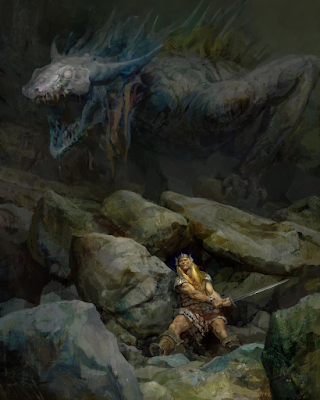
Globnaz! Try a Maiming Strike against that venemous stinger!
Art: Rodney Matthews


DISCUSSION 

Ok. I like this version because it retains much of the spirit of what I proposed earlier, with streamlined procedures, while better fitting use-cases observed in actual play. 

At the table, I found that some of my earlier ideas (including escalating damage risks for failed Maim/Killing Blow attempts) just made such attempts to risky to be appealing. Against weak targets, a normal attack vs. HP remained the logical choice; against stronger targets, the potential consequences made trying a "hail Mary" stunt inadvisable. This newer version, therefore, makes regular stunts consequence-free (apart from wasting an action if it fails), and the consequence for a Maiming Strike is tactical, rather than, well, medical (you don't take damage, but you put yourself in a really bad spot - one that your team might be able to mitigate if they can pull you back to cover to give you a round to collect yourself). 

And what about that Killing Blow? 

I noticed that Swords & Wizardry Continual Light offers a one-sentence variant class to turn a Thief into an Assassin, giving them a killing blow ability of their own: once per day, if the Assassin has snuck into position where they could attempt a backstab, they can force the target to Save or Die.

Well, I thought, that sounds a LOT like a much simpler version of my Killing Blow idea. 

However, "once a day" didn't really fit with what I had in mind for the lethal Fighter. Additionally, the single Saving Throw numbers for Swords & Wizardry escalate significantly (technically they deescalate since they get smaller, but you know what I mean, I hope).  At lower levels, a targeted foe still has a pretty good chance of failing a Save. Once you get up to about 12 HD+ monsters, however, you're looking at Saves around 2 or 3 - which means that there is very, very little chance of a Save or Die effect working most of the time.

In other words, my Killing Blow effect is a lot less overpowered than it might look. 


DANG IT! Since I'm on the cover of the Basic book, there's barely any chance I pull this off even if I do trigger a Killing Blow with a Nat 20 ... why couldn't I be on the Companion Set?


So, I decided to marry some approaches. I gave the Fighter the ability to trigger a killing blow randomly, so that they always have a reason for excited hope as they roll the d20. But they'll also trigger a Killing Blow when they blitz way past the target's AC. The general idea here is that as fighters level up, they should get better at just obliterating lower-level threats. 

Since I'm suggesting an attack bonus equal to level for Fighters, but capped at +14, the higher levels from 14 on presented an opportunity to make the Killing Blow a bit more effective against weaker targets (but not peers) from that point onward. 

If I'm doing my math right, an epic level 20 Fighter still has only a 1:200 chance of one-shotting S&W's version of Orcus with this rule. (Cue Dumb & Dumber: "so what you're saying is there's a chance!?"). But that level 20 Fighter has a real shot at beheading dragons with a single hit - which is not bad, given what Level 20 is meant to represent. 

So I think this should scale well enough. 


By moving the Killing Blow to a randomly triggered event, I'm focusing stunt choice on more tactical maneuvers. I like this version of the Maiming Strike; it should still feel risky but not overly punitive.

Oh, and about Hit Harder: I vacillated between just letting Fighters add their level to damage they inflict, or giving them a small possible damage multiplier. I might be crazy but I like multiplying the damage by 1d3:
Rolled 1: no effect - 1/3 of the time, this choice is wasted!
Rolled 2: awesome, doubled your damage
Rolled 3: epic blowout, triple damage, but now you've lost this option for the rest of the fight.

This may lead to some pretty wild moments, letting a Fighter end a combat with one very lucky 8-on-d8 multiplied by 3-on-d3 (to me, this actually helps me swallow limiting the Killing Blow, because we're moving more fight-ending stuff back into the realm of the normal hp-ablation procedure, which is technically how the game is supposed to work anyway). 

Although these ideas are based on playtesting, now I guess I need to playtest the newest iteration again. Sigh. Any feedback is welcome, as usual.


INTEGRATING WITH THE PARTY

When/Where/Why would these things help?

Well ... I think these offer a nice way for a contemporary gaming group (usually quite a bit smaller than many old-school modules actually envision) to run big old-school fights; still not loading up too much 'feat bloat,' still focused on the play instead of 'build choices,' and yet having a bit more survivability. It should definitely give you more to think about than just hitting again, but it leans a bit closer to allowing fast turns where the Fighter attacks and then exploits a bit more if it becomes possible. 

These do strain the power-balance a bit between classes - perhaps? (One of my initial motivations was to push back against the old linear fighter-quadratic wizard imbalance). Were I to integrate this as an actual hack to S&W, for example, I'd probably say that Clerics also get the ability to Turn not only undead but unholy/infernal foes, AND when they attack such foes in melee, they don't have to roll to hit - they just roll straight to damage. And maybe Wizards would get a 1d4 Usage die for Magic Missile, auto-dealing a little bit of damage until they roll that 1 (and upgrading to a d6, d8, d10 during level-up progression). 

Ok, I'm done rambling for now. Please let me know if you have any strong pro/con feelings. Happy Gaming!

Monday, April 22, 2024

Leaner, Cleaner ... still Mean. Lethal Fighters 3.0, now using X-in-6 rolls.

 After more work, and a very helpful feedback session on the NSR Discord, I come back to you now (at the turning of the tide?). My Lethal Maneuver rules to make Fighters more bodacious still use the same logic, but they've moved from the d20 to a simple X-in-6 roll on 2d6, measuring 0, 1, or 2 Successes. This sets it apart as a distinct, plug-and-play subsystem that is simple and feels distinct from normal to-hit rolls (this is meant to be fairly system-agnostic, something you can plug into most OSR-adjacent systems that might like a cooler Fighter). There are various little changes, too, but I think this is the best iteration yet among my recent proposals. 

If you're familiar with my recent posts, you can probably skip down past the "Terms" section, but I've fleshed things out there to clarify what I'm up to. The actual procedure, once you get into it, is pretty lightweight. To reward you for making it to the bottom of the page, we'll look at some specific examples, with pictures.  Ooooh shiny.  

Also: I removed the bit about slaughtering many much weaker foes with a single dice roll. I still love that idea, but rather than keeping it in and adding complexity to my Lethal Maneuvers (where it becomes an all-or-nothing storm that kills a ton of mooks or just gets you hurt) - instead, I suggest simply adding multi-attacks as a separate Fighter ability. Doing so makes fewer changes to the normal combat loop. So, to build a more generous version of the ol' Swords & Wizardry multi-attacks rule....

+ All Fighters may make multiple attacks per turn (equal to the Fighter's level) against targets with HD at or under 1/2 the Fighter's level (round up).

+ Also, all Fighters may make Lethal Maneuvers (see below).

When facing diverse foes, the Fighter must choose whether to spend their action attacking a foe once, attacking much weaker foes multiple times, or attempting a game-changing Lethal Maneuver. (Simple) choice is good for game design. 


FIGHTERS' LETHAL MANEUVERS, 3.0


TERMS & CONDITIONS:


Combat Stunt: a maneuver to gain positional or contextual advantage in combat, but without causing direct damage to a foe. Often, Stunts will inflict the Staggered condition on a target. Stunts must make fictional sense (per GM determination). Any character may attempt such a stunt; doing so takes a combat Action and is resolved per your system’s normal task resolution procedure (e.g.: PC rolls an Ability Check; target makes a Reflex Save, etc.). If your system does not include a procedure that you like for resolving combat stunts, you can use the X-in-6-chance maneuver roll described below (but only rolling once for binary success/failure). 


Lethal Maneuver: a stunt that causes direct harm to its target, beyond and with more narrative specificity than mere HP loss. These include Maiming Strikes and Killing Blows. Only PC Fighters may attempt Lethal Maneuvers. Lethal Maneuvers must be attempted in melee - not by ranged attacks. Like other stunts, Lethal Maneuvers must make narrative/contextual sense (per GM’s discretion). Players should clarify intended results with the GM before rolling. Such maneuvers require risky engagement at intimate range - if an attempted maneuver is failed or poorly executed, the consequence for the PC can be very dangerous.


Staggered: a target unable to fight to their full potential; mechanically, an NPC target at 1/2 max hp or lower, OR that has been affected by a suitably discombobulating combat stunt. Often, an affected character may recover by taking a suitable action. The Staggered condition makes a target more vulnerable to special Lethal Maneuvers by Fighters. Per GM discretion, Staggered targets also may grant advantage when being attacked via normal to-hit rolls, and/or suffer disadvantage when attacking. NB: by treating targets at 1/2 hp as Staggered, at least regarding Fighters’ Lethal Maneuvers, the rest of the party can whittle down foes to help ‘set them up’ for a Fighter’s attempted maneuver). Teamwork! 


Maiming Strike: sever the ogre’s hamstring; hew off the giant scorpion’s stinger; stab out the cyclops’ eye; cut off Sir Ronald’s guilty sword-hand. These maneuvers (semi-)permanently change the target’s abilities, imposing the Staggered/Maimed condition, and (as narratively appropriate) limiting or preventing use of certain special abilities. If poorly executed, the attempting PC 


Killing Blow: these risky, one-shot maneuvers kill or incapacitate the target (player’s choice) with a single flourish of arms. 


LIMITS: 


Before attempting a Lethal Maneuver, check the Fighter’s level relative to the target’s HD. A Fighter’s predatory, intuitive gaze can read the battlefield well; after the start of combat, a Fighter may freely assess (free action) how a foe they can see ranks relative to them.


Vs. Much Higher HD ( foe w/ 6+ HD beyond own level): 

  • may attempt a Maiming Strike against a Staggered target
  • May not attempt Killing Blows


Vs. Higher HD (foe 2-5 HD beyond own level): 

  • may attempt a Maiming Strike against a Staggered target 
  • may attempt a Killing Blow against a Maimed target 


Vs. Equal HD (foe +/-1 HD): 

  • may attempt a Maiming Strike 
  • may attempt a Killing Blow if the target is already Staggered/Maimed


Vs. Lower HD (foe 2 or more HD under own level):

  • may attempt any Lethal Maneuver


THE ROLL PROCEDURE 


Roll 2d6 and check each die for Success (result will = 0, 1, or 2 Successes). 

Nat 6 = always succeeds; Nat 1 = always fails.


+1 to roll vs Staggered/Maimed foe;

+1 to roll vs poorly armored foe [AC 12-] (or otherwise highly vulnerable, in GM’s judgment); 

-1 to roll vs heavily armored foe [AC 18+] (or otherwise highly resistant, in GM’s judgment)


Target Number (d6) vs.:

+ Much higher HD foe … 6 

+ Higher HD foe … 5+

+ Equal HD foe … 4+ 

+ Lesser HD foe … 3+

+ 1/2 HD foe … 2+ 


OUTCOME: 


0 Successes: on a Maiming Strike, reduce your own HP to next lower threshold (Full, 1/2, 1/4, 0 hp). On a Killing Blow, reduce by two thresholds. 

1 Success: reduce your HP as above, but accomplish your maneuver and inflict your normal combat damage. 

2 Successes: accomplish your maneuver and inflict your normal combat damage.


Once per day, the Fighter may declare their shield destroyed/sundered, negating one hp-threshold consequence (wholly absorbing a Maiming Strike consequence, and limiting a failed/complicated Killing Blow consequence to a single HP threshold lost).


EXAMPLES


Jeff Easley (from 1e's Monster Manual II)


Let's say this is a lvl 4 Fighter going up against a Hill Giant (8 HD). Hopefully he's got the rest of an adventuring party just out-of-frame, to help whittle down the beast's HP halfway. Until then, he can't even try any Lethal Maneuvers at all, unless he comes up with some really creative non-damaging combat stunt to put himself in a better position (slip between the legs and climb up the back of the loincloth!??!). 


Let's say he does have some buddies out-of-frame, who pepper the giant with arrows well enough to drop it to half-HP. Now (if he's still alive), our Fighter gains the option to try to Maim the Staggered Giant. So, he proposes to hamstring the thing, hindering its movement and giving it the Maimed tag. He needs to roll 4s, because the Higher-HD foe (5+) is Staggered, so he gets a +1. He rolls twice, getting a 5 and a 1 (1 success). Our Fighter successfully hamstrings the Giant, but with only 1 success, he also drops down to his next HP threshold. He was at 11 out of max 16 hp, so he drops down to 8 hp - half his hp - the next threshold. Now that the Giant is maimed, though, he can try again next turn to launch a Killing Blow. However, it may be prudent not to do so - if he fails that roll, or even only gets 1 success, he'll drop himself down to 0 hp. 


+++


Frank Frazetta


Who needs an armored torso when you've got a shield and a dope winged helmet? Frazetta's unfrazzled hero is (let us say) a mighty lvl 7 Fighter (I mean, look at those poised reflexes). He's been jumped by ... let's call it a Yeti, mechanically (5 HD). Silly Yeti. Our armor-eschewing S&S swordsman has two levels on his ambusher's HD, so he can attempt any Lethal Maneuver he wants, and he's got places he'd rather be. More importantly, he knows well the lore about these Yeti pass-guardians - knows, in particular, how they can grab a man in a terrible bear-hug, their wretched breath paralyzing even hardened warriors with fear while they rend a man to ribbons. Rather than risk suffering the beast's horrid attack, he's just launching a Killing Blow right at the start of combat. He'll roll 2d6, needing 3s to succeed. He rolls a 3 and a 4, impaling the thing's heart even as it charges him. The beast is dead. Had the Fighter rolled a 2 and a 4, he still would have killed the "not-Yeti," BUT he also would have suffered nasty consequences in the process - dropping two HP thresholds (those are nasty claws!). That might be worth sundering his shield to reduce, if need be. 


Saturday, April 20, 2024

Update: Lethal Fighters, 2.0

 Here's an update to my recent ideas about flashy, risky, lethal maneuvers for Fighters. I got some great feedback (here, and on Reddit/Discord). Although I haven't agreed with or implemented all the feedback, the conversation has really helped me hone this further, and some feedback has led to significant tweaks.

Among the most notable changes: decisive maneuver attempts/gambits still risk serious consequences, but when triggered such consequences now involve HP loss down to set thresholds (instead of getting narratively maimed or killed, and trying to block that with armor or abstract points). Also, I have decided (for now...) to decouple such gambits from the normal to-hit roll procedure. In the initial version, I suggested that one could require two normal to-hit rolls and base the full/partial/no success results off that. As one reader pointed out, doing so makes such gambits significantly less appealing for low-level fighters who don't yet have attack bonuses and magic weapons equal to common, mid-range Armor Classes. As you'll see, I'm now proposing a more truly system-agnostic flat roll, still based on the PC's skill/training relative to the target's (measured as level vs. HD). But there are no longer any bonuses added to this flat d20 roll. This means that all Fighters of a certain level have the same chance to pull off the same maneuver against the same opponent. That might seem odd or limiting, but I'll counter that this is not out of place in a classic or OSR game. In Old School Essentials, for example, all Clerics of the same level have the same chance to turn undead; all Wizards of the same level know the same number of spells; and all Fighters of the same level have the same chance to pass a Saving Throw against Breath Attacks or other, non-magical hazards. The closer you get to OD&D or B/X, the less Ability Scores really serve to differentiate among different PCs. I've harnessed that, letting individual player creativity and daring shape which Fighters of the same level feel better suited to attempting dangerous stunts. 

A flat roll also makes this hack compatible with a variety of systems, no matter which bonuses they do or don't use for their normal hit rolls. Slap this atop Knave for a Fighter class, or plug this into OSE to enliven the watching-paint-dry B/X Fighter. Of course, this should change the tempo and feel of combat - and this still requires playtesting. But I think this is getting closer to something coherent enough to test.

 Here, then, is my "Lethal Fighter, Quadratic Wizard" 2.0.


ATTACKS AND STUNTS FOR ALL CHARACTERS

Your game's normal combat to-hit rolls remain in effect. Foes still drop at 0 hp. Often, Fighters will want to stick with such normal attacks, which risk nothing on a miss other than a wasted action. 

Alternately, any character may use their combat action to attempt a combat stunt that does NOT directly deal damage. Use your system's regular procedure for task resolution. Examples: trip an enemy to knock them prone, parkour behind a foe to set up an advantageous strike, etc. Often, such stunts will incur advantage to follow-up attacks, or impose disadvantage on the foe's attacks, until the foe can act to change the situation. Stunt may be attempted against any foe, and in any situation, so long as the GM agrees that the attempt makes contextual sense. 

With the GM's permission, stunts may lead indirectly to damage against foes - for example, tripping an orc atop a castle rampart might cause it to fall to its death ("I didn't kill him. The fall killed him."). GMs may allow the affected foe a relevant Saving Throw to avoid such a fate. 

A foe discombobulated by a Stunt counts as STAGGERED. Enemies (not PCs) also count as STAGGERED when they are at 1/2 their max hit points, or lower. This tag becomes relevant for Fighters...


THE LETHAL FIGHTER

Fighters also have access to additional maneuvers and related abilities. 

Fighters are trained predators, swift to assess subtle signs of violent skill - or vulnerability. A Fighter may spend a combat action to determine whether any single foe in melee is currently at 1/2 hp or lower (and thus STAGGERED), and whether that foe's HD are much higher, higher, equal, lower, or much lower than their own level [NOTE: per the teachings of St. McDowall, I'm tempted to just give Fighters this information for free, rather than requiring an action].

Fighters (and only Fighters) may attempt Maiming Strikes and Killing Blows. These represent risky but skilled attempts to exploit momentary openings to change or even end a fight. If a Fighter's speed and skill beat their opponent's, such gambits can be very useful - but they require closing to dangerously intimate range, making the Fighter highly vulnerable should their maneuver fail. 

Accordingly, Maiming Strikes and Killing Blows can only be attempted in Melee - not with Ranged Attacks. 

MAIMING STRIKES are maneuvers in close combat that cause direct damage or ability loss, beyond simple HP loss (to inflict simple HP loss, make a normal to-hit roll as usual, which risks nothing but a wasted action on a miss). A Maiming Strike seeks to impose a lasting debility on a foe or to deny a specific ability to the foe. It is similar to a "called shot"; it is similar, too, to a combat stunt, but once affected a foe can not simply 'snap out of it' by standing back up, wiping sand from their eyes, etc.

Select Examples:

  • Slicing an ogre's wrist-tendons, granting Boon/Advantage to further attacks against it and imposing Bane/Disadvantage on the ogre's own attacks.
  • Shearing off a giant scorpion's tail stinger, so that it loses its venemous attack option.
  • Stabbing out the eye of a creature with a gaze attack. 
  • Blinding a cyclops, so that its further attacks count as vs. invisible targets. 
  • Crushing an opponent's groin, inflicting searing pain that hinders their further actions with Disadvantage. 

In each case, the maneuver differs from a regular combat attack because it has the potential to change the target's combat abilities, and/or impose mechanical penalties, that remain in effect for the rest of the fight. A Maimed foe automatically counts as Staggered for the remainder of the fight. 

KILLING BLOWS use the same idea, but they directly kill an opponent. Chop off the ogre's head. Slice the wicked Sir Rodney from collar to hip-bone. Pierce the dragon's underside and drive your spear into its heart. 

But such useful strikes are risky, and are limited by a Fighter's skill relative to their foe's.


FOE CATEGORIES

When fighting foes with:

Much higher HD (6+ HD higher than level): the Fighter may NOT attempt Maiming Strikes or Killing Blows against this target. 

Higher HD (2-5 HD higher than level): the Fighter may attempt a Maiming Strike against a Staggered Target, or a Killing Blow against an already Maimed target. 

Equal HD (+/- 1 HD): the Fighter may attempt a Maiming Strike. Against a target that is already Staggered or Maimed, the Fighter may attempt a Killing Blow. 

Lower HD than your level: the Fighter may attempt a Maiming Strike or Killing Blow. 

Much lower HD (half your level or lower): the Fighter may attempt a Maiming Strike or Killing Blow. A successful Killing Blow affects multiple eligible targets up to the Fighter's level (a lvl 3 Fighter may kill up to three 1-HD targets, a lvl 6 Fighter may slaughter up to 6 3-HD targets, etc.). To attempt such a maneuver against multiple targets, use the "Lower HD" rather than "Much Lower HD" TN. 


THE ROLL TO EXECUTE THESE MANEUVERS (PUN INTENDED)

To attempt a Maiming Strike or Killing Blow, run your idea past the GM, who will confirm whether the proposed maneuver would work in the current context and as envisioned by the player. Make sure both GM and player share an understanding of the possible outcomes. 

Then, the Fighter's player rolls 2d20, and checks whether they rolled 0, 1, or 2 successes vs these Target Numbers (no modifiers are added to the rolls):

Higher foe    TN 14+

Equal foe    TN 11+

Lower foe    TN 8+ including multiple Much Lower foes)

Much Lower foe     TN 5+ (for a single foe)

If a foe is very well-armored (ascending AC 17+), treat their TN as one category higher. If a foe is very poorly armored (ascending AC 12-), treat their TN as one category lower. If a foe is Staggered (and/or already Maimed), treat its TN as one category lower. 


RESULTS

2 Successes: you accomplished your intended Maiming Strike or Killing Blow! Also, inflict your normal weapon damage agains the target's HP. 

1 Success: you accomplished your intended maneuver, AND you inflict your normal weapon damage agains the target's HP -- but at great costIf you achieved a Maiming Strike, you also take damage that drops your hit points to the next-lower threshold (Full HP, Half HP, Quarter HP, 0 HP). If you achieved a Killing Blow, you take damage that drops you by TWO HP thresholds. (For example, a Fighter at about 60% of their max HP would fall to 1/2 HP (Maiming Strike) or 1/4 HP (Killing Blow). Writing down these threshold levels on the character sheet will speed up play. 

0 Successes: your intended maneuver fails, and you pay a great cost. Suffer damage to HP as described above. 

Ouch! These maneuvers are risky. But Fighters have a limited way to mitigate that risk. Once per day/overnight rest, they may narrate how their armor, cat-like reflexes, etc., saved them from one consequence (this fully absorbs the consequence from a Maiming Strike, but still leaves one "hp step" inflicted after a failed Killing Blow). If a GM allows players to "sunder" shields or helms from their inventory to ignore an attack's damage, a Fighter may also sunder their shield or helm to ignore one consequence-step from a bad maneuver -- but only once per day. 


EXPECTED IMPACT ON THE FLOW OF COMBAT


As noted above, these still require playtesting, but I think they're now in a shape to allow it. I think what that will reveal is that this retains the value of all players' normal attacks - they can still kill off foes by dropping them to 0 hp. However, non-Fighter attacks are now helpful because they set up the Fighter to be able to pull off a Maiming/Killing attack more easily against a Staggered target at 1/2 hp. But the risk of losing a lot of HP at once should limit how often Fighters try these moves. I'm hoping this leads to 'signature moments' when Fighters really shine ... or really groan when the move goes wrong. Adding a simple but regular dimension of risk-reward analysis should enliven the Fighter, giving the player a sense of reading the flow of battle and always assessing whether or not to attempt a quick, finishing blow that ends a potentially dangerous threat. This also lets creative players narrate debilitating attacks that actually feel more consequential than just dropping HP off a monster. 

A pair of Fighters can work together -- if the dice cooperate -- to stagger, then maim, or maim, then kill, an opponent. Teams can experiment to find their own rhythms. Of course, different encounters will call for entirely new approaches.

Thanks for reading, and for any further feedback. 


Tuesday, April 16, 2024

Dynamic, Lethal Fighter, Quadratic Wizard (feedback, please...)

I'm having some thoughts about a possible simple way to make Fighters exciting again without much rules bloat. Pray tell me whether you think it's worthwhile. Basically, it's a simple overhaul that lets Fighters (and only Fighters) maim or even one-shot certain opponents, but in a way that shouldn't nerf all combat, and which still gives non-Fighters important jobs to do in fights. 


MY SAD ORIGIN STORY FOR THIS POST 

Quite a few years ago, I was a player in a fun little Dungeon World campaign, and my PC was some sort of martial fighter-type character. During an exciting, dynamic fight, I told the GM about a special maneuver I wanted to try. In real-world German medieval longsword fighting, there was a rather nasty maneuver that involved closing in or opening up distance while using blade pressure to slice incisions around the opponent's wrists...a horrifyingly effective move that, obviously, would hamper follow-on strikes by said foe. Eww!

Anyway - I said that I wanted to attempt that maneuver against an ogre, so that it would have trouble hefting its big ax for the rest of the fight, suffer disadvantage, etc. The GM gave me the green-light; I rolled well (!) ... and ... the ogre took some HP damage and the fight continued as usual - with no extra mechanical penalty to the monster. Despite DW's vaunted narratvist "to do it, do it" mentality, things fell kinda flat that time. Now, I've run a fair bit of DW since then myself, and I'm sympathetic to the GM. There are other ways we could have adjudicated things, but one of DW's shortcomings as written is that it tries to combine the dynamism of PbtA fights with the book-keeping hit points of trad D&D ... and the result isn't always as successful as one might hope. 

I've long idly dreamed of a combat ruleset with true narrative dynamism but the precision of trad/d20-based rules. I tend to like any well-executed "combat stunts" system, for example. However, such stunts often (not always) are limited to things that don't directly cause damage - since, reasonably, the extant combat and HP-ablation rules are already thought to represent your best available efforts to damage opponents. 

Hmm. Well, my recent review of the Brimstone game rules got me thinking again about how I would try to combine dynamism with OSR compatibility. Think I did, and now I've got some rough ideas to share. I welcome - nay, I request - feedback. 


MAKING A DYNAMIC FIGHTER - SOME RULES FOR MYSELF

Here are some key assumptions/design pillars:

+ In a game centered around fighting monsters, Fighters should be a lot of fun to play. In reality, most old-school rulesets feature Fighters that are only slightly less boring than watching print-on-demand rulebook spines come unglued. Yes, I know that you can narrate what they do anyway but I can just play a freeform game if I want rules that don't match what actually happens very well. 

+ In combat, skill is even more important than strength or armor coverage. 

+ compatibility with printed OSR bestiaries makes Johnny a nice boy who gets invited to parties.

+ Fighters should get better at killing things impressively as they get more experienced. No, correction: Fighters should get much better at killing things impressively as the level of relative experience between them and their foes increases. In other words, fighting equal-level foes should always remain risky; but against lower-level foes, Fighters should be unspeakably terrifying in close combat. 

+ from a Gamist perspective, giving players meaningful choices attached to risk is a good design move. 

+ giving players meaningful ways to mitigate risk is also a good idea.

+ keep it as simple as possible. 


'ERE WE GO - DEADLY STUNTS FOR FIGHTERS

I thought at first about letting any character attempt these, but I think it's fitting to limit it to martial characters (then again, I'm also toying with a ruleslight approach in which all PCs are some form of Fighter or Wizard, but that's a side-matter...). 

So - please bear with me as I outline this idea in a series of definitions and rules. 

Bloodied = ripped off from 4e. When you're at 50% hp or less, you have this status. 

Staggered = you're having trouble in the fight. You automatically have this status when you're bloodied (which is important for what's to come - it means that even characters who DON'T do the cool lethal stunts still have a useful attritive role to play). But you can also get Staggered because somebody knocked you down, tripped you, threw Mordenkainen's Lime Mojito mixed with Alka-Seltzer in your eyes, etc. (normal, non-damage-inflicting "combat stunt" stuff). 

Maimed = you've taken some kind of specific, narrative damage that changes your fictional/mechanical abilities. 

Attritional Attacks = what you already know as "normal attacks in D&D." These involve a to-hit roll and, if successful, degrading the foe's hit points. As usual, if such an attack reduces a character/monster to 0 hp, they are taken out/killed. Cool. But why might we want more? 

  • because flashy killing blows are cooler.
  • because, sometimes, terrible things will happen if you don't kill the thing blocking the escape route RIGHT NOW. Or maybe Larry is a goner, for sure, if we don't kill the thing possessing him ASAP. 

Deadly Maneuvers = risky but highly consequential "stunt"-like maneuvers that Fighters can attempt. These are combat stunts that can also deal damage - nay, not just "reducing hp," but causing immediate, narrative-shaping wounds or even fatalities. You know: chop off the goblin chieftain's head. Slash around the ogre's wrists so it can barely lift its axe. Slice off the giant scorpion's stinger so it can't poison you all. That kinda stuff. 

Now, how to implement this in light of my earlier-listed ground rules?

Art by Justin Sweet. 
Realistically, this guy is either about to pull a successful Deadly Maneuver (or two), or he's going to die. 


There are 3 levels of possible Severity:

Severity 1: a Staggering blow, opening up Advantage on any further attacks. Note that this allows them to get up and rectify the situation: it's a contextual disadvantage, not a bodily effect. 

Severity 2: a Maiming strike, this Staggers the foe AND changes their abilities/capabilities; they become Maimed (you're actually crippling, imposing ongoing disadvantage and loss in ability for the foreseeable future - certainly for the duration of this fight, barring some magical means of restoration). The scorpion loses its stinger, the ogre can gets its wrists to support much weight, etc. 

Severity 3: a Killing blow; you outright kill/incapacitate the foe in a single, gory move. DEAD!

When a Fighter launches one of these moves, the GM compares the Fighter's LEVEL (skill/experience) to the target's level or HD. 

Against foes of HIGHER HD: the Fighter may only attempt a Staggering Maneuver. However, if the foe is already Staggered, the Fighter may attempt to Maim; if the foe is already Maimed, the Fighter may hazard a Killing blow.

Against foes of EQUAL HD (defined as within 1 level): the Fighter may attempt a Staggering OR Maiming blow. If a foe is already Staggered or Maimed, the Fighter may attempt a Killing blow. 

Against foes of FEWER HD: the Fighter may attempt a Killing blow outright. 

Against foes of HALF HD OR LESS: cut through them like wheat before the scythe! The Fighter may attempt a Killing blow that, if successful, affects a number of eligible targets up to the Fighter's level (that is, a Level 3 Fighter may Kill up to 3 1-HD targets, a level 6 Fighter may slaughter up to 6 level 3- targets, etc.). 


Justin Sweet
What it looks like when a level 6 Fighter pulls a Deadly Maneuver on a bunch of low-HD goons.


Well, that all sounds great! Why wouldn't a Fighter do this constantly? 

Yeah, because...

TO EXECUTE A DEADLY MANEUVER, declare your intention, and then roll TWO attacks. 

With TWO SUCCESSES: you accomplish the intended maneuver - the foe suffers your stated consequences!

With ONE SUCCESS: things got complicated. EITHER inflict one level of severity LOWER than what you intended, or carry out your intended maneuver, but the foe inflicts a maneuver of the same severity against you (wait, this will make sense below). 

With 0 SUCCESSES: Ugh. Disaster. The Foe inflicts the same maneuver, or one of equal severity, that you tried to pull on it. 

Now, you can just run this on top of extant D&D/OSR combat rules, using two normal attack rolls vs. target AC. I am tempted, however, to fiddle with an HD/level comparing TN system, but that, too, is a side-issue. 

So it's very risky to run these dramatic, decisive maneuvers. What makes them even vaguely worth attempting is that Fighters can mitigate bad results with an extended version of that ol' "shields shall be splintered" rule. 

HAUBERKS, HELMS, and SHIELDs may each be used to block 1 level of Severity that a Fighter would incur. This doesn't "break" the item, but it's used narratively to absorb the blow, and then can't be used that way again until after a solid night's rest. Also, a Fighter may buy-off Severity, 1-for-1, by paying the GM Doom Points. 

Normally, only PC Fighters can launch these decisive Deadly Maneuvers. But the GM may pay 1 Doom Point to allow a monster to initiate a possibly lethal Deadly Maneuver against a PC. 

Just to be clear, of course, Deadly Maneuvers always require fictional coherence to pull off. "I launch the sling-stone deep into the Gelatinous Cube, killing it DEAD!" Um, no. "I rake my mundane dagger across the Iron Golem's face, shattering its head into myriad fragments!" That's amazing, except for the bit where it won't happen. The proposed actions require vetting by the GM to ensure that they make sense and are allowable. 


BUT WHYYYYYYYYY, GUNDOBAD? 

Sorry, I haven't even playtested these yet (I'm in professor-grading-papers season, and things are a bit bonkers). I'd like to imagine, though, that these ideas, or something similar, could really distinguish martial characters, giving them a powerful and unique (but simple) set of mechanical options for doing amazing things in the fiction with solid mechanical consequence. This would help Fighters better "match" the coolness, complexity, and creativity of magic-users - especially because this system scales over levels; you're always going to be scared to fight bigger monsters, but it might be worth trying to behead the dragon if you're desperate ... and if you've got good mates who can help you whittle it down to Bloodied/Staggered status before you try. There, too, this lets all the normal combat actions and attacks matter - your non-Fighters are still doing things, and they'll still sometimes strike the final blows that reduce foes to 0 hp. But Fighters are now the pinch-hitters, the big guns, the ones who can step up to the plate when everything is going sideways, and do something that no other class could do to save the day with a single throw of the dice. You know, since it's not like the Magic-user would have been able to cast Sleep or anything...