Friday, September 29, 2023

[Ahsoka] Dave Filoni, PLEASE hire a consultant who understands small-unit tactics

 SPOILERS ahead for the ongoing STAR WARS: AHSOKA show on Disney+. 


We've been keeping up weekly with the Ahsoka TV show. I was apprehensive at first; we aren't really fond of the Rebels characters, and although we had fun watching The Mandalorian, The Book of Boba Fett, and Obi-Wan Kenobi, we also felt like these recent offerings could get lackluster at times. (On the other hand, I regard Andor as an absolute masterpiece). 

However, I've been pleasantly surprised on the whole by Ahsoka. There are bits and pieces I don't like, but I've found the storyline engaging and the characters often enjoyable. Like everyone else on the internet, apparently, I'm enjoying the late Ray Stevenson's Baylan Skoll character a lot. I've enjoyed the move to "a galaxy far, far away, but a different galaxy." And I was excited to see what they'd do with Grand Admiral Thrawn. 

And so we come to the substance of today's complaint. It's just a nitpick, I suppose, but it's the kind of illusion-shattering nitpick that really dampened my enjoyment of the last episode (whereas the episode before that was great). 

So. You know how Thrawn's whole shtick is that he's this mad tactical genius? And his too-busy-to-clean-their-armor, hardened "night troopers" have apparently done nothing for YEARS except run ops for their tac-savvy boss? 


https://starwars.fandom.com/wiki/Night_Trooper

Filoni, you can't just tell us that. Here, you really do have to show it. And doing so would be almost comically easy, given how the Star Wars franchise has usually handled Storm Troopers. Given how much money has obviously been poured into making this show, given the fact that the lightsaber fights have been stage-choreographed (how well is a contentious matter, of course), I have no doubt that Disney's budget could have included one afternoon with an infantry veteran consultant. Just one afternoon. 

When Thrawn's troops disembark from their landing craft to back up Shin Hati against the three Jedi/former Jedi/wannabe Jedi heroes, the Grand Admiral issues a tactical formation command to partially encircle the foe. Ok, good, they've got standard operating procedures (though I can't remember whether they partially or fully surround the good guys; fully surrounding them in a firefight would be a really bad idea, as it just invites friendly fire. 

But when Thrawn issues the order to fall back ... all these tacticool troopers just ... turn around en masse and run directly back to their transports like kids on a field trip who've just realized the bus is actually, finally about to roll away from the water park. 

Fire and movement. Bounding overwatch. Voice-coordinated maneuvers, in which one team faces the enemy and keeps up suppressing fire while the other team falls back to the next piece of cover. Then, still coordinating with voice signals, the teams switch roles. So every storm trooper gets back safely to the nice warm transport, but somebody is always pointing a blaster at the enemy, until they're safely back in the transport (and maybe even longer). Frankly, the trooper extras wouldn't even have to perform these maneuvers particularly well; just making some visible effort to move tactically would make them stand out (which is kind of sad). 

Here's the thing: when you write fiction, making the villains idiots makes the heroes' efforts fall flat. When you make the villains compelling professionals, and then come up with some way the heroes' desperate resistance could work anyway ... well, now we're talking. 

This is just a silly gripe, of course. And I know that Storm Troopers' functional incompetence is almost a cliche in Star Wars. But it is astonishing to me that so many Star Wars shows of late have asked us to take this group of combatants more seriously ... but then they hamstring that entire effect by not making the slightest effort to make them behave like they've at least been through boot camp. 

Rant over. Cheers. 

Thursday, September 21, 2023

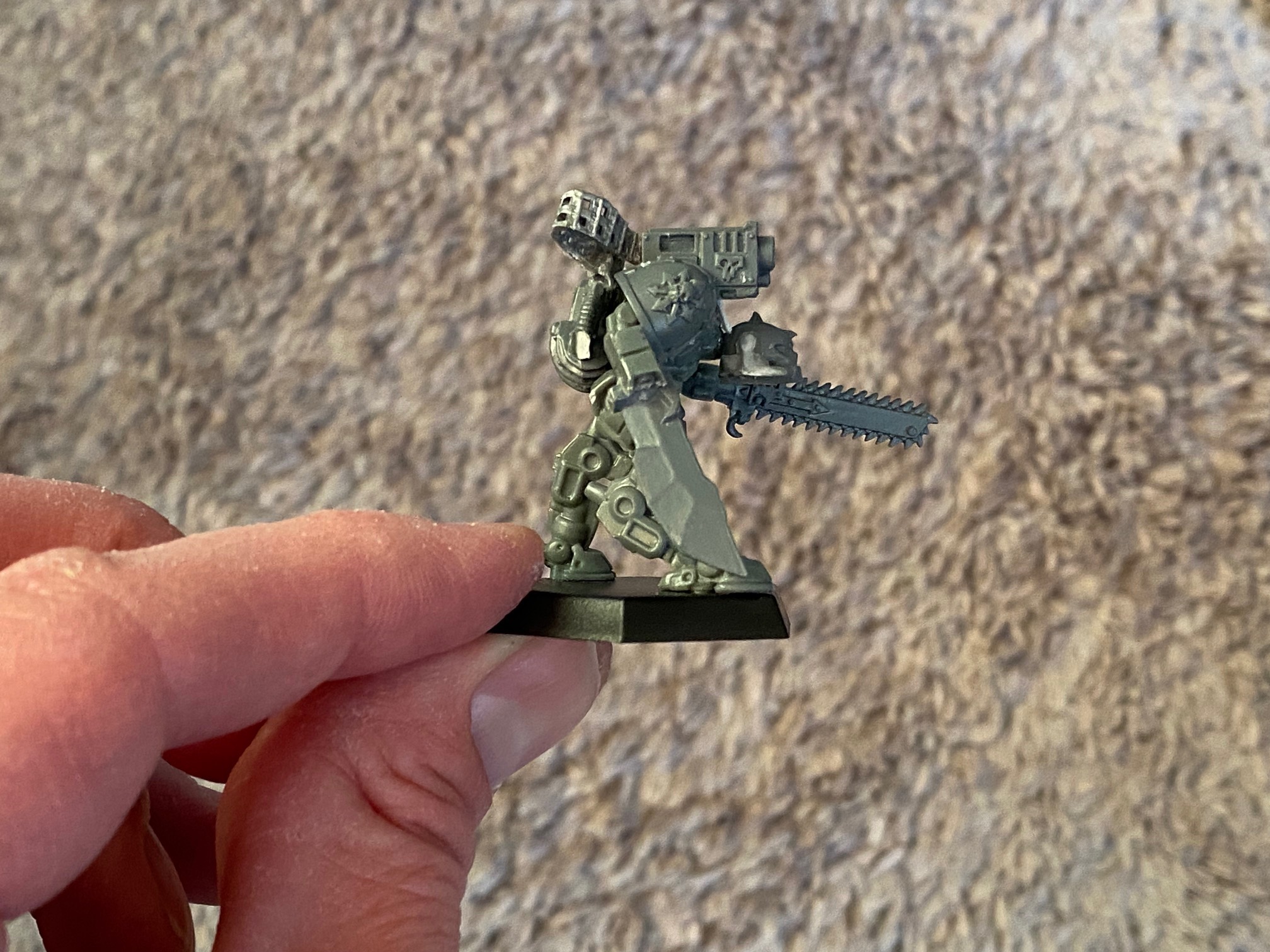
Another Oldhammery Traitor Knight conversion

 My tiny Traitor Knight retinue continues to grow! 

These are, for now, intended for use with old 3e Warhammer Epic: 40,000 rules. As with recently featured mini conversions, I am using current Battletech mech minis as a basis for (sometimes extensive) kitbashing and conversion. The Battletech minis are MUCH cheaper than GW's actual Knight/Titan minis. 

I'm very pleased with this one. I'm starting to wonder why I ever wanted to buy GW knights - kitbashing these things is both cheaper and CRAZY fun. 


Here's how he started the day! Almost unrecognizable?!


For those interested in ideas for such tomfoolery, here is a general 'recipe' -

+ I slightly trimmed down the head, and then glued around a bit of flexible plastic (formerly part of a cottage cheese tub) to give the top a bit of that "curved armor plating" look that many Helverin and War Dog knights have. That's the white stuff you can see on one of the photos above.

+ The arm weapons are an Ork sword (right arm) and the business end of a Chaos Marine chainsword (left arm). I cut down the forearms on the mech to make a decent fit. 

+ The "big autocannon" on the right shoulder is an old Ork bolta pistol, sans its magazine and grip. The ammo-feed belt supplying rounds from the rear is a bit of a 30+-year-old 1:72 WW2 plastic tank tread. 

+ The ammo-supply pack and associated weird tech accessory (so fashionable!) on the back is a Chaos Marine power armor backpack, but turned upside down, with the stabilizer jets cut off, and with the now-upside-down skull filed off. The ammo feed belt connect to the back side of the pack. 

+ The head is a trimmed-down Chaos Marine head, with some extra cuts so that it fits flush where I mount it. 

+ Chaos Marine Shoulderpads, because in the grim darkness of the far future, there are only hyperprotected shoulder joints. I normally like to mount these sideways/reversed on my kitbashed knights - they look more 40k knight-ish that way - but mounting them the normal way was a much better fit on this particular model. I think they still look cool. 

Happy gaming!

Wednesday, September 20, 2023

Domain-Play Lessons from ... Shadow of War?

Now that my offspring are of that age when gruesome video games feel like "questionable parenting" instead of "atrocious parenting," I let them borrow the Middle Earth-themed Shadows of War on Xbox from the local library (at our library, you can even check out things like chainsaws and snowshoes - hopefully not for use at the same time, and especially not for LARPing something like Shadows of War). 

Ahem. 

Anyway, I expected a pretty mediocre game (and we almost abandoned it after about 20 minutes). But as more of the game unfolded, I started noticing some positive aspects! I won't have much to say here about the game's alt-canon storyline, in which a good guy does emo-grimdark good guy stuff by acting like a bad guy by beating the snot out of orcs so he can mentally dominate them in order to build up an army worthy of challenging Mordor, because ends and means or something like that... 

So, not much to say about all that. (I also have never played the earlier Shadow of Mordor, so I can't say anything meaningful to compare the games). Rather, as I chewed on Shadow of War's design, I noticed three features that made the gameplay loop more appealing - and I realized that these could make a tabletop RPG's domain play more efficient and fun.


To wit:

+ NPCs as proxies for warbands. 


D&D (and adjacent) rules for domain play usually include a way to recruit and maintain army units, warbands, etc. In some cases, this gets pretty technical and economiwhatsit. At the other extreme, Into the Odd and related games instead provide a refreshingly light and abstract system for hiring "detachments," paying their upkeep, and fending off narrative problems that can afflict any would-be tyrant. But even at that rules-light end of the scale, the "detachment" is still a faceless entity, an asset, and recruiting one basically comes down to one factor - have you got enough gold on hand to pay them? 

In Shadows of War, you don't recruit a new warband; you recruit a Captain, who is in command of a warband. And each Captain has their own personality, their own motives, their own story and grudges and desires, and their own in-play/in-combat distinctions. This means that gaining more followers feels really personal. You don't just think of that block of spearmen who will be useful to lengthen your battle-line; you think about how annoying or funny or suspicious or brutal the new guy feels while he's extending your battle-line. 

Especially in the kind of domain game that I find most appealing - relatively low in scale/scope, where the number of troops and units stays manageable - it would be pretty easy to add a lot of color and fun by associating a new NPC commanding officer with every single detachment/warband. Have you had that experience where a random retainer/hired follower gains a name, personality, and a beloved place in your party's story? Now multiply that times every warband the party will deal with. You can still keep using whatever rules you're using for armies/detachments, but add a face and contact person who feels different, and who speaks for that unit. 

Another nice thing about this approach is that recruiting or maintaining a warband might be about money, but it doesn't have to be. Maybe Xantharikos the Red and his Crimson Lancers just want to get paid by Tuesday; but Larry and the Lizardmen are in it because of their fierce vendetta against the hobgoblins, so they'll fight for you for nothing but hobgoblin meat - but WATCH OUT if you ever make peace with the enemy ... or if you show weakness. (Insert myriad other possible Captain/unit motivations and intrigues). 

+ A finite number of warbands in the setting. 

But how long can you go on recruiting new regiments to replace the ones you just fed to the meat-grinder? 

As ye classic guide to the demographics of a fantasy setting recognizes, the number of fighting troops in an agrarian society should be pretty low, at least as a percentage of the overall population: being a skilled combatant is a kind of highly specialized labor supported by far more numerous food-producers. At some point, then, there should be a ceiling on available troops. And in a particularly war-torn, volatile setting, it's not implausible that all the available fighting power has already been identified and mobilized, at least in the form of reserves (village militias, etc.). Having a master list of available units - with a hard cap - can, and maybe should, be part of a small setting. 

Whether consciously or not, Shadows of War reflects this. So far as I can tell from watching the game, the total number of recruitable Captains is finite. Especially if you enjoy sparsely inhabited "points of light" settings (as do I), you can really get away with having not that many warbands even available to recruit across the entire setting! In such a context, destroying an enemy warband in battle might work (along with the usual risks), but maybe enemy fighters are too precious to put to the sword - so, back to the previous point, above: what would it take to make that specific warband switch sides and stick with the party? By making recruitable units a limited resource, you accentuate the stakes of the choices involved in dealing with them. 

And, of course, this makes losing an allied detachment in battle a much bigger deal. Unless you are planning to run a campaign that lasts for the next 35 years, providing a small campaign with 20-30 total detachments to engage -- each one led by a defined, named personality -- has much to offer. 

+ PC-level actions as domain play. 

Domain and mass battle rules often gravitate toward either moving units and assets around like a wargame, into which the PCs' actions sort of fade into the background, or like a set of military-themed skill challenges that emphasize PC choices and efforts, but which may not feel like an actual war/battle. 

Shadow of War definitely emphasizes PC actions, but it manages to make the domain game -- conquering and keeping a territory -- feel pretty central. It does this by emphasizing cool bits - winning new recruits, maintaining their loyalty (sometimes by side-quests), and storming fortresses - while allowing lots of room for individual-level stealth and combat missions (you know...your normal D&D stuff). But then it basically ignores (unless I'm not looking closely enough) the boring bean-counting. Raising food and taxes, etc., fades into the background. 

If you want to run a mostly military campaign, this is not a bad way to handle things. I think it was in comments around my domain/mass battle posts some years ago that someone suggested using "Influence" instead of "gold" for maintaining detachments. I am intrigued by the idea of a campaign in which you run dungeons, etc. to gain social influence in the setting, and then spend that social capital to help recruit followers. Beyond that, if you want to run a domain game as a list of military targets or fantasy adventure quests, why not just limit it to that?

More detailed simulations aren't wrong, of course, but Shadows illustrates that you can still have some fun without as many variables. Adding regular D&D play on top of that would make things richer still. 

Closing observations

I suspect that having a small campaign setting with a few dungeons and a pre-defined list of politically active NPCs and detachments could enable a pretty fun campaign, one focused just as much on personal intrigue and unit battles as on picking the lock down on level 4 of the nearest dungeon. I also suspect that once an initial setting was built, you might be able to run a very low-prep campaign, just making "moves" to respond to whatever happens in session. 

I have been tweaking just such a session in the background as a personal project. It may never see the light of day, but I'm hoping it might ground my next campaign, or maybe even be worth sharing with Ye Gaming Publick. 

What do you think? Does the idea of a faction-focused sandbox with finite, limited military units, each led by a known NPC, sound fun? 

Monday, September 11, 2023

Itinerant Circuit Dungeoncrawlers?

 There are wandering monsters, of course, and many old wandering encounter tables add rival adventuring parties to the menu. Not all those who wander are lost (the good Professor reminds us), but where are they going? 

Well, why don't we have itinerant circuit adventurers

In U.S. history, circuit preachers were clergy who rode around from congregation to congregation, preaching at various stops, because there weren't enough clergy for each community to host one permanently. Similarly, circuit courts and circuit judges' titles evoke (in part) times when the voice of the law made its rounds from place to place. 

I've recently been tinkering with some sandbox setting construction that would emphasize faction situations over unknown locations (as hinted at here), with ample room for interesting little warbands (detachments, if you favor EB/Into the Odd-speak). But I'd also like to include a few small dungeons - while keeping things easy to prep. 

So then I started thinking about restocking dungeons after they've been explored...and I started thinking about plausible and enjoyable reasons for itinerant circuit adventurers to want to visit the same few dungeons, over and over again. 

For this to make sense, I really think you'd need to integrate it into the setting's logic. I'm thinking about a culture with several ancestral sacred sites - dungeons - but there is a strong taboo (or maybe even an actual geas) that prevents most of the People from visiting these sacred sites. A minority are born/come of age/etc. with a special mark or vocation to tend these sites - which means that you have a small class of ready-made adventurers, whose society supports what they're doing. And the PCs' job is to travel from shrine to shrine, clearing out all the nasty sacrilegious things that don't give a rip about taboos, like monsters, brigands, etc. (You can't just let the goblins defile Balin's tomb!). And because it's a good ol' points-of-light setting, there are many more nasty things than heroes in the wilds between settlements. 

A recurring game-play might look something like this:

+ leave base

+ travel overland to the next shrine - the route would be known, so the challenge isn't exploration of an unknown as much as facing the challenges of getting there (think of Aragorn leading the Hobbits from Bree to Rivendell - that sort of challenge)

+ reach a shrine and deal with whatever is the latest challenge there - this might require combat, diplomacy, or - sometimes! - nothing at all.

+ continue the cycle and repeat, but increasingly have to deal with factions that complicate travel, block/permit access to select routes, or get entangled in broader "domain" play issues. 

I haven't tried this, but I'm intrigued by the concept. It would make the dungeons not a "dark mythic underworld that hates you," but rather "something precious and beautiful but quite dangerous, a place that constantly must be returned to order." It would enable dungeoneers who are less "rapacious freebooters on society's outskirts" and more "essential specialists who help preserve their People's cultural identity." 

Sort of like an anti-Symbaroum premise, maybe? 

You could even hack Into the Odd's dirt-simple leveling-up scheme, but change "expeditions completed" either to "shrines cleared" or "full shrine circuits completed." 

As I keep tweaking sandbox ideas (mainly for fun in the background while I work on a real-life big writing project), this is one of the ideas I keep coming back to. We'll see whether it sticks. 

Any analogous systems or games that have taken this approach, that I've overlooked? 

Happy gaming - G

Saturday, September 9, 2023

My Craziest Kitbash Yet?

 As some recent posts have shown, I'm working on armies for 3rd edition Warhammer "Epic" - Epic 40,000. I am building a large detachment of Knights for my Chaos force - they're fallen Mechanicum/traitor Knights. Not having a spare $80,402,314.52 on hand to make eleven GW Titanicus knights, I have been using Battletech minis for the knights and small/scout titans (see an earlier example that I'm pleased with here). 

At any rate, I spent some time this weekend making some of these guys look less Battletech and more In the Grim Darkness of the Far Future, There Is Only War... these are meant to be like "War Dog" smaller traitor knights.

I'm quite pleased with this fella. Here's how he looked at first:


But now...erm...things have changed...


He's got a genestealer skull cut to shape as a cockpit-helmet, a genestealer miner tool weapon refitted for his right hand (some kind of hulking Epic-scale lightning claw, we'll say), and a terminator lightning claw for his left hand. And a sideways-mounted chaos marine shoulder pad on the right shoulder to give him a bit more of a "40k knight" profile. 

I like him. His room-mate, however, is probably my sickest and weirdest kitbash to date. I wanted to get a nice picture of him, but I accidentally left him in the Warp for 10,000 years, and now - well...


There he is on the right. He's got a terminator claw-arm too, and a chaos bolter pistol refitted as an antipersonnel weapon for the left arm. The cockpit helm, in this case, is an aggressively trimmed old chaos marine backpack with some dwarf bits added! But see the weird spider pincers coming off his face? That's because, if you look behind him...


I've given him a rather notable mutation - a bloated arachnid abdomen hanging off his back end. The spidey-bits are from a hard rubber Halloween toy my kids were done with. :-) 

I have a feeling that the human pilot inside that thing hasn't been answering emails in a looooooong time.

As always, I really enjoy kitbashing. I don't have any "green stuff" on hand, which may account for whatever roughness you can spot here, but I'm trying to fit things pretty well. So far, this army only has scratchbuilt or converted/kitbashed vehicles. What they all lack in standardization and official detail, they make up for in the inventive, creative pursuit of my own bespoke force. Very fun. 

Happy gaming! 

And if you've made it this far and you're really wanting some more RPG musings, don't worry...there's more of that in my thought-pipeline, too. 


Tuesday, August 22, 2023

On "Shadow of the Weird Wizard," now on Kickstarter

 This week, I did something quite out of character: pledged for a gaming Kickstarter, and not at the "here's a dollar" level... This is unusual, and marks only the third time in the past decade of gaming that I've jumped in to fund one of these things. But which product has sucked me in, and why?

Well, it's very-veteran-game-designer Rob Schwalb's Shadow of the Weird Wizard, an "evolution" and seriously tone-shifted successor to the Shadow of the Demon Lord RPG (SotDL). When SotDL released years ago, and since then, I liked much of what I heard about its design and experience in play: a d20 system, but streamlined and lighter than 5e, while still offering a fairly tactical experience in combat (some have said a more tactical experience than 5e). It is often described as filling that middle ground between games like 5e/Pathfinder and OSR games or Dungeon World

However ... SotDL also released, judging by things I've read, with an almost puerile insistence on being ludicrously grimdark, in which grimdark isn't grimdark without enough potty humor, so that the whole thing might seem a bit like a parody of a black metal album as recorded in a junior-high bathroom. Hmm. Well, I wasn't really interested in inhabiting that space at the table, or in sifting through everything to weed that tone out.  

But Schwalb eventually announced that he was working on a more 'family friendly' edition that would apply some lessons-learned while making the game feel a bit more like a 'normal' fantasy RPG. That sounded better - and after several multi-year delays, the thing is finally coming together!


There is a "quick play" document available for free on DTRPG that offers a taste of things. Note, however, that a few things here don't seem too clearly explained (I'm hoping that the final edits in the actual game book make this much simpler). Veterans of the 1st game consistently describe the game's ease of use and play, however. And the sample scenario already shows that when Schwalb says "family friendly," he does NOT mean "sucking all the maturity and gritty violence out of fantasy." Oh, no. Nope. Nay. Just ... no need for genitalia falling off mid-spell, and so forth. 

Why am I excited about this new game, and about the Kickstarter options? 

+ that middle ground between OSR and 5e-level games, as noted, is an important one; I've never really landed solidly with the available options, even though it sounds great for my normal gaming group. 

+ SotDL - and now SotWW - offer wild character customization. Not via PF2e's myriad of feat choices as you level up, but through a more streamlined system of choosing Novice, Expert, and eventually Master 'paths' that are a bit like sub-classes. This lets you deeply specialize or go broad with various character styles to suit your tastes and the story that develops across campaigns. I can imagine telling those players who've enjoyed Pathfinder 2e that "this game can create literally millions of possible character configurations." 

+ I am optimistic enough about this game's potential that the Kickstarter offerings really proved tempting. SotDL (in)famously was supported with a plethora of little .pdf supplements - to the extent that many people felt it was costly and scattered to keep up with over time for those who didn't fund the original KS. The Weird Wizard Kickstarter is going very well - it's currently at about 1,000% funded - and they just yesterday unlocked a key stretch goal that will include print-on-demand AT COST codes to make most of the initially planned supplements available in print, "for the cost of glue and paper" - plus shipping (tho you have to back at least at the $99 USD level to benefit from those). There are so many cool supplements already unlocked, from a major bestiary expansion to 30 pre-written mini-adventures as well as campaigns, class options, etc., etc. 

Anyway - I still love me some gnarly OSR gaming, still love the dynamism of PbtA gaming, and still feel that Pathfinder 2e offers the best tactical combat RPG system I've ever run - but ... dang, I'm tired of feeling like prepping the world around the next set-piece PF2e fight is an engineering schematic problem! I am hopeful for exciting things with SotWW. 

Passing these thoughts along for any not already aware of this option. Happy gaming! 

Friday, August 4, 2023

Game ideas inspired by the Yukon's forest of signs

 While driving north to Alaska, we passed through Watson Lake in the Yukon. That hamlet hosts a great "forest of signs" - somewhere now between 90-100,000 signs nailed, screwed, strapped, etc. to trees and posts in a massive collection that has been growing since the mid-20th-century. I expected a rather small affair, and was blown away by wandering the aisles and lanes (!) of this small 'forest.' 


It got me thinking about why a similar collection might grace a fantasy gaming universe. Here are some ideas. 

+ Like Borges' infinite library, the forest of signs is a legendary mystical archive recording the location of every discrete place that exists in the world -- even places utterly lost and forgotten. Not sure whether the tomb of the Fourteenth Emperor was ever constructed, or how to find it? You'll know if you find it's placard in the Forest of Signs, though the three billion other signs might slow you down a bit...good luck with the random encounter rolls while you search.

+ By official decree, all communities that yield to the Glorious Benevolence of Empire mark their submission by sending delegates to post, and later maintain, their community signpost in the Forest of Signs just outside the great capital. Of course, the Empire's rival districts measure their dignity by the lavishness of their respective signs, and harried imperial administrators have been known (or so it's said) to base regional appropriations not on the mountains of paper notes sent to the capital but simply upon the size and appearance of various signs. This makes having a better sign than rival cities of great importance. The place is well-guarded during visiting hours, but after dark, the Forest of Signs becomes a hotbed of gold-leaf-thieves, vandals, would-be-repair workers, and other adventurers paid well to boost one or another city's status. 

+ Or no, perhaps we're taking all this too literally. The Forest of Signs isn't about signposts to places; it's about Semiotics. In fact, the "Forest" lies at the world's edge, and the 'signs' posted here are guides to the mystic resonances between things, ideas, and the word-not-word signs/signifiers/etc. used to (try to) communicate with reality through the Language of Magic. As all wizards and magic-users know, graduation to the next degree of mystic mastery ('leveling up' cough cough) always requires a fresh venture into the Forest, to learn and master a new set of potentially meaningful correspondences. But the Forest can be deadly, so maybe bring some friends? 


Huh.