Thursday, March 17, 2022

The d20 lore-for-XP table: from my Iron Age Isle of Dread/alternate Nithia campaign

A while ago, I finished running a campaign set on the Isle of Dread - not just any Isle of Dread, mind you, but a heavily modified sandbox version, incorporating a variety of additional content from modules and my own imagination, and set in the same Iron Age alternate-Mystara setting that featured in my earlier B10 Night's Dark Terror campaign

It occurs to me that I should share here some of the things I ended up doing in that rewarding campaign. Today's post contains a lore-dump. Well, yes, but it's a lore-dump with a point. 

See, for this campaign, I made finding and collating lore one of the campaign objectives: PCs gained XP by finding ancient texts that could flesh out their knowledge of the past. They had two in-game reasons to do so: one character, with a background as a Scholar, learned that his sister had been kidnapped by an up-and-coming potentate who wanted to exploit a new court history for political leverage - so he was told to go research a history in exchange for his sister's return. But the other players were also investigating a series of mysterious, cultic killings around the Sea of Dread, killings apparently connected to a dark group with ties to something from the past. But what was that ancient evil, and what did it have planned in this age? And why had one of the PCs lost a year of memory "between campaigns", and was reported as having been active around the Sea of Dread during that missing time? 

In the canonical Mystara, Nithia was an ancient kingdom that "now" survives in the Hollow World. My version makes a deliberate shambles of the canon, and has the Nithian population as a more self-conscious remnant along the Sea of Dread (the Scholar PC was of Nithian ancestry, and he ended the campaign as the petty king of a new Nithian state on the Isle of Dread. It was pretty epic).  


In our Iron Age "Mystara", the players' antics in an earlier B10 campaign
left "Karameikos" divided in two.

Here's how the lore-tables worked in my campaign. At the start, I gave the players a King-List of Nithia-That-Was from the Great Library of Rothago (Minrothad and Ierendi were fused into not-Phoenician island city-states). The king-list contained the barest outlines of history, and a chronological list of the monarchs of Old Nithia. In other words, the players started the campaign knowing everything that appears below in the non-indented, non-numbered sections, but the rest had to be puzzled out as they discovered lore in random sequence [the notes on absolute chronology ("from 3,000 to 1,800 years ago" were added artificially for player convenience)]. What would make matters more complicated for the players to figure out was that some parts of the old Nithian lands now lay beneath the sea (it took them a while to figure this out as they worked with an old map they found, and tried to reconcile it with their exploration of the Isle of Dread).


Funny, that doesn't look like the Isle of Dread...does it?

As they explored the Isle's ruins and found a variety of preserved ancient texts, the players triggered lore rolls. I needed simply to roll 1d20 and feed them the resulting snippets of history, which they could place in the right chronological spot using their "king-list." When all was said and done, the "full story" below was known, the players confronted the ancient evil and saved the world from another cataclysm, and the Scholar led an assault to get his sister back from the Pirate Queen holding her captive. Amateur RPG archaeology, for the win! 

On my own version of the X1 sandbox, I removed a number of spots, tweaked many others, added in the Forgotten Temple of Tharizdun (renamed "Tharis"), added two new human settlements to the island and worked out their political relations, and replaced the X1 plateau "finale" with AA 35, Desert Shrine of the Sightless Sisters, also integrating it into the island's political network and the hidden cult threatening the world. THERE COULD BE SLIGHT SPOILERS FOR EITHER OF THOSE MODULES IN THE TABLES BELOW, though these will reflect my own substantial changes. 

Good times. 


d20 HISTORY OF NITHIA-THAT-WAS


First was Nithia’s Golden Age, lasting from 3,000 to 1,800 years ago. 


In this age reigned the kings from Ardaka I to Ardaka XII. 


And in the time of Ardaka I was the Royal Prophecy, that each lord of Nith should reign a century at a time, and their kingdom never fail, except that a firstborn heir fail to take his father’s throne after a hundred-winter reign. 

And from this age forward the Historiomancers of Nithia recorded their lore, hiding it away in deep archives to study and weave its patterns.


And in this age was the Priesthood Undivided, but also there came the Philosopher Kamuan.

+ In the time of Ardaka XI there came the Philosopher Kamuan, teaching that material creation is but a prison for pure spirit. And, said Kamuan, “hate the lusts of the flesh and the flesh itself, for such bring only suffering; but seek instead enlightenment where pure mind wanders beyond the firmament.” And many called him mad, but some among the Priesthood Undivided heeded his words, and began to look to the stars - and beyond.


Then was the Age of Division, lasting from 1,800 to 1,300 years ago. 


Then reigned Ardaka XIII.


+ In the time of Ardaka XIII, some among the Disciples of Kamuan made contact with beings who claimed to be extra-firmamental spirits; and from these, the Disciples harnessed strange new powers, thanks to which the Disciples’ influence began to spread widely.  


Then reigned Ardaka XIV. 


3 + Ardaka XIV was the first king to patronize the Disciples of Kamuan and to fund their research with royal resources. He took from the Order of Historiomancers their Archive at Tharis in the southern highlands, and gave that site to Kamuan’s Disciples. There, they began their experiments in projecting consciousness. 


Then reigned Ardaka XV. 


4 + In the time of Ardaka XV, the Disciples learned the arts of necromancy from their spirit allies. Seeing that they had such powerful knowledge, the king gave to the lords of the Disciples command of the armies of Nithia; and the sorcerer-generals pushed the royal banners deep into the northern mainland.


5 + But the son of Ardaka XV, being devoted to the order of creation, without his father’s permission selected for himself a private reserve among the army’s officers. And naming them his Falcon Guard, he charged them to uphold Order in the empire in wholesome ways, and to keep watch against any evil by the waxing Disciples.


6 + And Ardaka XV learned what his son had done, and was wroth; and he ordered that the Falcon Guard be disbanded after the execution of its leading men. But the king’s son defied his father, and vowed to share his officers’ fate. So for love of his son - and because of the Royal Prophecy - Ardaka XV relented, and the Falcons continued their watch. 


7 + But meanwhile, even as they grew in temporal power under Ardaka XV, the Disciples were frustrated in their greatest goal. So they began to dabble with flesh itself, thinking that by thus understanding the limits of flesh, they might better escape it. Thus they gained the name Flesh Lords, who wove themselves the more into aberrations of flesh, the more that they struggled against embodiment.


Then reigned Ardaka XVI, and the Falcon Guard with him. 


8 + When Ardaka XVI came to the throne, he gave to the Falcon Guard direct command of his armies; and he severed direct royal patronage of the Flesh Lords. But the Disciples now were too strong to force them to disband; and there was muttering against the king. 


9 + Because Ardaka XVI had robbed the Flesh Lords of their armies, they made dark experiments in laboratories in the priestly highlands and along the empire’s northern rim. And thus they bred vile armies of their own, crafting inhuman aberrations from human stock: beast-men, and snake-men, and jackal-headed legions, and the gobrach hordes. And these forces they held ready.


Then reigned Ardaka XVII.


10 + Ardaka XVII maintained his father's policies, yet with less zeal. Mainland barbarian tribes in the northeast threatened his coastal holdings and consumed much attention and many resources; and so he was distracted, and unprepared for civil war when it came. 


11 + Seeing that Ardaka XVII would not reverse his father’s decisions, the Flesh Lords despised the court. But they judged, too, that their age-long central aim - spiritual transcendence - had failed only due to a lack of adequate power. Therefore the Flesh Lords unleashed upon their Nithian brethren their undead and humanoid forces. Breaking like an unexpected wave upon the empire, these hordes slaughtered all in their path as human sacrifices; and with dark relics they gathered life force as they slew. Whole provinces were razed, and across the north, nearly half a million were slain.  


12 + At the time of the civil war under Ardaka XVII, the Flesh Lords also seized the southern Priestly highlands, and directed the war from their strongholds there. From that fastness they unleashed all the life-force they had stolen, hoping to rip apart the firmament itself and to cast themselves beyond it. But, wary after many setbacks, first their twelve lords anchored their consciousnesses to a simple brazen hand mirror; a way back, should they fail yet again. 


13 + The Flesh Lords’ bold venture against Ardaka XVII failed. The firmament held - though not a few star-elementals were knocked to earth, and some burned in the sea, while others wrapped themselves in the hatred of the Flesh Lords and became hidden tyrants of dark cults; and the wise say some linger to this day. The Flesh Lords themselves, however, achieved nothing, and as their strength was spent their wrath was impotent. 


14 + Then in dire anger, the Falcon Guard of Ardaka XVII moved against the Flesh Lords in their strongholds. Those they found they slew with cleansing flame and beaten bronze and the bright power of Order. Other Flesh Lords, hidden in a deep secret vault beneath their stronghold at Tharis, the Falcons could sense but not find. Reaching out with power, the Falcon Guard spent most of the might allotted to them to trap and bind the Flesh Lords where they lay hidden, and they sealed them beyond the reach of mortal man. 


Then reigned Namak-Ardaka, the Peerless King, who wed twenty-seven times, and sired no children. 


15 + Two-score years into the reign of Namak-Ardaka, a scavenger looted an old brazen hand-mirror from a ruined highland stronghold, and carried it away north to the plains. Through this theft, men unwittingly renewed contact with what should have been locked away, and with enslaved minds, men began secretly to worship hidden lords, and plot how to free them. 


16 + Meanwhile Namak-Ardaka continued to produce no heir, though he promised twenty-seven times that a new bride would ensure his legacy. More and more desperate he grew, until he welcomed those who whispered quietly of lost Flesh Lord arts, and he allowed their secret ministry even at his own court.


Then was the Cataclysm, and the Breaking of the World. 


17 + In the last year of Namak-Ardaka, the Flesh Lords’ puppets made dagger-wands from a Soul Worm’s fangs, and etched in them a labyrinthine glyph of life-binding. With these tools they secretly marked many, and through their marked vessels they grasped the life force of whole towns and city neighborhoods. Then, after the appointed year’s time, there came the second Great Killing. And the king himself was among the slain, and the line of true kings of Nithia failed; and all the life-force of that cull the cruel Flesh Lords drew through the mirror and turned against their bonds. 


18 + With Namak-Ardaka slain and the world in the balance, the Falcon Guard poured forth all its remaining power to keep the evil ones imprisoned. So terrible was that struggle, in which both sides exhausted their might, that the land itself was cracked and drowned around them, and the lands of the empire were overthrown, and chaos filled the earth, and waves overrode most of the empire. And the Flesh Lords failed and fell back into their prison, and their mirror was lost in a city drowned upon the plain, and forsaken beneath the sea. And the Falcon Guard spent nearly all its strength, and most of them perished in the strain of that contest. And now the world is broken. 


Tuesday, March 8, 2022

My House Rule for Identifying Found Magic Items

 In our current campaign, I've hit upon a convenient house rule for the identification of magical items found in treasure. I know that a purist would demand that players use trial-and-error to figure out what every potion, wand, and suit of magical armor does -- or use magic/pay a magic-user to tell them. On the other hand, my group has limited real-world windows for play-time, and I'm not really keen on spending those few hours playing "drink the potion and see whether it levitates you or kills you."

I used to 'solve' this problem by just telling the players what they'd found, and how it worked.  

This saves a lot of time, but it also means certain magic items just don't work - namely, cursed magic items, or even magic items with some unusual wrinkle or hidden cost of use! [Or, uh, I could just lie to my players, which I don't want to do]. 

But recently I hit upon a compromise solution that I've started using, and am pretty happy about. I don't know whether others have used it, but I'll share it here in hopes it helps someone else. 


GUNDOBAD'S SNEAKY DICEY MAGIC IDENTIFICATION HOUSE RULE:

When the players recover a new magical item, I roll a d6, where the players can't see it. 

+ If the die shows 2-6, I tell them exactly what the item is and does.

+ If the die shows a 1, I tell them they can't figure out what the item is, and they'll have to hunt someone down who can tell them - or experiment.

+ If the item is cursed or harmful...I roll the d6 anyway, but regardless of its result, I tell the players they can't figure out what the item is.


I'm not misleading the players; I've told them explicitly how the rule works. They know that in the rare cases that I won't identify a found magic item, it means either that it's cursed, OR they got a 1 on the 'identification' dice roll, and it's not cursed but something potentially quite useful. 

In play, this means that the players can decide when something is worth experimentation, but it becomes an unusual and interesting quandary, not a recurring grindy drag. 

So far, this rule has led to one cursed item that I refused to describe; there were enough contextual factors around it that the players fortuitously decided to destroy the item instead of trying to use it. Then, in our most recent session, they found a useful magic item but I rolled a 1, so now they've got an amulet pendant of unknown properties (a player tried it on, and nothing happened, so they'll have to try something else to see what this thing does...like go pay a sage to identify it). 

Meanwhile, we can get on with the business of looting dungeons, without nerfing cursed or poisoned items. Yay!

Happy gaming! 

Saturday, February 26, 2022

In Praise of the Half-Blank Hexmap / Illmire + Brandonsford + etc. (contains SPOILERS)

This post reports on my new home campaign (a sandbox combining The Evils of Illmire with The Black Wyrm of Brandonsford), plus a comment on the enjoyable tension of GMing a hexmap with deliberate gaps. 

Please note: this post will contain SIGNIFICANT SPOILERS for both of those (excellent) published adventures. If you are a player and you read this, you will be sad, and you will lose all hope and reason to continue, and you will end your days wishing you had heeded my warnings. 

My latest home campaign is off to a rousing start. For rules/system, I'm using Knave as a chassis, supplemented by some serious house-ruling to shoehorn classes back into the game. 

I knew I wanted to run a sandbox/hexcrawl, but I've been burned in the past by my own tendency to over-plan. Various grognards on Ye Interwebs preach the good word of starting small. What do they know? Grumble, grumble...Oh wait, they DO know. Last time I was asked to plan a sandbox (for my kids), I toiled over an artisanally-designed campaign setting, poring over different adventures to seed across the map, etc., etc. Well, we ran one (very enjoyable) session in that campaign...and then it died. 

Sigh. 

But we learn. We grow. We try not to repeat the same mistakes. 

This time, I combined several useful assets. First, the cold voice of experience. Second: two really great indie sandbox modules, The Evils of Illmire and The Black Wyrm of Brandonsford (I've reviewed the latter here on the blog, and it has since received some updates, making it even stronger). [Oh - all DriveThru product links on this post are affiliate links, by the way - using them helps support this blog's activities at no added cost to you. Thank you!). Illmire is a compact but really packed hexcrawl involving a sinister cult afflicting a village ... though it turns out the cult is just the tip of the iceberg of what's going on in the region. Brandonsford is much smaller - the adventure's map scale allows the entire thing to fit in one 6-mile hex. 

So, for my new campaign, I decided to slap both microregions down near each other, and just let my players romp in a points-of-light sandbox. 

It's been REALLY GOOD so far.


WILL THE REAL CULT LEADERS PLEASE STAND UP?

We started with a Witcher-inspired campaign concept. The players are "Claws" - monster-hunters born with a birthmark indicating their membership in a strange group predisposed to adventure and well-equipped with the requisite competencies. Boom, instant reason to adventure together. I'm granting XP ONLY for treasure collected (though I use silver rather than gold as the standard). 

To kick off the campaign, I gave them a quick overview of the campaign area (in very sketchy detail) and offered three job hooks: go answer a covert plea for help from the Lord Mayor of Illmire, answer an open call for Claws from the leader of a logging camp near Illmire, or go check out these rumors of a dragon disrupting highway traffic near Brandonsford, further East. 

The players decided to start right in Illmire. They met the mayor, quickly realized things weren't right in town, accepted a mission to check out the nearby watchtower, had a bloodbath of a fight with the bandits posing as legit guards there, and wisely ran away from fighting the giant hideous awfulbeast in the basement. The strongest PC got knocked out twice on that mission - ah, the delights of old-school play. 

Then, back in town, the players learned more about the doings of the sinister cult afflicting the area, started freeing some locals from mind-control, and finally launched an assault on the cult's center of operations. Now the local cult leader is dead and the cultists have been driven out of town (for now), though one PC lost his left arm below the elbow...ah, the delights of old-school play. (Actually, the PC should have died, by rights, but I allow the "last stand" and "terrible bargain" death houserules from this juicy post on Boxfullofboxes). 

Then, the players went to check on a weird circus encamped near the town, en route to go hire out to the logging-camp leader. Here is my first modification to Illmire's basic structure. Esmeraldra, fortune-teller at the circus, is already described as an ancient sorceress secretly rivalling the Observer, who is sort of the ultimate power behind the scenes in Illmire. I have decided that the Observer was once a human mage-prince who accidentally fused himself with an interplanar being, and thus went mad - explaining his Beholder-shape now - and Esmeralda's real name is Smaragdia...she was the Observer's queen. So the war between them was a civil war between former lovers. The Witch in nearby Brandonsford, I've decided, was one of the witches who helped Smaragdia resist the mage-prince, so that will be a potential string tying the regions together, too. Smaragdia/Esmeralda has begun cultivating the PCs as agents; if they survive and keep working with her, she'll try to get them to storm her former citadel and take out the demons imprisoned there - I've decided that Smaragdia's main power has been locked down in the need to maintain that prison. In other words, if the PCs do 'solve' that problem, the grateful Smaragdia will be able to seize all her old power. What could possibly go wrong? 


All shall love me, AND DESPAIR!!!

The players can tell Esmeralda is something much more interesting than a random fortune-teller, but they don't know her backstory yet. Well, as of this past session, the players accepted a potion of underwater breathing from her, and have been using it to try to solve the Fishmen problem in the lake west of Illmire. To their credit, they tried hard to find a diplomatic solution, and eventually prevailed in talking sense into the fishman chieftain despite several flare-ups with the reaction rolls/dice. Now, they've just made a deal to spend 24 hours trying to figure out how to cure the cursed fishmen, before they get driven off again. 

And so, onward. I'm having lots of fun!


DESIGNING THE CAMPAIGN - KEEPING THE MAP JUUUUUST FULL ENOUGH...

The hexmap below shows how I've joined up the two published adventures' campaign regions, and situated them within a larger area. South of Illmire, there are two rival 'noble' territories at loggerheads with each other (I thinly sketched out their leaders' personalities using the tables in WFRP's Border Kingdoms guide). "Halfway House" is a fortified inn; "Longbridge" is an interesting settlement detailed in a Raging Swan village background settlement, torn between the nearby feuding powers. 


My normal instinct would be to go hog-wild and immediately fill in all those blank hexes. I have resolved not to do so unless I actually need to. Rather than repeating my earlier habits of over-preparation, this allows me to focus my energies on the already rich resources in the two published modules, while dangling some tantalizing question marks in front of myself. I have added an additional campaign baddie - a sinister noble warlord named Sir Volter Costanze, who I've decided sent the OG Illmire cult leaders into the region to begin with, before they betrayed and abandoned him. But I'm not really sure who Costanze is or what his agenda will be. And I don't need to find out until he becomes more relevant. 

Are there whole kingdoms across the mountains? Howling wastelands? Lands of tyranny and death, or urbane cosmopolitan cities? Who knows! Not me! Not yet! 

I'm really enjoying the sense of creative freedom and promise, but also restraint and discipline, in NOT fleshing out everything on my map. I realize that for many of you, this is just a "well, DUH!" insight, but it's been important and rewarding for me to implement. 

Anyway. Happy gaming!

Thursday, February 17, 2022

[Review, Part 3 of 3] SOULBOUND RPG - Supplements, Scenarios, and Summing Up

 Well, this has become quite a series - time to wrap this up! Here at last is the final part of a three-post review of Soulbound, the Warhammer Age of Sigmar RPG (this post contains affiliate links). In Part 1, I introduced the game, talked about its role at my table, and dove into some interesting features of the game's setting. In Part 2, I talked about the game system's core rules and combat. 

Today, I'll close with:  

+ a quick overview of some of the game's rules supplements
+ a critical perspective on trends in the game's published adventure scenarios
+ a summary of my overall thoughts on Soulbound

DISCLAIMER - please note that Cubicle 7 provided materials for a fair and honest discussion of the game. I received free .pdf review copies of the core Soulbound game, the Bestiary, and the Champions of Order and Champions of Death supplements. I also liked the game enough that I purchased the GM screen and some other products. Please note that links on this blog to DTRPG.com contain affiliate links, which help support this blog's activities (at no added cost to you) if you purchase items from DTRPG.com. Those desiring physical copies of game materials can order them from Cubicle 7, at a local game store, or elsewhere online. Thank you! 


SUPPLEMENTS - FLESHING OUT THE RULES

Although Soulbound's core rulebook gives you a lot to work with, various supplements add still more to the game. Below, I address the rules supplements that I've had a chance to look through, noting which ones seemed more or less useful to me. 

The Bestiary: GMs, if you get into Soulbound, and you only get one other resource to help your games, pick up the Bestiary. As I noted last time, it contains some quick tips on encounter design (that really belong in the core book, in my opinion...). It also substantially increases the number and variety of foes at your fingertips. Many factions have a few entries in the core book, but see significant expansion in the standalone Bestiary ('Greenskin hordes', undead 'Ossiarch Bonereapers', chaotic forces of Nurgle, etc.); other factions are entirely absent from the core book but show up in force in the Bestiary (you gain Seraphon/Lizardmen; ghostly Nighthaunts; Ogor Mawtribes; and even a short but impactful section on giants!). The list of monstrous creatures/animals, mundane human forces, and champions of Order also grows here). Again, this book is my #1 pick for a GM wanting to expand beyond the core book. 


Through Fire & Smoke: Despite its small footprint, and because of its relatively low cost (sold in .pdf for 3 bucks USD on DTRPG), this is also an easy recommendation. It offers dozens of new ideas for environmental hazards or effects, which you can use to make different zones in your battle-maps much more interesting. This offers a nice way to add a bit more spice, variety, and challenge to combats. 


Champions of Order: Unlike the titles above, this is mainly for players. I'd recommend it highly for any player with the desire and budget to expand beyond the core rules. CoO offers new archetypes (basically, 'classes') across various elven, dwarven, human, and Stormcast factions [again, please note that I'm using normal-people names instead of leaning on in-game spellings like Aelves or Duardin]. It also adds rules for  an entirely new playable 'Aelven' faction/species (Lumineth Realm Lords, sort of 'mountain High Elves' who are part of Age of Sigmar). As much as those options expand player choices at character generation, this tome also adds a bunch of stuff for already established characters. We get new miracles, spells, talents, and equipment choices; new downtime options; and new info on the Soulbinding process and on the lives-cycles of Stormcast characters, along with additional XP-hunting goals for player characters. 

Of real interest, too, is this book's addition of new Sub-Faction rules. These may apply to any character, even retroactively. They offer small but narratively interesting and mechanically helpful ways to distinguish between characters of the same faction or even archetype. So, for example, we read of different kinds of Stormcast Eternals, different backgrounds across the mortal human cities of the Realms, etc. - and in each case, identifying your character with one of these backgrounds adds a Talent-like tweak of personalization. This is really neat. 


Champions of Death: Wait now, what? Yes, this dark cousin to Champions of Order does everything I just described, but for undead player characters - ghouls, skeletons, vampires, ghosts, wights, or human necromancers (who must have had really bad high school guidance counselors). Wow. This will leave some players cold (pun not intended?) while others will jump at it. Helpfully, this is more than just a guide to running 'the evil character campaign.' You could indeed play a team of walking corpses devoted to the dark cause of Nagash, Lord of Death - but you might also be an undead champion begrudgingly assigned to a team of Order's heroes to help fight off an even greater Chaos threat. Or, still further, you might play an undead character who is slowly realizing that Nagash ... isn't the hero of Age of Sigmar. Quite a few of the undead character options easily allow for champions who were unwittingly exploited by Death magic and are now coming to their senses, seeking redemption from their tragi-gothic fate. Ooooh. 

Otherwise, you can pretty much read everything I wrote about Champions of Order and apply it here: new archetypes and factions, cool sub-faction rules, new talent, miracle, spell, and equipment options, etc. Although this book's theme didn't really grab me, one of my kids really enjoyed the option of playing a ghost character (you can see his spectral miniature in the battle-in-progress photo of my Part 2 post). 


Based on online forum conversations, I believe that a parallel Champions of Destruction volume (orcs/orruks, ogres/ogors, etc.) is in the works, but Cubicle 7 has decided not to produce a Champions of Chaos (they are the ultimate villains of the series, after all). 


GM Screen: What can I say? It's got art on one side, and most of the rules you'll want in play summed up on the other side. I picked up a physical copy and find it helpful when running the game. This includes a separate booklet of adventure ideas; I'll talk about the game's published adventures separately, below. 

So, so far: if you want to expand the rules for Soulbound, I'd strongly recommend the resources above. The next one on my list left me feeling a bit more ambivalent. 

Stars and Scales: Playable Lizardmen (Seraphon)! Well, that's cool. If you're really into Lizardman lore, you'll probably enjoy the worldbuilding details and species-themed spells and equipment items found here. This also provides scaly sub-faction choices and two new archetypes, the bruising Saurus Oldblood and the wily, magical Skink Starpriest. These options are ... good. I just didn't have my socks blown off by any of this, and the limit of two archetypes felt a tiny bit underwhelming (though, again, those sub-faction options help). The book stresses that Seraphon should seem "utterly alien", making them effective NPCs, but perhaps a challenge to play well as PCs (or just an easy out for someone with zero interest in roleplaying beyond cracking skulls) :-). 


This resource also includes adventure seed ideas for the GM, but I'll talk about adventure scenarios separately, below. 

Supplements I haven't read: there are also plenty of other supplements I haven't read; one expanding gear and transport options, one addressing ancient relics, and lots of little mini-resources (like a discussion of hidden refuges players can find across the landscape). 


SCENARIOS - MIGHTY HEROES ... AND RUSTY RAILS... 


***Please note - SPOILERS FOLLOW for several published Soulbound adventures.***

Ok, gang - here, I'm afraid, I will offer my most critical points of the review. The situation is simple: Soulbound adventures offer many good points, but too often they show an alarming tendency toward railroads that minimize or suppress players' creative agency and problem-solving skills. 

Apparently, there's a market for that; I've noticed something similar in the few Warhammer Fantasy RPG 4e adventures I've read ... also from Cubicle 7. I'm not saying people shouldn't be allowed to play this way - if this floats your boat, that's great - but for me, this undermines one of the primary benefits of tabletop roleplaying games. 

What am I talking about? Well, I'll give some examples. 

Reap and Sow is an intriguing introductory adventure (complete with pre-generated characters) with a cool concept, throwing PCs into a Seven Samurai-style showdown to protect a settlement from an undead "bone tithe." A cool concept - articulated in button-mashing, railroady style. Upon the PCs' arrival at the soon-to-be-threatened settlement, the GM is informed which NPCs will come up to talk with each specific pre-gen character; exactly what the PC must do to solve the problem presented by the NPC; what type of dice check this requires; and even (in some cases) *how* the player will actually go about doing so in the fiction (for example, telling a PC what they talk about while attempting to "sooth [sic] Wullum's frayed nerves, recounting tales of Sigmar's trials as he journeyed through Shyish"). No need for PCs to come up with their own solutions to problems, or even in-character color! Meanwhile, the party's Stormcast fighter "must" (the adventure's words) "rush to the site" of an industrial accident and make a specific skill check to lift some rubble so that someone else can free the laborer trapped beneath. Later, the actual scenario threat arrives: hulking undead constructs who demand a 'bone tithe' -- offerings of fresh human bones to honor the king of the dead and restock his skeletal armies. That's pretty epic! The module's handling of this problem? Less epic. A specific pre-gen character "can attempt to negotiate" to buy the town one extra day of prep time for a defense (they get two days anyway for free). Once the baddie envoys leave, the game imposes specific guidelines about which specific PC may attempt to sway the urban crowd in desired directions. Should your players have the temerity to suggest any possible response other than the pre-scripted Seven Samurai-style showdown, the module tells the GM exactly how to penalize them. In the end, as the game states explicitly, "there is only one option: make the settlement ready to defend themselves from the Bonereapers." 

Crash and Burn is another free starter adventure that also relies on Ye Olde Railroad. Here, it's a scene-based railroad that allows for the illusion of flexibility by allowing some scenes to occur in 'any order.' On the other hand (in a callout box specifically about 'choices and consequences'!!!!), the scenario shows the GM exactly how to punish the players (mechanically, via Doom) if they act in selfish or unapproved ways. 

Grr. Look, I get it; these are starter adventures, so maybe they're for tables with little practice running games or roleplaying. But no no no no nooooo. I remember the moment when I taught a friend to roleplay for the first time ever, and he singlehandedly stopped a kidnapper's stagecoach in his first roleplaying character action ever in his life by brainstorming a way to use a spool of wire he had randomly rolled up with his starting equipment. In the old-school-inspired way of gaming that I find most natural, the whole point is to present factions, situations, and challenges as the GM, then sit back and watch the PCs come up with some cool response (or die trying). Framing railroads in starter adventures just teaches bad habits to players and GMs, in my opinion.

Besides, the problem isn't limited to Soulbound's starter scenarios. "Little Rats Run" is a scenario seed in the Stars and Scales Lizardman supplement. It's basically a (rather painful-looking) railroad for PCs trapped in an ancient structure, who have nothing to do but walk to the middle of the structure, where they become hunted by a foe they can't damage or restrain in any way and which explicitly ignores all attempts at diplomacy, until the PCs catch some skaven with a missing macguffin who are trapped in there too, and do this ritual thing with the macguffin, and then do it two more times, and then get chased by the monster they can't damage up to the surface, and watch the monster finally vanish. Whee! Oh, and if the PCs decide this is all bonkers and they want to retreat, no problem - "the entrance that brought them here no longer exists." Are the "little rats" of the scenario title the hiding skaven, or the player characters as mindless GM lab rats? 

Don't misunderstand my rant: not all Soulbound adventures do this, not by any means. Between the Stars and Scales supplement and the scenarios published with the GM screen, I've got my hands on quite a few more respectable adventure seeds. Many of them could be fleshed out into something quite fun. It's just a shame that too many of them read like loose narrative excuses for the next pre-fab scene of combat and skill-challenges - given the epic scope of the game's premise, it really begs for something grander in the scenarios. That being said, I've noted before that I'm using Soulbound mainly as a kind of low-stakes, lower-prep tactical skirmish game when my regular game won't happen. It doesn't hurt me to have a bunch of fights + fluff, since that's the role I'm going for. But I'm not sure I have a great sense of what a full-on, well-rounded sandbox campaign, full of room for player choices, would look like in Soulbound.  I bet it could look really awesome. 


REVIEWING SOULBOUND - OVERALL SUMMARY

So. Here at last are my overall impressions, in a nutshell. Soulbound is a light-end-of-medium-crunch RPG. It's pretty easy to learn, easy to run, and fun to play. The books are well-produced overall, and enjoyable to read. 

I have really enjoyed running Soulbound as a tactical skirmish game; for me, it will probably replace D&D 4e in that niche at my table. I don't expect to run it as a proper campaign, using it instead as a well-crafted filler game for combat-focused one-shots. Combat is fast, dynamic, and full of interesting and meaningful tactical choices. Player characters tend toward the super-heroic, prompting some gamers online to call Soulbound an ideal Exalted-light RPG. The game offers rich variety for interesting and distinct player characters, albeit with a tendency (which can be resisted) to emphasize combat. 

Of the published supplements, I'd immediately recommend the standalone Bestiary, and would endorse picking up the Champions of Order players' supplement for any players able to get it. Other supplements (that I've seen) may be a bit more niche, but still offer lots of goodies. The published adventures (that I've seen) are sort of hit-and-miss, in my opinion, too frequently devolving into railroads or set dressing between pre-determined combats. 

Ironically, the setting itself is rich and interesting. This is an epic world for epic PCs with the ability to make a significant difference (all the more reason to avoid railroads...). I think it remains to be seen whether the product line will continue to empower local tables to make the world their own, or fall into the trap of scooting players through predetermined narratives -- a potential pitfall for any game set in an established IP environment. Age of Sigmar's relative newness, and the Mortal Realms' vast scale, do offer at least a chance for this setting to remain really fresh. 

At any rate, GMs remain free to do what they wish at their own table, and there's a LOT of fun stuff you can do with this game. Despite my few critiques, my overall impression of Soulbound is very favorable. I've really enjoyed running it and I feel I've only begun to plumb its potential depths. 

Thanks for reading - and happy gaming! 


Wednesday, February 9, 2022

[Review, Part 2] SOULBOUND RPG: Core Rules and Combat

Onward with my review of Soulbound, the Warhammer Age of Sigmar RPG! In Part One, I discussed the game's setting. I was quite positive about the setting (almost to my surprise). This time, I'll discuss the core system and the game's approach to combat and some other stuff. In this post, I'll have many positive things to say about the game's system (with a few grumbles), but a somewhat more critical perspective about certain aspects of the published scenario-supplements will emerge in my next, and hopefully culminating, section of this multi-post review (along with points of praise there, too).  

DISCLAIMER: As I noted before, Cubicle 7 supplied materials for a fair and honest review of the game. I received free .pdf review copies of the core Soulbound game, the Bestiary, and the Champions of Order and Champions of Death supplements. I also liked the game enough that I purchased the GM screen and several other game products. Please note that links on this blog to DTRPG.com contain affiliate links, which help support this blog's activities at no added cost to you. Thank you! 

In Part One, I noted the role this game has seized in my stable of RPG options: it's now my leading go-to game for short-notice, high-action, moderate-crunch tactical combat roleplaying with (super-)heroic characters (whew, that's a mouthful!). It fulfills, in other words, the vocation I'd hoped 4th edition D&D would satisfy at my table - my not-too-demanding, off-night, let's just rumble with a bunch of baddies because a player is away or I'm too busy to prep a regular session game. 

Let me explain why. 


THE CORE SYSTEM

...runs on a pretty straight-forward dice pool mechanic. PCs have points across 3 core stats - Body, Mind, and Soul. You also have levels of training in various skills, like Athletics or Ballistic Skill or Intimidation. To assemble a dice pool, you add your points in the Stat and in the relevant skill; so (for example) trying to break down a barred door would require a Body + Might check. The GM provides both the target number required for success and the number of successes required. This is written like so: 5:1, for a check requiring at least one result of 5+ among the dice rolled.

That's pretty easy to administer. This allows for checks with variable degrees of success, too, based on the total number of successes rolled. In some cases, the game will call for more complex and harder rolls - say, a 4:3 roll, where you only need 4+ on each die for success, but you need to roll at least 3 successes. This is less common, but it gets a little wonky. GMs are given a chart showing different target number/number of success combinations ranked by difficulty, to aid in eyeballing the best difficulty level, but honestly this seems a little creaky and opaque. In play, however, I've tended to just ignore most of this complexity, almost always calling for only a single success but ratcheting up the target number to 5 or 6 if I think something should be a little more challenging. 

[By the way, the game also supports an easy advantage/disadvantage mechanic, but only within the combat and opposed-roll sub-systems]. 


COMBAT

Though I've described Soulbound as my alt-4e D&D, one feature immediately distinguishes the two games' approaches to combat. Unlike the slow (to me) square-counting normal in 4e, default Soulbound combats take place on a map of abstract zones, each normally about 30 feet across unless otherwise specified (this can be quite flexible). I normally associate combat zones with more story-gamey systems (I think I first encountered them in FATE or some similar game), but I find it works really well here. Combat distances include arm's reach, same zone, adjacent zone, 2 zones away, or 3+ zones away. This allows maneuver and position to matter, so it's more precise than pure 'theater of the mind' combat -- but it is MUCH faster than a more granular gridded/square-counting system (interestingly, the core book offers guidelines in case you really insist on running with exact measurements or gridded combat - see pp. 298-299). Zone boundaries also make environmental effects and hazards really easy to adjudicate, along with special Area of Effect attacks. In the combats I've run, my players have had to think hard about exactly where and when to move, but the overall feel remained quite dynamic. Thumbs up. 

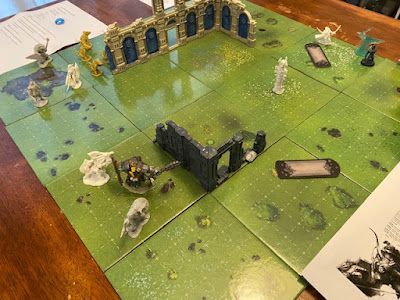
Here are some visual examples of zones in use. First, a more-elaborate-than-necessary setup; note that I was basically running Soulbound here as a tabletop skirmish game with my kids. In normal play, you can just dash down some sharpie or dry-erase lines on a blank space. Here, instead, I used Master's Atlas Worldcrafting Tiles and treated each tile as a zone, ignoring the square grid within each tile, then slapped down a bit of Warcry terrain and a bunch of minis: 

So much unpainted plastic! Clearly, heresy remains a key part of the Warhammer experience.

Notice the little gaggle of ratmen partially obscured by the wall at top left? If the game's weaker monster minions gang up within a single zone, they form a Swarm, which grows a bit more powerful but stays easy for the GM to control. All that bunching up also makes them convenient to devastate with heroic powers, of course ... in this fight, if I recall, the hero archer took out the entire skaven gang in a single round (!). In Soulbound, the little grunts are really there to get in the way, wear you down, or just make you feel awesome before you get stomped on by the bigger, nastier foes. 

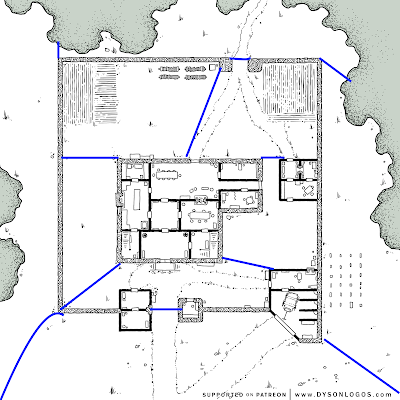
Mapping zones for online play is pretty easy, too - at least the way I do it. I grab a free Dyson map, add some colored lines with quick home edits, and have a battle map ready to go, like this one:

For this Dyson Logos map, I drew my own zones in blue, and treated each room in the tighter confines of the manor house as its own zone, too. We had quite a fight here. 

Once a fight breaks out, characters act in order of their Initiative, which is static. You don't roll for it; you just note down the fixed Initiative # of everyone involved and then start cycling through them in order (though there are tactical actions that can change your place in that order). I've liked this fixed-Initiative system more than I thought I would. It's certainly simple. As a generalization, the weaker, Swarm-forming foes tend to act absolutely last, so players often have to decide whether to focus on cleaning out the mobs or prioritizing the deadlier but lone big-bads. 

Once your turn comes around, you can Move and take an Action. Well, in fact, you can usually do a whole lot more than that, but that is the basic action economy. It is stretched by two factors: the generous definition of Free Actions and the use of a spendable action currency, Mettle. You can use a Free Action to relocate anywhere in your current Zone, or to open a door, draw a weapon, or drink a healing potion. Since you can chug that healing elixir in between hacking apart a monster and running out the door, recovering from your beatings is surprisingly easy in this game. A bit oddly, the game proffers a liquid resource called "Aqua Ghyranis" as both your healing energy drink AND your market currency (in the game's setting, lumps of gold are a dime a dozen on one of the settled elemental planes, so precious metal has little value; but water that restores life, now there's a real commodity...). To heal via potion, then, you gulp down what in other games would be your gold pieces. 

Mettle  means you can ... do MORE. Most characters have access to 1 Mettle per turn; some can start with 2. At either rate, if you spend it, you recharge 1 point of Mettle back every turn. You use Mettle to gain certain mechanical bonuses to rolls, to activate certain miracle effects, or - more commonly - to take another Action. Since you'll start your turn with at least 1 Mettle, you are usually guaranteed at least two Actions along with your Move and Free Action, unless you spend that Mettle on some other awesome thing. This simple action economy gives players small but meaningful choices every single turn, and keeps them feeling competent as active agents on the battlefield. Oh yeah, but ... the bigger, bad foes can spend Mettle too...which gets scary. 

Combat attacks use the general dice pool system described above, with a few extra wrinkles. You'll determine your dice pool for attacks by adding points from your Body stat and the relevant Skill (Weapon or Ballistic Skill). Also, each character has a qualitative rating for Melee, Accuracy, and Defense. These are written as words; for example, a Skaven Gutter Runner warrior has Good Melee, Average Accuracy, and Average Defense. The six available ratings run on a ladder: Poor, Average, Good, Great, Superb, and Extraordinary. To attack someone, you compare your own Melee (or Accuracy, if shooting) to their Defense. The number of steps up or down between your ratings will determine the Target Number needed for successes on the dice in your pool. So, for example, I might end up rolling 5d6 for my attack, and if my Good Melee is one step above that Gutter Runner's Average Defense, then I will count die results of 3+ as hits/successes. 

This is an interesting move, design-wise. In recent years, the Warhammer skirmish game Warcry introduced something a bit like it - simplifying some of the traditional multi-roll procedures in Warhammer combat via a quick relative comparison between the combat levels of enemies. I wonder whether this was just convergent evolution, or whether Warcry influenced Soulbound's design? At any rate, I worried that constantly cross-checking these levels for every combat attack would be too fussy, but in actual play I've found that it quickly falls into the rhythm, and my players get attuned to the short range of possibilities - so that after a while, I can just say "he's got Good Defense" and they mostly nod and check for the needed target number. 

Many weapons will add to your # of successes rolled; conversely, enemy Armour will subtract from the total successes. Any remaining balance gets deducted from the target's Toughness. Dropping Toughness to 0 kills most foes, but PCs - and stronger enemies - have a separate Wounds track. There's a somewhat intricate system for Death Saves and recoveries that works ok. In keeping with the game's overall tenor, catastrophic damage is both a very real threat and pretty easy to bounce back from if you've got luck and resources on your side. If it looks, however, like your character is pretty much doomed, you can accept the inevitable and choose to go out in a blaze of glory -- with a pretty epic Last Stand mechanic. 

Worth noting: there are plenty of things to do besides just hitting the opponent. The game provides fairly simple rules for things like called shots, charges, defending a target or area, dodging, running away, pushing and grappling a foe, helping another character mid-fight, or even trying to verbally de-escalate an undesired fight right in the middle of the action. 

I haven't yet mentioned the PCs' secret weapon: Soulfire. This is like super-Mettle, drawn from a common pool shared by all characters whose souls are knit together in a party-wide bond (which generally means all the PCs except any Stormcast Eternal uber-knights or Lizardmen/Seraphon [the latter show up in a supplement]). This campaign resource recharges very slowly, so its uses are precious, but powerful. Spending a point of Soulfire can do some pretty impressive things, like choosing before you roll to make an entire dice pool count as if you'd rolled all sixes, or cheating Death to bring a mortally wounded friend back into action. Soulfire can be particularly helpful to maximize some of the spellcaster characters' abilities.

That's a fair bit of detail about the way you run combat. In terms of how it feels and plays, I'd say it is fast, tactical, and rewarding. Most turns provoke meaningful and sometimes difficult choices; player characters are both vulnerable but very, very competent. Almost everything is smooth and easy to run, though if you happen to have some characters imposing a lot of special conditions on others (Stunned, for example) then this can slow things down a little unless you track it efficiently. Overall, as I stated earlier, the game runs tabletop skirmish RPG wargaming in a faster and more pleasing manner than 4e D&D, which is just dandy with me. 

Another useful comparison, for me, is to Savage Worlds, another RPG with ancestral roots in tabletop wargaming (I reviewed the Savage Worlds: Pathfinder core rules last year here on the blog). SW is billed as 'fast, furious, and fun', though in play we found it to feel a bit swingy. That is, SW characters are capable of pretty amazing feats in combat or other challenges, but often because you get a lucky throw that cascades into a truly stunning success. Soulbound takes a different approach: PCs are much more reliably awesome, so you can count on doing somewhat epic things in most fights...but the opposition is dialed up, too, to match. The whole baseline is shifted up a tier; you remain vulnerable and aren't assured of victory, but you aren't just waiting around for the really spectacular rolls. I like that. 

Speaking of the opposition - who's out there waiting to kill/eat/corrupt/enslave your characters? Monsters and other foes are statted up similarly to player characters, though (again) most of them die at 0 Toughness, unlike your PCs. Many of the classic Warhammer baddies are here, along with many new ones from Age of Sigmar. Foes aren't just bags of numbers; they often have their own special powers that are both thematically evocative and mechanically interesting. The special abilities remind me a lot of 4e monster entries; like 4e monsters, however, they require the GM to take a good read through each one before combat erupts (at least ideally - or you'll discover mid-fight that you've missed reacting to some special trigger-condition, etc.). The core book includes a 42-page bestiary section. It is ... adequate. Well - it's good, in its own right, but it has limits. I'll talk about supplement books in my next review post, but I will note here that the separate Bestiary supplement would be my top recommendation for expanding the core rulebook. You could run games for a while without it, but a lot of Warhammer standards will feel lacking if you only have the core book. 

On that note, I was bummed not to see guidelines (or I missed them, if they're in there...) for creating your own monsters. You certainly can reskin and retool existing ones (there's already a healthy fan-made monster base online) but the game doesn't really prepare a GM for that [perhaps the licensed IP militates against it?]. More seriously, it isn't until the supplementary Bestiary book that the GM receives guidelines on how to design a "level-appropriate" combat encounter for your characters. Boo! (They're good but short guidelines, too, so it's not asking for a ton of work in the core). 

I often hang out in OSR-adjacent rpg design spaces where "level-appropriate encounters" are eschewed in favor of open worlds and responsible players. That approach definitely can work in Soulbound, but the overall lethality of some monsters is hard to pin down until you try them and their special abilities in play. So, in some ways, encounter design for Soulbound is an acquired art, not a science, but after running about half a dozen games of it, I feel I haven't mastered said art. 


MAKING CHARACTERS

Character creation involves a point-buy system, but it's kept pretty straightforward via some (optional) archetype templates. The core book presents 23 of those archetypes across a diverse species array of humans, kind-of-no-longer-human Stormcast Eternals, dwarves, elves, and tree-folk, so there's plenty of choice. These archetypes make it pretty straightforward to eyeball an interesting concept, make a few choices to taste, and then start playing. 

Once you get to know the game a bit better, however, it's quite easy (and book-legal) to build alternatives to the archetypes, or to create a completely different character from scratch. That does require, as I noted above, point-buying options from a pretty lengthy list. If you are familiar with the range of Skills and Talents (feat-like, sorta) then this becomes pretty do-able in about 15 minutes, but to get to that point, I first had to comb through the Talents list with an eye to specific tactical abilities I was looking for. 


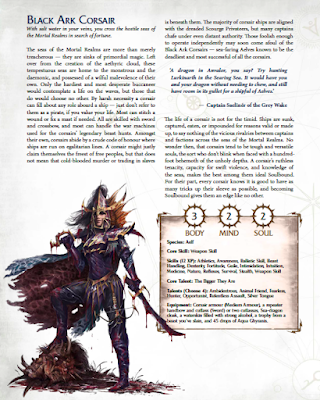
A sample Archetype - you can use these for quick character creation,
or as a foundational template for a 'class' of your own.


Worth noting: when using the pre-generated characters available for download, or just the core archetypes in the book, don't take anything for granted. Take a moment to look up and read the description for everything. For example, we had run an official, pregen Dwarven "Duardin Skyrigger" for several sessions - with a pretty amazing steampunky 'drill launcher' on the weapons list - before I noticed in the core book that this weapon comes with a really heavy head, so that most characters will only carry a single reload. Oh. Well, that required new tactics. :-) Conversely, an item of clothing that sounded like flavor text on the Dark Elven Corsair's archetype page turned out to have quite useful special stealth effects. I suppose it's not rocket science to say "be sure to read the rules" but sometimes Soulbound's general simplicity can fool you into thinking something is straightforward when it isn't. 

As is pretty common nowadays, the character creation chapter includes somewhat more 'narrative' ways to round out your character and the group as a whole. These range from suggestions for names and physical-appearance details to questions about your background - and a random-roll table to provide backstory connections between PCs if you're having trouble thinking of one you like. The game also has you - you individually AND you all as a party - set short-term and long-term goals that grant milestone XP. XP points are exactly the same kind of thing you spent during character creation to buy new Skills, Talents, and Attribute levels (unless, again, you stuck with a pre-written Archetype that keeps all the relevant math hidden in the background for you). This approach offers the benefits (and drawbacks) of a milestone-XP system, but prevents a GM from railroading entirely based on their desired outcomes; players have an important say in the things they want to be rewarded for. 

Note that some of the game's initial supplements include players'-option books that really add a lot of further power and flexibility in character creation. 

We found in play that the pre-gen characters released by Cubicle 7 could be a little underwhelming in combat (note, though, that we really emphasized combat over everything else at our table while testing Soulbound). I decided to craft some characters to really shine in specific combat roles. This did involve ... the dreaded min-maxing! Happily even min-maxing in Soulbound doesn't really take up much time, so I could sheepishly enjoy my wannabe-3.5e experience... ;-) I created, for example, a Dark Elf corsair with a signature move; he can hamstring opponents and knock them prone. The fella plays like death on sneakers, a mobile guerrilla assassin who regularly changes the battlefield. While it's easy to create specialized troops like that, they do run the risk of being so single-focused that unexpected combat situations can make them feel less enjoyable. 

As PCs gain XP to spend on themselves, they can keep honing those precious combat abilities, or train up in non-combat related Skills. My own focus on running Soulbound as a tactical skirmish game is probably blinding me to some of its potential for longer-term campaign play, but combat is potentially bloody enough that I'd pity a character not well-suited to fighting, here. 

Creating a spell-casting character is not 'class limited' - rather, it depends on spending points to gain the Talents that grant access (either to cleric-style miracles or mage-style spells). Then, gaining additional powers under those umbrellas costs further points. Using the pre-set archetypes makes creating a spellcaster quite easy, but the point-buy option means you can create a sort of 'multi-class' fighter-wizard, if you want to combine/dilute the different specialties that way. 

Miracles and spells use different rules: spell-casting is essentially a gamble, requiring a dice-pool test to succeed. If you really blow the roll, there's even a "Price of Failure" miscasting table (p. 266). Though much less zany than DCC's miscast table, things can definitely go VERY wrong if this happens. On the other hand, spells can be pretty powerful! Priestly miracles are generally more reliable, either succeeding automatically at the expense of an Action, or requiring that you spend your Mettle metacurrency to power the effect (or keep it going for a longer duration). Both types of magic have diverse schools/domains that are well-connected to the setting material, and can make two spellcasters (even of the same 'type') feel quite different in play. 


OTHER STUFF

Along with an in-book core bestiary (see above), detailed setting description (see my previous review post), and a suitable discussion of rules for magic and equipment, Soulbound also provides two other short but noteworthy sections. 

One is a downtime system for PC activities between adventures/missions. This sort of thing has become more common in recent years - it was championed particularly by Blades in the Dark - and it lets players feel more connected to the campaign world while continuing to differentiate their characters. These activities might be as mundane as shopping for or maintaining equipment, or you might find yourself researching old lore or new inventions (or magic spells). Alternately - if you're fantasy Batman - you could keep up appearances with a fake identity. If you're a Stormcast Eternal, slowly losing bits of your humanity every time you return from death, you could spend time seeking fragmented memories from your own past, perhaps allowing the GM to hand you new story hooks. 

Also worth noting: a 13-page GM's guide section. Some of this offers your standard introduction to running an RPG. More interesting (to me) are the detailed tips on creating the feelings envisioned for Soulbound (the game "has four primary tones: mythic, hopeful, tragic, and dark") - or, if you'd prefer, making it your own and changing some fundamental aspects of the game. Want a game closer in tone to Warhammer Fantasy RPG's low-power grittiness? There are rules suggestions for that.  Considering some of the more obvious rules hacks? You'll find discussion and recommendations on house rules. Think it would be interesting to make some changes to the default setting? The book explicitly calls out running games in a different period of the world ... which aaaaaaaalmost implies "go ahead, use your own setting for this official Warhammer game!" 

For the record: I think it would be pretty wild to use these rules to run an old-fashioned, high-level D&D adventure arc, like Against the Giants...

The GM section also includes procedures for integrating Rumors and Threats into the campaign. This reminds me of Fronts in Dungeon World, and offers some structure for setting up dynamic campaigns

PLEASE STAY TUNED...I've one more post in this review mini-series, commenting on some Soulbound supplements, and then summing up my own overall impressions of the game. Thanks for reading, and happy gaming! 


Saturday, January 29, 2022

Warhammer, Scratch-Built & Kitbashed - from a Deodorant Hovertank to "Chaos Stormcast" (!?!)

 Geeky readers of a certain age - those who cut their teeth long ago on the OG, first edition Rogue Trader 40k rulebook - may remember a time when White Dwarf encouraged players to build their own vehicles from parts at home! I remember reading about the 'deodorant stick hovertank' back as a teenager, and this ludicrous, brilliant idea lodged itself firmly on my hobbyist bucket list. 

Well. Not anymore. 


My kids and I like to play 40k (when I say "play 40k," let the reader be wise and understand: why bother with endless codex updates and complex rules when you can run your grimdark platoon- through fire-team-size fights more simply with Squad Hammer, Space Weirdos, the various One Page Rules systems, etc.?). To support our ongoing shenanigans, I decided to throw together a fighting vehicle suitable for use by pirates, rebels, or down-on-their-luck planetary defense forces. Something a bit ramshackle, with a 'Russian Civil War, but in space' vibe, would be just right. 

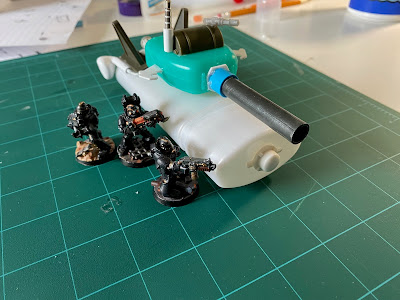
Here it is. 


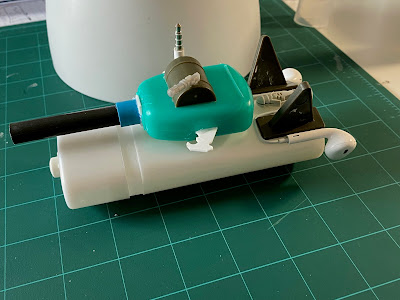
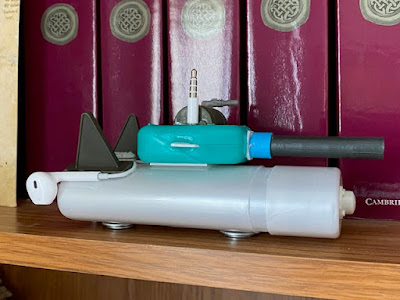
I may add a few more cosmetic doohickies to the fuselage, but it's pretty much done. Of course, it needs paint, but "Spraypaint with adequate ventilation" and "January in Canada" are not optimally paired, so we'll see how soon I can get that done. I'm imagining a stripey camouflage pattern with local highlights thereafter. 

This was fun to put together! It is, quite literally, pieces of junk. The fuselage is an empty deodorant canister. The fins were plastic signs from a 'green army men' set (they had stickers with 'no entry' warnings or something like that). The "aft attitudinal-stabilizer nacelles" and their fuel lines are, of course, Apple headphone earbuds! I had an old set giving up the ghost that I just replaced, and I decided in an odd fit of inspiration to cut them up for the bits box. The turret is a floss box; the main gun was the plastic tube holding together a roll of dog-poo collection sacks (!). The little blue bushing around the gun barrel was a spool inside the floss container. Atop the turret are more pieces from the army men set, and the power plug from those headphones as a rather robust antenna. The sort of mandible-shaped fins 'welded' to the turret's sides are meant to add a bit of menace but also unprofessionalism to what I imagined might be, again, a pirates' vehicle. Those 'fins' are just bits of a plastic bread-bag closure tab. :-) 

We will have to see, but I've high hopes that once painted up properly this will do the space-scum proud, and satisfactorily mark the deodorant hovertank off my bucket list. 


I BASH, YOU BASH, EVERYBODY KITBASH...

In the top photo above, the three infantrymen in position near the tank are part of a four-man kitbashed fire team of which I'm quite fond. I don't think they're particularly clear in that photo - it's just detailed enough to show you that I'm no great painter - but you may be able to pick out their essential elements. I wanted to make some tough-looking troops who might be pirates, private security, etc. I used Chaos Space Marine bodies with no shoulder pads and no backpacks. I added Skitarii Vanguard helmets and a few parts crafted from plasticard or clipped from other GW bits (the fellow firing one-handed in front has a comm-unit or perhaps a detonator in his left hand; it was formerly just one of the doodads hanging from a Skitarii backpack). 


FOR ORDER AND GOODNESS, DOGS OF CHAOS! WAIT, WHAT NOW?!? 

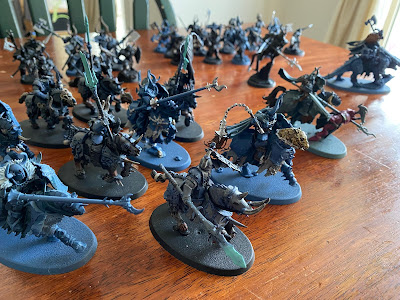
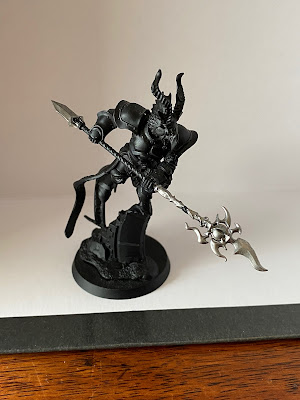
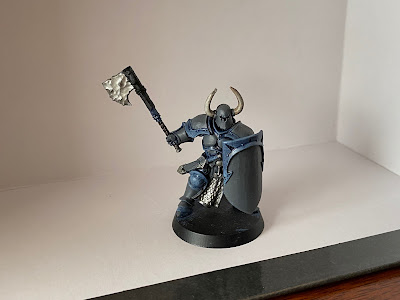
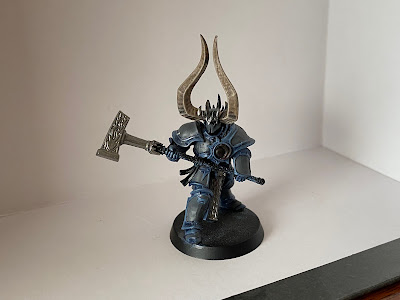
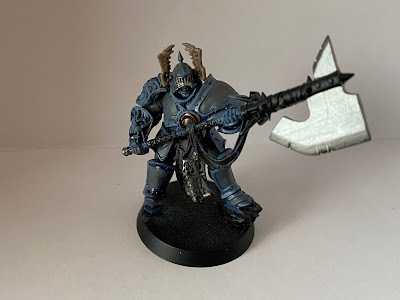
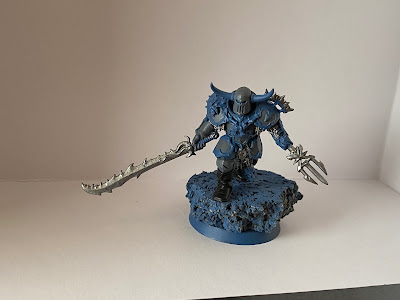
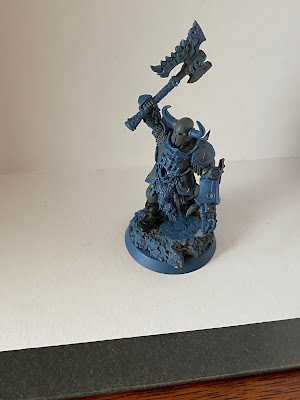
Next up on the topic of kitbashing is something I can't take any credit for, but wanted to share. My FLGS runs a nice cabinet for re-selling used miniatures. This past Christmas, I acquired a really interesting collection of kitbashed Warriors of Chaos. In a nutshell, they combine parts from Stormcast Eternals ("good guys") and Warriors of Chaos ("baddies"), though as you'll see below there's more to it than that. 

First up, some cavalry:


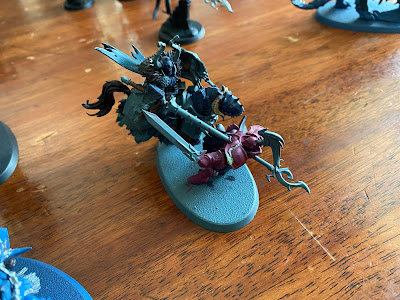
Alright, that's Chaos-y...but check out that fella toward the back!


It's been made up almost like a little diorama: a charging Chaos Knight has impaled a falling Stormcast Eternal on his lance. Now, let the record show that this is a highly improbable lance-head for stabbing into plate armor, but otherwise, this is quirky and cool. 

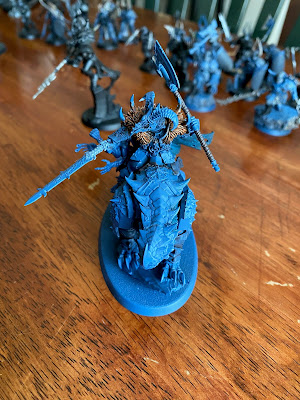
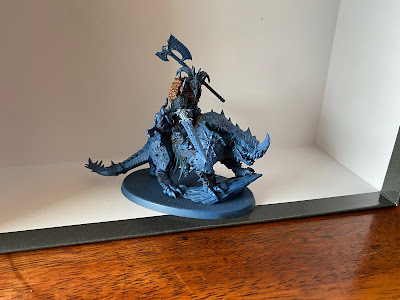
Check out the general:


This guy's got some kind of Beastman helm or head, and there's an imp riding shotgun behind him. 

The modifications get more aggressive with the infantry. This fella, for example, appears to be a Stormcast Eternal, but with a Kroot Carnivore's head from 40k:


I believe this next one combines Stormcast parts with bits from the Tzeentchian variety of beastman:


Some of "the boiz" are more straightforward mixtures - Stormcast Eternals bodies with Chaotic helms and, sometimes, weapons: 


I find this a really interesting vibe. They definitely still read "bad guys" - but the use of orderly Stormcast parts moves things away somewhat from the normal "chaotic evil edgelord" feeling of Chaos Warriors. I almost imagine these guys like Pathfinder Hellknights - who are lawful evil! In fact, these guys make me want to come up with backstories about once-noble knights who fell into error as antipaladins through their own pride and hubris...but who probably still think they're the good guys. 

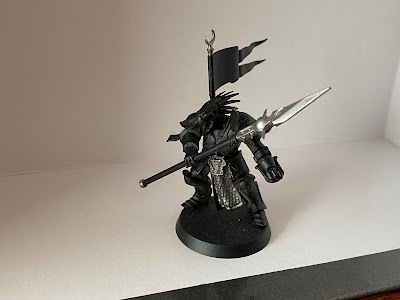
On the other hand...I call this guy the Mouth of Sauron.


If he was ever a nice guy, it was - oh, like way back in 2020 or something. 

Some other figures in the lot are more typical Chaos Warriors, but they're still kitbashed in interesting ways. This fella, for example, has a trident for a left hand.


And, bringing in a dash of science fantasy, here's a Chaos Warrior with a giant mechanical prosthetic hand. I've been trying to figure out what kind of part was used - it has a Necron-ish look to it - but I haven't figured it out yet. Any idea? 


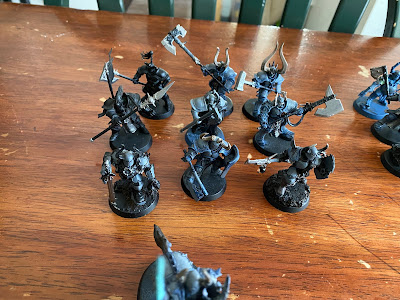
ANYWAY - These are some leading examples from within the batch. Just a final shot of some of the gang together...


I'm really pleased to have got my hands on such a quirky warband with so much personality. In general, I find kitbashing really fun, and seeing someone else's handiwork is inspiring. 

Thanks for checking out the kitbash gallery! And speaking of Warhammer, I'm mid-draft in the second half of my Soulbound RPG review, and have plenty of other stuff I may talk about soon, too - so stay tuned. Happy gaming!