Saturday, November 19, 2022

On Running Very Different Types of Games

Prepare ye for some musings on the philosophy of gaming... 

I used to spend far too much time, not too long ago, trying to figure out my 'perfect game system.' You know, that one, elusive RPG rules-system -- whether about to be published, somehow already published but not on my radar, or the pending product of my intensive house-ruling and hacking -- that finally would usher in a blissful millennial regime of perfectly satisfying game-play.

Yeah, um, about that...I'm pretty sure gaming doesn't work that way... 

...mainly because I don't think life itself is supposed to work that way. Pre-conditioned by a consumer-driven society to always lust after something else, anything else, just not one of the 5,000,000,000 gaming .pdfs already sitting on my hard drive, my flirtations with (one hopes!) middle-aged maturation point me towards greater contentment with what I've got ... or at least with a more realistic view of the point of getting new games. To be clear, I still love me some new gaming action, and I've got my beady eyes now on a few choice titles on the horizon ... but I'm trying to be a bit more deliberate and thoughtful about it all. 

Perhaps ironically, fixating less on the pursuit of 'that one perfect game' has helped me recognize more clearly how very different systems have lots to offer just as they are, for a particular niche. That tired old debate - "system matters! no, you dolt, system doesn't matter!" - like any (false) dichotomy, obscures the grain of truth on each side of the argument. A creative, flexible, experienced GM can make almost any RPG system do wonderful things, but of course system directly impacts the experience of gameplay. 

A while ago, I made a list of different niches for rules systems - different types of games that I find appealing at different times. What, I then asked, might be my preferred rules systems for executing each kind of game? It proved helpful to me to think not in terms of genres, but in terms of the experience of different play-styles. Here was my list of categories: 

  • OSR - more complex/substantial
  • OSR - less complex/rules light 
  • PbtA (Powered by the Apocalypse games - I'd add Forged in the Dark games here too)
  • Solo or Cooperative games
  • Tactical RPGs
  • Games with High-Powered player characters 

There's a lot of potential for overlap between some of those categories, though each one has its own distinct play-style or experience. As I worked to articulate what systems might best suit my preferences in each category, I noticed some games that I like fitting in multiple categories, while others obviously had more limited roles. Somehow, breaking things down like this also gave me some clarity about the kinds of gaming I wanted to do for the present season. For example, I realized that - at least for now - the 'more complex OSR game' wasn't really where I wanted to land. On the rules-lighter side, I absolutely love Into the Odd, but I can get disenchanted with the real limitations of its ultralight framework. What I realized, however, is that I'd rather accept ItO's intended niche and use it to run a freewheeling, rules-light OSR/NSR game ... or if I wanted something with more heft, I'd rather use something crunchier than most of my 'centrist' OSR systems (I had looked in earnest into Low Fantasy Gaming for a while, for example, before settling for...something else. More below).

After shifting from a science-fantasy campaign using Dungeon World, I had been running a campaign using a house-ruled Knave-based system. Knave is great! We played through most of a mash-up of The Evils of Illmire and The Black Dragon of Brandonsford that way. But I started feeling that Knave wasn't delivering the experience we wanted for the time being (see, it's a great system - but wasn't right for the moment). On the one hand, some of my players really longed for more detail and agency for custom-tailoring their characters during advancement. And as GM, I was getting bored with the monsters-as-lightly-flavored-bags-of-hit-points phenomenon that (like it or not!) can stand out in OSR games when compared to crunchier systems (yes, yes, I know; there are ways to address that with GM creativity. But system doesn't matter, except when it does). I wanted critters that were more mechanically interesting to throw at my players, and I wanted a little more tactical specificity in the rules so I could lean hard in combat without constantly breaking the PCs - or pulling my punches. (I doubt it's a spoiler to note that The Black Dragon of Brandonsford has ... a black dragon in it. The fight with that monster, under Knave rules, was memorable, but I came away feeling that I was always one or two GM-fiat choices away from a cakewalk or a total party kill. I wanted to play hardball, without being arbitrarily cruel!). 

For a variety of reasons, we switched the campaign over to Pathfinder 2e

It would not surprise me to learn that I'm one of few (or the only?) GMs out there to have converted situations and encounters from the thoroughly OSR-ish Illmire and Brandonsford into PF2e! Or to have multiple recurring villains in an ongoing PF2e campaign who started as NPCs in those modules. I integrated them into a new region 'just across the mountains' and started up a very faction-heavy, situation-based campaign that draws on a lot of old-school resources despite the very modern rules system. (Gotta say - I am digging playing in my own sandbox full of conflicting, home-made factions). 

Well, how's it going, and what have I learned?

Here again, I'm seeing how different rule systems can offer so much while simultaneously imposing their own kinds of limits. Despite turning up my nose for years at Paizo's flagship system, I'm now finding PF2e a really excellent base for gaming centered around tactical combat. Pleasantly, I've found the system works well, too, when I set aside 'the grid' and run a much looser battlefield - in fact, it's almost easier and more fun that way. One of our favorite fights in the campaign so far used abstract zones on a vertical, side-facing cutaway color diagram of a dilapidated slum tower - from a Warhammer Fantasy RPG supplement - instead of a top-down gridded map. I ran another fight (near "Illmire") using a handrawn rough sketch of a swampy battlefield about 100 meters across that took about eight seconds to draw. Balanced fights are really easy to plan and run, and monsters generally feel distinct and interesting and often pose mini-puzzles for players to crack during combat. Several of my players are reveling in the greater customization and control afforded by the system. So, huzzah!

On the other hand ... our pace has SLOWED down!!!  

Right now, the party is exploring a floating dwarven citadel (thanks, inspiration from Dragons of Desolation!). They got there on a flying dwarven skyship, seeking clues to the reason the castle got torn skyward centuries ago, and also to recover a relic axe (the PCs are trying to help a group of dwarves boost recruitment for an army to retake their halls from a dark Duergar cult; recovering the axe should give them the P.R. boost needed to swell the army with fresh recruits - while causing some indirect problems with other factions that the PCs will have to deal with, too). 

Due to various real-life factors, our sessions of late have been limited to about 2-3 hours most weekends. Two sessions ago, we got through a bit of freeform roleplaying and lore-dumping to set up the mission, and then the PCs were dropped off on a balcony (under fire from angry Strix birdmen) and fought their way inside, finding a treasure-laden workshop guarded by several dwarven-crafted automata. The resulting fight took up the rest of the session. Then, in our most recent session, the party left that room, climbed a central stair-shaft, dealt with some brown mold on a kitchen cabinet, had a big fight in a haunted banquet hall, climbed more stairs, and entered another room where they'll obviously face a big fight - and time was up for the session. So, basically, one complex fight, and two 'empty' but trapped spaces - in a full session. 

That is kind of frustratingly slow compared to the pace of other campaigns I've run (a few years back, we used Dungeon World to roll through B10, Night's Dark Terror, and X1, The Isle of Dread. We got SO MUCH DONE some nights in those campaigns! Not to mention the night we played what would normally be an entire campaign's story in a single night using On Mighty Thews...). Right now, the slower pace required by the more detailed, crunchy combat mechanics and turns in PF2e is pushing me to focus on designing memorable, interesting encounters, but at the cost of flexible, more open-ended play. I feel like a technician instead of an artist: checking moves, maintaining order, applying rules, tracking mechanics (and that's even with a willingness to just make rulings when I can't find the 'proper' PF2e way quickly). I'm really missing the playful, creative sense of surprise that I get when GMing a less crunchy and more open system. 

So...hmm...what's a GM to do?

An earlier version of me would probably be screeching to a halt already, deciding that 'this isn't THE system, after all', and moving on in search of greener pastures. But the shift in my thinking in recent years, as described above, has me looking for a different solution. PF2e is a GREAT engine, FAR better than many other games I've run at doing certain things. But it's also slower and more cumbersome when compared to many other games I've run.  

Instead of jumping ship and looking for 'something better', I'm trying to focus on celebrating what we are gaining from using this system at this time, while thinking clearly about what else I might like at an appropriate - and maybe other? - time. 

I do think I want to tweak something, but I suspect the answer might lie in budgeting time for something else while persisting to do this current campaign real justice. I'm thinking of a few ideas ... like maybe committing to run something much more freewheeling for a break in a few months' time. Forged in the Dark systems are really calling my name right now (in fact, I've got some thoughts I hope to share soon about FitD rules-light options for 'domain play' and mass combat). Alternately, maybe the answer is to switch back and forth - maybe we could run two concurrent campaigns, with something like Blades in the Dark one week, and PF2e the next? That might scratch the right itch for everybody (I've got one player in particular who really misses the system of Dungeon World). 

Whatever I do, though ... I want to be mindful and content if I'm going to run something. I'm not afraid to abandon a campaign that isn't going well (I've done that before), but I don't think that's where I'm at right now. Instead, maybe the right approach now involves being aware of the different kinds of play that I like, celebrating the ways I'm getting some of that, and waiting patiently and flexibly to try other styles at the right time. 

Hmmmm. Thanks for bearing with these musings ... hopefully they provoke a few useful insights for somebody else, too. 


Tuesday, October 4, 2022

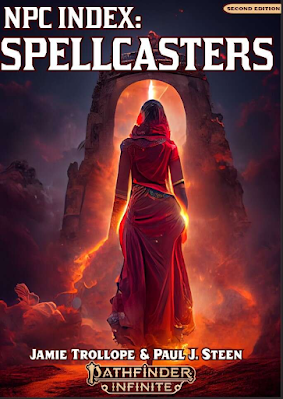
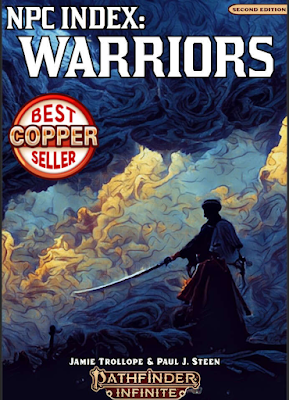
[REVIEW] PF2e NPC Index - Spellcasters / Warriors (Pathfinder 2e 3rd-party supplements)

TL;DR - This post starts off with some general chitchat about my move into running Pathfinder, 2nd edition. I then review a handy pair of third-party resources, the NPC Index: Warriors and NPC Index: Spellcasters supplements for PF2e. For disclosure, I purchased the Warriors Index, but then received a free copy of the Spellcasters volume in exchange for a fair and honest review (I decided to address both supplements here). In short, I think these are both great resources that will offer a lot of utility for any PF2e GM's repertoire - and will save lots of time, too. That being said, I also offer a few critiques about some ease-of-use features. Links to the products are OneBookShelf/DTRPG/Pathfinder Infinite affiliate links, which help support this blog's activities at no added cost to you. Thanks for reading! 

Purchase (affiliate) links:

Spellcasters

Warriors


SO... PATHFINDER 2e... 

Historically, at my own table I've mostly run rules-light games without a lot of crunch. Long-time readers  may be surprised to learn that my home campaign is currently running in Pathfinder, 2nd edition (PF2e). I chose PF2e partly to give players more customization (that I didn't have to homebrew constantly...), partly to re-invigorate my monsters (no more 'bags of hit points'! Everything has thematic tricks in combat!), and partly to run a more tactical system in which I don't have to pull my punches, but also don't have to worry much about balance. PF2e certainly allows as much square-counting and board-gamey action as you might want (or not...), but I find that it also works quite well for more flexible, less detailed combats. Our most recent fight was great fun, but our 'battle map' was just a vertical, side-profile building diagram from a Warhammer Fantasy Roleplay adventure. I simply gauged movement by zones and made rulings on the fly whenever something was unclear, and we had a great time in a fight against undead shadows hunting the PCs up rotting staircases in an abandoned slum building (yes, PCs could and did fall through broken steps to the landings below!).  

Having said all that, Pathfinder wouldn't be Pathfinder without some measure of crunchy mechanics. As an experienced GM but someone quite new to running PF2e, I've had a lot to wrap my head around. So far, the experiment is working well, though I've had my work cut out for me by insisting on running a sandbox campaign. First, I converted the tail end of a contemporary OSR standout campaign, The Evils of Illmire, to PF2e. My players just finished with that converted content and are now at work in a new region of my own creation.  Although many GMs grab a pre-made 'adventure path' that fills in the blanks for you, our current adventures exist on a map that I drew, onto which I placed about fifteen different factions with competing goals and assets (I wanted an intrigue-heavy, social-relationship-emphasizing campaign, albeit with some cool dungeons waiting out there). 

But this leads quickly to a problem: how to stat up all the NPCs running those factions? 


RUNNING NPCS: RESOURCES (AND LIMITS) OF PF2E

One of the great features of PF2e is that the rules and bestiary entries are free to read online. This includes the NPC statblocks published (in an "NPC Gallery") in the PF2e Gamemastery Guide (the online versions are here). That collection is very useful, but it isn't terribly flexible. If you run PF2e using the standard rules, there's a tight math loop that makes creatures or NPCs within about 3-4 levels up or down from your party fair game for a fight (outside this range, mathematical probabilities will make most fights too one-sided to be interesting; inside the range, fights can be great). The rules do provide "Weak" and "Elite" adjustments that bump a critter's level up or down by 1...but that's a pretty minor adjustment for a game built to span 20 levels. 

In my case, this posed some problems. The NPC gang leader looked cool, but the NPC Gallery profile Gang Leader is level 7. Hmmm. That's several levels higher than what I was looking for. Keep the cool thematic abilities but stay overpowered? Settle for a less thematically suitable but lower-level Ruffian? I wanted a Necromancer, but the GM Guide NPC Gallery Necromancer is Level 5...just a bit higher than what I had in mind for this role...oh, and it has a special ability with a hideous stench aura. Ok, but I wanted a necromancer who is just getting into the dark arts and is still connected to polite society, so that tell-tale stench just won't work. Can I just hand-wave these things away? Yes, of course I can - but then I'll be monkeying with the balanced math loops, etc. Not ideal.

Now, PF2e - in the Gamemastery Guide, again - does include a guide to building your own creatures and NPCs. But ... it's about 18 pages long. The 'building NPCs' section is just a few pages, but it refers to and builds upon the whole section. I am a busy person with a life and a lot to do, and ... I am not going to work through ten pages to prepare every NPC I need for this campaign. Nor am I willing to build each NPC as a proper character using the PC class rules. 

Crumbs. What's a GM to do? 


ENTER THE 3rd-Party NPC INDEX


Rejoice, for my problem has a solution! 

Jamie Trollope and Paul J. Steen are co-authors of NPC Index: Warriors and NPC Index: Spellcasters. Oh, and before I forget - each supplement also has a Foundry VTT module sold separately or in bundle form, if you're into that sort of medium). The volumes are sold via OneBookShelf's Pathfinder Infinite, an official community-content marketplace for Pathfinder/Starfinder supplements (I gather this is similar to the Dungeon Master's Guild that WotC has set up through OBS as well). The service is integrated with (my preferred) DriveThruRPG.com, so if you have any store credits burning a hole in your pocket on DTRPG, you should be able to clean them out here! :-) Each volume costs $12.99 for a .pdf. Warriors has 110 pages over 56 .pdf spreads and covers; Spellcasters offers 114 pages over 58 spreads and covers. 

Awright, awright, but what do they do

Put simply, they make class-based NPCs, at many different levels, with a variety of special abilities and ancestry templates, and they do so pretty quickly and easily. To quote the product blurbs: 

Here you'll find 100+ ready-made statblocks for spellcasting NPCs of every level, from a lowly apprentice to the most awe-inspiring archdruid.

Here you'll find 100+ ready-made statblocks for martial NPCs of every level, from a lowly squire to the most terrifying barbarian chieftain.

Spellcasters lets you craft Clerics, Druids, Sorcerers, and Wizards. Warriors contains Barbarians, Rangers, Fighters, and Champions. (I understand that a third and pending volume will cover offer Alchemists, Bards, Monks, and Rogues). The blurbs above suggest that you're grabbing a fresh list of 100+ NPCs, but don't believe the hype - the reality is even better! Because the book uses a modular format - kind of the Build-a-Bear approach to NPCs - you have here the tools to stat up something like 3,100 different NPCs, per book, and that's probably being conservative with the way I run the numbers. Let me explain. 

Each volume offers two different approaches for NPC creation. 

First approach: start with one of 31 (!!!) different ancestry templates (these are things like 'halfling, dwarf, orc, tiefling, poppet'). Then, "you can follow the rules for creating NPCs in the GMG..." and then, finally, select one or more level-appropriate Special Abilities from a list provided here. Uh-oh - my heart sank at first when I read that "use the rules for creating NPCs in the GMG." I thought I was here because I'm weak and foolish and can't handle those rules? Aaaaaah! Not to worry; although this option is available to expand options for GMs with a good handle on creating their own NPCs, it isn't necessary. Instead, we have...

Second approach: use those pre-made statblocks, but tweak them as desired with your chosen ancestry. Tweak the abilities further if you so desire. 

This is where the book really shines, in my opinion. The statblocks are organized by class, but also by level.

There are multiple versions at levels 1, 4, 7, 13, 16, and 19. This is because by applying the Weak or Elite templates, these statblocks cover all 20 levels, so you can prepare encounters with NPCs that range from the lowliest street thugs, all the way up to the mightiest warlords. 

Let's look at how this works in a bit more detail. 

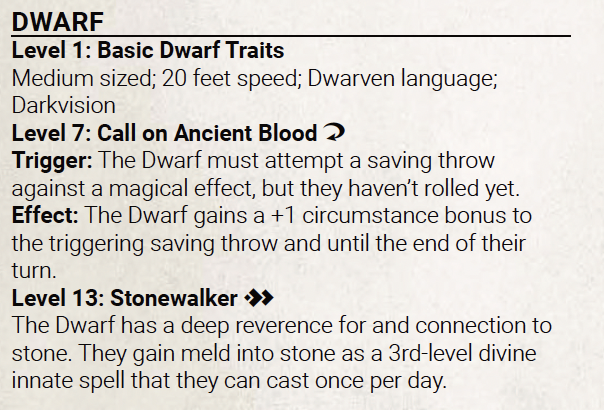
Early in the book come the Ancestry templates. As the book notes, these are deliberately simplified, offering a few key thematic special abilities. Each one follows a "base, bonus at level 7+, bonus at level 13+" format, like this:


What ancestry options are present? Well (deep breath)...Dwarf, Elf, Gnome, Goblin, Halfling, Human, Android, Catfolk, Fetchling, Hobgoblin, Kitsune, Kobold, Leshy, Lizardfolk, Orc, Poppet, Ratfolk, Shoony, Sprite, Tengu, Aasimar, Beastkin, Changeling, Dhampir, Duskwalker, Geniekin (Ifrit, Oread, Suli, Sylph, Undine), Tiefling. Oh, and half-elf and half-orc too. And each one feels just different enough to earn its place: hobgoblins are good at beating down demoralized foes, whereas orcs get a limited reaction that keeps them resilient when they would reach 0 hp, and kobolds can cower to try to dissuade an angry assaulter. The abilities mostly make sense, though this one made me scratch my head a bit:


That Level 13+ Revivification Protocol is a riff on an official Android Ancestry feat in PF2e, so no worries there, but the official version also includes a "once a day" limit, and clarifies that it's triggered as a free action when a PC has the Dying condition and is about to attempt a recovery check (which is why it's described as an action, not a reaction). That context doesn't really work for a PF2e NPC, as I understand it - they're just supposed to drop at 0 hp, and they don't make recovery checks. So this one needs a little tweak; unless I'm missing something, this would be better as a once-per-day Reaction triggered by hitting 0 hp, to put an enemy android back on their feet just as the PCs think they've cut it down. 

Once you've picked your NPC's ancestry template, you move over to the class sections. Each of these opens with a one-page overview of the class, its tactical features, and some general observations on getting the most out of these roles and abilities in play. The advice here won't be revolutionary, but it was helpful to me as someone new to the intricacies of PF2e. 

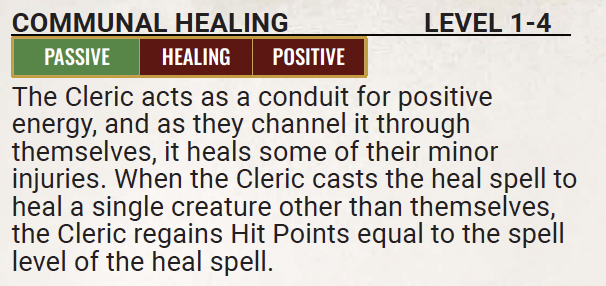
Then, for each class, you have a list of a FEW free abilities that every NPC of that class should gain (these, again, are simplified when compared to actual PCs of that class), some guidance if you are actually following the procedures to build your own character instead of using statblocks, and then ... a roster of more special abilities that can be chosen for further customization. These are grouped by level-tier, and there are simple guidelines on how many you should select for NPCs of different power levels. The abilities look like this:


There are enough to be interesting, but not enough to get really overwhelming. For spellcasters, the ability lists are followed by domain and sample spell-lists to simplify the options that an NPC caster has prepared. 

And then come those sample statblocks. So many of them! They are laid out just like a regular Bestiary entry, though you'll just need to fill in the few details from whatever ancestry template you also selected - and then you're ready to roll! Notice how (apart from the ancestry details) everything is pre-selected for you - spell selections, stats, attack rolls, abilities, etc. ... all you have to do is meander through the Index, around the level-range that you're looking for, until you see something suitable for whatever you have in mind. Here's one of the Sorcerer options:


By combining the 100+ statblocks in each book with the 31 different ancestry templates, you have the potential of up to 3,100 different, evocative NPCs - even without you tweaking the profiles any further, which you can do. In fact, I quickly ran into situations that did call for tweaking the statblocks provided. This is because -- as rich as this resource already is -- the pre-made statblocks only scratch the surface of the possible combinations one could make with the ancestry and special ability templates provided. Although there are statblocks provided for level 1, 4, 7, 10, 13, 16, and 19 characters (adjustable, again, to any level 1-20), each of those level benchmarks gets about 4 sample characters. That is far too few to exhaust the potential here. Sorcerers, for example, are categorized by 8 different bloodline/spell traditions: draconic, imperial, angelic, demonic, elemental, fey, shadow, or aberrant. Thus, the sample level 1 Sorcerer statblocks are: Draconic Novice, Angelic Novice, Elemental Novice, and Shadowy Novice. 

Notice that this leaves half of the 8 available bloodlines unused for the Level 1 Sorcerer statblocks; the rest of them do get used, but across later levels. This is not necessarily a problem, but it did raise two issues of note.  First, it sometimes took me longer than I'd like to figure out just which options a given level range was presenting. For the sorcerers, the use of named bloodlines made things pretty clear, pretty quickly. That's not so for all of the classes. Here are the four Level 1 wizard statblock options: Curious Apprentice, Incompetent Apprentice, Astute Apprentice, and Capable Apprentice. Why? Well, a closer look reveals that these four are also practitioners of, in order, Abjuration, Conjuration, Divination, and Enchantment. Great ... so why is the Conjurer incompetent, and the Enchanter capable? I have no idea.  Apart from the different pre-selected spell selections, their statblocks are almost identical; "Mr. Incompetent" actually has a slightly higher AC, whereas "Mr. Capable" has +2 more points on his Reflex save. There seems to be a serious misfit between some of the names chosen for statblocks and the actual content of those statblocks. This problem plagued me elsewhere, too. The Cleric statblocks are distinguished mechanically by their Doctrines (Cloistered vs. Warpriest Clerics), Fonts (Harm vs. Heal), and various Domains. Their statblocks are named, however, after the various deities of Golarion, PF2e's official setting. Thus, at Level 1, we have Acolytes of Nethys, Urgathoa, Chamidu, and Calistria. Sweet. Except ... I don't use most of those figures in my homebrew setting, and I'm not very familiar with the canonical gods of PF2e's setting - making these titles a little bit of a roadblock for me (I recognize that many PF2e fans won't have this hindrance). My point, though, is that some kind of naming convention that pointed more quickly to the actual mechanical differences would help. The issue is present in the Warriors volume, as well. Quick, can anyone tell me about the expected mechanical differences among the Mean Thug, Spiteful Thug, Heaving Thug, and Irate Thug? (These Level 1 Barbarians can all Rage, of course). In actual practice, it just takes a moment to glance through a statblock to see which domain, bloodline, school of magic, or mix of special abilities has been assigned to it - but saving me that extra moment with more communicative titles would have been even better! 

The other issue with the mix of statblocks is that - as noted above - there will be cases when you want (say) a Level 5 Draconic Sorcerer, but the pre-made statblocks of the appropriate level (4, with an Elite adjustment) only offer Imperial, Demonic, Feylike, or Aberrant Sorcerers. In these cases, you're going to need to do a little reverse-engineering to get what you want. The good news is that -- as far as I can tell -- this works pretty well. So long as you understand the basic logic of each class statblock (such as whether a cleric is a Cloistered or Warpriest NPC, for example) then you should be able to grab a suitable statblock of the appropriate level, remove the non-standard special abilities and/or spell-list that you don't want, and just plug in the details from the sub-class you were looking for. I'll give you an actual example from my own prep. I needed to stat up a significantly higher-level, ambiguous patron-and-possible-enemy-someday magic user to interact with my Level 5 PCs. I figured that around Level 12 would be appropriate for now (they'll need a few levels if they want to dream of 'solving' him in combat). One simple option = take the Level 13 "Astute Highmage" statblock (a Diviner), add Human ancestry features, and then apply a Weak template to reduce the NPC from 13 to Level 12. Done, and quickly! But I sort of had my eye set on the Imperial Sorcerer bloodline, which would fit this character's background well. But the Level 13s didn't offer me an Imperial. To handle this, I could instead: 

Pick (say) the "Angelic Theurgist" Level 13 Sorcerer...
Add Human ancestry template features...
Swap out the statblock's spell-list for the spells and cantrips provided on p. 70, describing the Imperial bloodline spells...
and, finally, use the Weak adjustments to drop my man down to Level 12. Done!

So this is not so bad! But it took me a little bit of working with the NPC Index to realize that I had this option at my fingertips. It's particularly important to take each class on its own terms, get to know how it's working in this supplement, and then proceed accordingly. At first, I got kind of confused and worried, but playing around with different options for NPCs turns out to be really feasible here. 

This is nice. 


NPC INDEX: LAYOUT, ART, AND PRESENTATION


On the whole, these supplements are visually appealing. There's often a lot of content crammed onto each page, but this is a utility tool to support play, not armchair reading. The .pdfs use spreads and are well-bookmarked. In general, the layout of the pages keeps things together, but you do occasionally have to flip over to a new spread to finish reading something. One unfortunate layout bug caused problems for me. The abilities for the Catfolk Ancestry Template are spread across pages 7-8, but in such a way - due to placement of art, columns, and section breaks -- that the Catfolk entry appears just to end prematurely before "Halfling" starts on the next column (when, in fact, "Halfling" and "Human" are part of the previous section. The rest of "Catfolk" is a page-flip over, on the next spread, but two times so far I've missed this and wondered whether the Level 13+ ability was missing. I think that flipping the position of the art on this page, so that the broken text in "Catfolk" would occur right at the end of the spread in the bottom-right corner, would have been much more intuitive for readers to follow. 


As this image shows, the pages in the indices can be very colorful and, well, characterful! The art throughout is a mix of what I believe are stock Pathfinder character and monster portraits. I think these 'come with the territory' for Pathfinder Infinite productions, but they look fine and tie the product visually into the overall PF2e product line. But, additionally, each class section opens with a full-page, full-color portrait in a different style. Here's one: 


I'm not certain, but I think these may be AI-produced art (they're certainly computer-something-or-other art), but I have to say that I really like most of them! They add a certain vibrancy, whimsy, and mystery to the presentation. For a third-party supplement meant to improve play, then, I think these products look great overall. 

The text ... did distract me with a number of typos. These generally do not hinder comprehension, but they occurred juuuuust often enough to be a little distracting. Some examples: 

"TIELFING" instead of Tiefling
"Warpriests can mnake"
"Gnomes and Spites are very strongly tied to Fey" (Sprites...)
BESERKER (instead of Berserker)

Not the end of the world! But if there's ever an update or follow-up on these - and/or before going to POD, which I think fully deserves to happen - it would be good to clean this stuff up. 


FINAL THOUGHTS

Overall, then, NPC Index: Warriors and NPC Index: Spellcasters are two very useful resources for anyone who wants to run PF2e, without relying entirely on the pre-made characters in Adventure Paths. If you want to convert something else to PF2e, or come up with your own content (so long as it involves NPCs, and not just monsters!), then these guides should prove quite helpful. They make it easy to grab thousands of possible NPCs, with a wide range of possible ancestry backgrounds and distinct, meaningful mechanical differentiation. 

The books could be a little bit cleaner and tighter here or there, and it took me a little time for orientation before I realized how to get the most of the resources here. But that time was well-spent. Last weekend, my party had a near-confrontation with a troublesome barbarian prince who -- although low-level -- thinks the local community needs him and his drunken men around for protection. A fight almost broke out. If blows had been traded and initiative rolled, I would have been ready - because NPC Index: Warriors lets me grab one statblock from p. 41, add a Human Ancestry template - and start fighting. That's helpful. 


Monday, September 5, 2022

Warhammer: Age of the Valar (a thought experiment - Sauron as Tzeentch, etc.)

EVEN THE SMALLEST FAN-FIC CAN CHANGE MIDDLE EARTH

[Edit: added Deep Elves, below]

 LOTR and the Silmarillion are back on my mind, what with the Amazon hubbub and whatnot; and Warhammer is usually on my mind in one way or another. So here's a mash-up thought experiment just as a bit of fun (besides, it's a nice break between formatting course syllabi...). Consulting Google, I am unsurprised to see that others have put "Middle Earth and Warhammer/Sauron and Chaos Gods" in the same box before, but let's see what I can come up with here for a fun twist. Or, I dunno, just file this under sad fan-fic and move on. :-) 

In the First Age of Middle Earth, the Chaotic Enemy was one, though it bore many names - among them Melkor and Morgoth. Yet Morgoth did not fight alone - the Chaos Lord commanded a vast host of beastmen, balrogs, fire-drakes, and - worst of all - his thrice-thirteen champions, the Thirty-Nine Grand Agents of Chaos. But after an age of horror, the Valar marched against Morgoth's hold; the Chaotic enemy was cast down into the void, his forces scattered. The Valar returned home, westward. 

The Second Age seemed at first a Golden Age, an untroubled time of wise scholars and wealthy merchants linking Human, Elven, and Dwarven halls across Arda - even unto the royal isle-citadels of Numenor. But the taint of Chaos remained. For, though Morgoth still lies bound in the void, his Grand Agents cannot truly be slain while in this world; when a Grand Agent is destroyed, the chaotic energy that endowed it merely flees howling into the wastes for seven centuries, but can then return, always seeking a fitting new champion to empower. Thus the most dreadful of Morgoth's servants emerged again to sow deceit, division, and death - seeding dark cults that swayed the Numenoreans, and raising dire strongholds  to wrest the mastery of Middle Earth. Again the Valar reached forth; they thrust Numenor beneath the waves and Bent the world. Cut off from the Undying Lands, the Lords of Chaos turned on each other. At the foot of Mount Doom, an avatar of Nurgle beheaded Sauron's corporeal form and stole his neck-torque (though he did not know the torque's secrets, and thus could not imprison Sauron's wraith). Thereafter, the desperate Last Alliance of elves and men confronted the Pox-Lord and cast down his diseased towers. Many elves then fled westward from mortal realms, and the Second Age came to an end. 

Now is the Third Age. What even the wise long tried to deny now cannot be ignored: the Grand Agents of Chaos have returned in force again.


FORCES OF CHAOS IN MIDDLE EARTH


SAURON


Among the mightiest and craftiest of the Grand Agents of Chaos, he is called by many names - Sauron, Tzeentch, the Lord of Change, the Deceiver, the Father of Lies. From his stronghold in Mordor, Sauron threatens all free peoples nearby - though he also schemes to steal power from his chaotic rivals. His armies are dreadful, but equally dangerous are the hidden sorcerous cults and cabals that serve him in the shadows of most kingdoms. Gonder and Harad are particularly vulnerable to his influence; Umbar has even declared openly for him.  


Long ago, aided by deceived Noldor smiths, Sauron forged a terrifyingly powerful neck torque. Its wearer - if the proper spells are known - can capture the energy of a slain Grand Agent of Chaos, preventing its exile in the wastes, trapping the energy within the torque and making it available as raw power in the service of the torque-bearer. The wise fear that thirteen such Agents already lie trapped within the torque. The torque has been lost since the end of the Second Age, but Sauron's cultic agents tirelessly scour the world's dark places in search of the relic. If found by the powers of Order, perhaps the torque could be turned against Chaos - but its true loyalty is to Sauron, and its seductive appeal is profound. Or, the torque could be destroyed, if dipped into the fresh blood of Sauron's current corporeal form - but who would dare bring the torque into Sauron's own presence, even if under arms? 


NURGLE

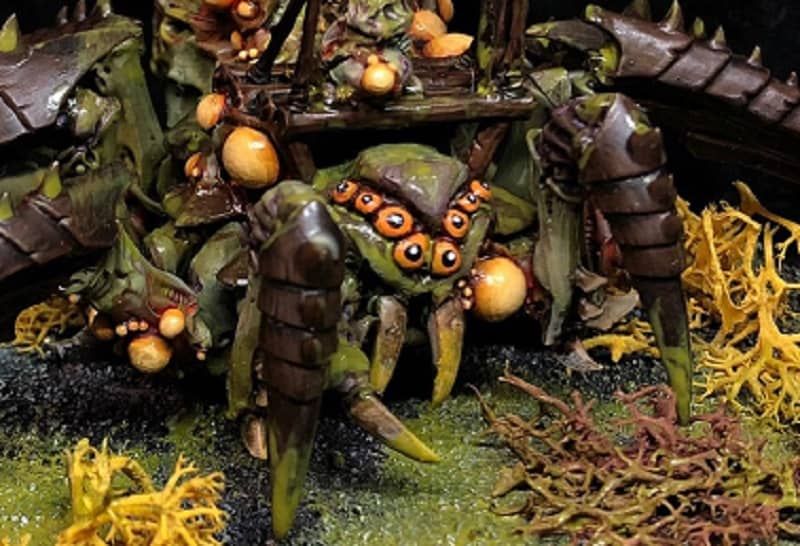
Nurgle, the Plague-King of Angmar, is strongest where minds turn most to thoughts of growth, fertility, fecundity, and the needs of the earth. Though Nurgle-fed pox threatens any dense city on Arda, Nurgle's servants are found more commonly in the countryside. Though few noticed when the lovely Shire almost fell to a Nurgling cult led by the pox-priest Bubo Baggins (I'm really sorry, I couldn't resist...), the prospect of great Ents seduced by Chaos is more disturbing; and the inner copses of Mirkwood are haunted by huge, bloated, pustulent spiders. Every year, the elves of Lothlorien must patrol their borders and cull, weeping, any trees seeded by Nurgle's taint. 


Source: https://spikeybits.com/2019/05/spider-of-the-rot-nurgle-conversion-corner.html


SARUMAN, THE DEATH-KING

Saruman, Nagash, the Bone-White, the Necromancer, Old Sharkey - this Grand Agent of Chaos was among the wisest and (it was believed) the most virtuous of Order's heroes, until he accepted a dark bargain and became the latest avatar to the chaotic energy associated with death-magic. Now, he rules a kingdom marked by no borders but the grave - barrow-wights answer his call in the northwest, tomb-lurkers in Far Harad heed his will, and (the sea-elves say) even drowned legions beneath the sea march at his command. 


FALLEN DWARVES

TBH, I'm not hugely into the current style of Warhammer Dwarves (especially the Fyreslayer dudes, which I've described before as "guys at a nude beach in an Asterix comic." Bring back the classic dwarves, I say - and that means Chaos Dwarves, too!


In the Grey Mountains, the northern Misty Mountains, and the Iron Hills, some dwarf-lords have yielded to Chaos' temptations, and now threaten neighbors in every direction. Fortunately (for the Free Peoples), the reconquest of strongholds at Gundabad and Khazad-Dum occupies much of these foes' attention. 


FOOT TROOPS

Let's assume that there are no Orcs in this vision. Nope, don't need 'em - plenty of beastmen, tzaangors, ogres, trolls, giants, wolves, undead, and human cultists around to cause trouble. Or, if you insist, we'll call GW-style orcs/orks/orruks "funny-looking green beastmen." 


FORCES OF ORDER IN MIDDLE EARTH


STORMCAST 

Ever since the Valar Bent the world, travel to and from the Undying Lands is a dire undertaking. To travel to those lands is usually a one-way ticket; to travel from them is an even greater undertaking. 

The Stormcast are a host of penitent immortal elves, already home in the Undying Lands, who took pity on the kindreds left behind to face Chaos during the Third Age. With the grudging consent of the Valar, the Stormcast project their being from the Undying Halls into Middle Earth, riding lightning bolts that carry the likeness of their will and form. The Stormcast cannot truly be slain, for their actual being remains in the Uttermost West; but with each death in battle and re-projection, it becomes possible to send less and less of the fighter to aid Middle Earth. Thus, Stormcast might fight in a hundred battles for the cause of Order, yet seem to lose more and more of themselves each time. Whether such ordeals can touch the wellbeing of the elves at their source in the West, not even the wise know. 


DEEP ELVES


Set by the Valar as wardens upon the sea, the Deep Elves' task is to ensure that any chaotic secrets drowned in the downfall of Numenor stay that way. Empowered by the Valar to patrol a watery realm, the Deep Elves are seen only rarely on Middle Earth. At times, however, they return to the surface, clad in mystical water-pockets, joining with allies to fight against Chaos. There are those, however, who whisper that even the Deep Elves themselves could be tempted by darkness - or that their true purpose might be to hunt the ancient Silmarils cast into the depths long ago...

Tuesday, July 26, 2022

Painting (another) Kitbashed Chaos Champion / On the new Army Painter Speedpaints

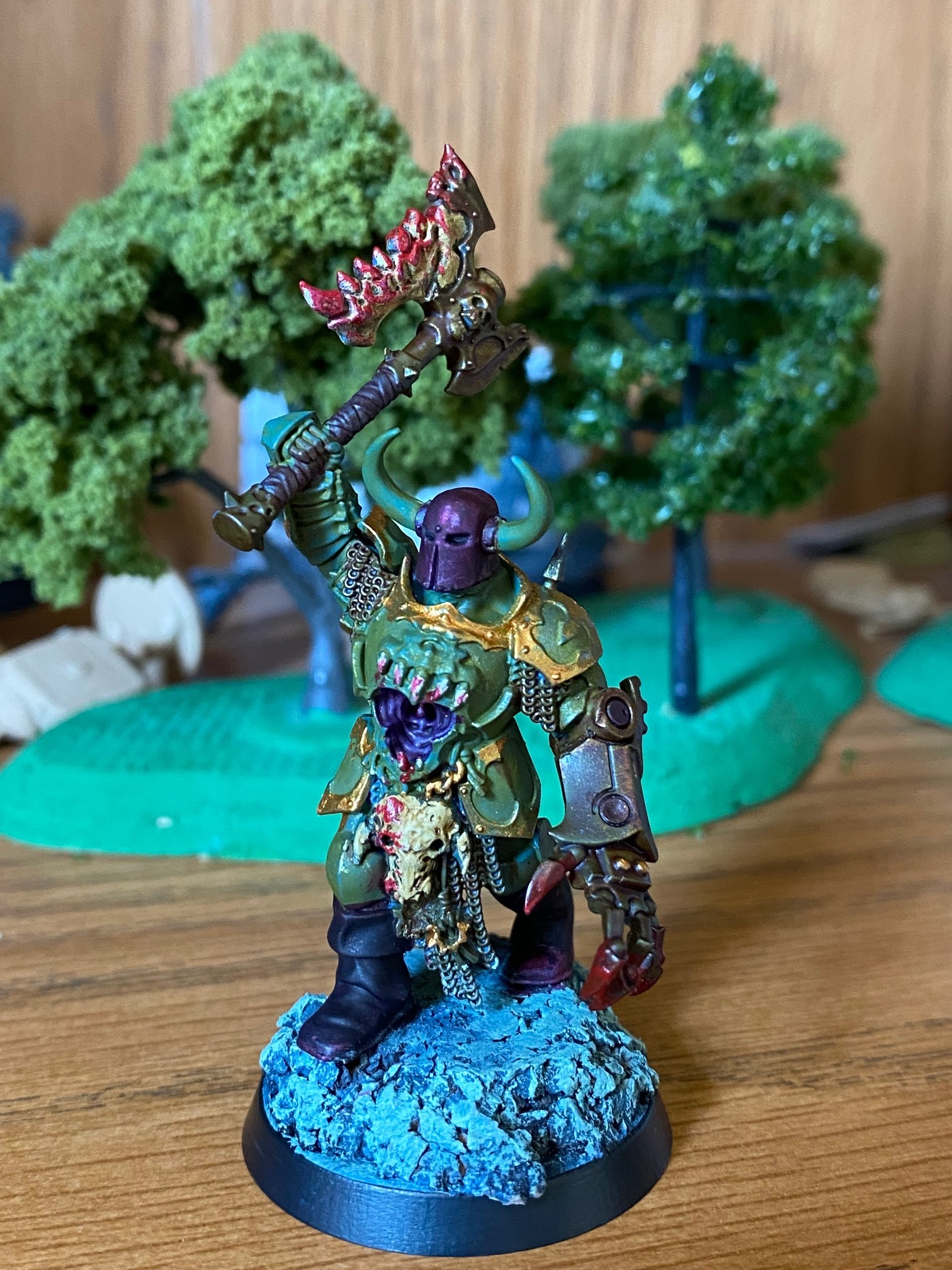
 This past weekend, I carved out some time to attack the 'unpainted' pile. Exhibit A is an interestingly kitbashed Warhammer Chaos champion. I bought this fella second-hand last year as part of an army of Chaos figures that draw heavily on kitbashing with (for example) Stormcast Eternal parts or even bits from 40k. This particular specimen combines a 'Nurgle'-style mutated maw-in-the-tummy with a very sci-fantasy-leaning mechanical claw arm (I'm *still* not sure where the arm comes from; something Necron, maybe?). 

I fancy myself an advanced Beginner painter, or maybe a Mega-Noob Intermediate painter, or something in there. Despite a few missed strokes I'm quite happy with this guy's overall appearance.


This was also an early opportunity to try out the new-ish Army Painter Speedpaint collection, a recent splurge. It seems these speedpaints are taking the mini-painting world by storm, so I have been eager to try my hand at them. The paint-job featured here combines several types of paint. When I acquired the figure, it was already wearing a sort of minimalist blue and gray coat of paint. 


To proceed, I first drybrushed with silver...


...and then got to work, laying down (mostly) speedpaints supplemented by 'regular', metallic, and blood-effect paints for some specific local touches. 


I decided to go for a hint that the guy used his bloody axe to pulp something, used the bloody claw to pick it up, and then fed part of it to the bloody maw in his midriff.
Ah, Chaos champions! No table manners at all. 


One thing that really strikes me is the impact of the undercoat color when using these translucent speedpaints. The green on this champion is 'Malignant Green' (the 'Nurgle' color), but it came out very dark on top of the blue basecoat. The mechanical claw is painted with Stone Golem, and I think it makes a very nice 'dull bronze' look - but it is exactly the same speedpaint color used to paint the bare, white bases on these 'just tabletop ready' sci-fi grunts from Reaper Bones!


...Slapping out three of these Reaper Bones grunts, including pre-work with silver touches here and there, took about 40 minutes total (!). This stuff is great for batch processing units. 

Although I can see that the Speedpaints require their own skillset, I'm quite pleased after my initial trials. 


Thursday, July 21, 2022

Old but (Fairly) Good: AC4, The Book of Marvelous Magic

 I recently picked up a .pdf copy of AC4, The Book of Marvelous Magic [affiliate link], by Mentzer & Gygax (1985). Although I vaguely remember inheriting a print copy of this book as a teenager, this is not a resource that seems to command much attention nowadays in the OSR-ish blogosphere. Although there are some good reasons for the book's present obscurity, there's enough genuine usefulness between the covers that AC4's fairly inexpensive availability on DTRPG deserves more notice. 


So, what is it? AC4 is a collection of magic items, not spells or other magic abilities. It contains "all the miscellaneous magic items that appeared in the Basic, Expert, and Companion Sets" - along with an additional 500 new items. The book is pitched as suitable for both D&D (that is, BECMI) and AD&D; an appendix states that "The D&D and AD&D games are actually different games" - then describes D&D as flexible and open to what we now call hacking, with AD&D too complex to make house-rules prudent. Harrumph. I will return below to the question of using these magic items across different rule-systems.

The book is arranged alphabetically by item type. Refreshingly (depending on one's perspective), this is very far from a list of standard dungeon-crawling items with arcane abilities slapped on. No, this feels more like an array of magical items from folklore fantasy literature, with spools, thimbles, masts, anchors, kettles, and strings concealing their mysterious powers. 

I would group the book's items into several categories. To be clear, some of these are (to me) useless rubbish, so it's the latter categories that really catch my eye:

+ Placeholder references to earlier published material. Ya know, like these:

BAG
Bag of Devouring: See D&D Basic Set.
Bag of Holding: See D&D Basic Set. 

In other words, these entries don't contribute anything, except that they're integrated with new stuff on the book's random-roll treasure tables. 

+ Joke material, often with a long-past shelf life:

The book opens right on this note with the "Alternate World Gate", which could be cool, except that they are a variety of items that port in characters from other 1980s TSR games, like Top Secret, Gamma World, Boot Hill, and Gangbusters

Advisory: puns are also present. 

+ Cursed items. Well, at least we're getting to material that might actually contribute something new in-game. Historically, I have tended to avoid seeding hoards with cursed items - partly because I don't love 'gotcha' games with my players, and especially because I didn't have great mechanical ways to incorporate cursed treasure without making treasure identification a risky drag. (That has now changed with my house-ruled simple 1d6 treasure identification rules, which I find fun, easy, useful, and still respecting of player agency and risk/reward judgments). So, now I'm more willing to incorporate cursed items here and there. There are a LOT of them in this book. Probably far too many, to be honest - and they tend to be sneaky little things that look and initially act just like one of the already-obscure helpful magic items first published here in AC4 (I suspect this means TSR expected, or wanted, players to buy and comb through this GM resource, becoming familiar with the loot they could gain, so that they'd genuinely worry about whether they'd just found a "Cymbal of Crashing" or a cursed "Cymbal of Symbols"). 

Now, look: up to this point, I've been wasting your time in the interests of an honest, comprehensive overview/review. It's the final category that makes this thing worth your attention:

+ Quirky, genuinely useful new magic items. I like that these tend to affect the game's 'fictional positioning', if you will, rather than just slapping some +2s on everything. The items' applicability to the narrative rather than the mechanics makes this book a handy and fairly system-neutral resource. I'm currently running two campaigns: one in the very light EZd6, the other in Pathfinder 2e. I can use AC4 equally well in either campaign! I'm not kidding; here's a magic item that will appear in the dungeon my PF2e players are now raiding:

ARMCHAIR
Armchair #2: Armchair of Relaxing. When sat upon, this item vanishes along with its user, and travels to the Outer Plane. The user is instantly put to sleep and has no saving throw. The armchair reappears in 1 turn and awakens and releases its user; it bestows magical rest, as if its user had a full night's sleep during that period on the Outer Plane. The chair functions once per day.

In use, I'll be making this something a bit more period-suitable than an 'armchair', but the players will have reason to wonder why the BBEG has two separate beds in their bedchamber, and they have been warned by a covert ally 'not to let the leader go to bed.' This requires basically no conversion to run in PF2e. 

Here are a few other magic items that piqued my interest. 

Brooch, Lunar: This piece of jewelry bears the likeness of a crescent moon. If worn by a spell caster, it bestows additional power to any light or continual light spell cast. The light from either spell causes any and all lycanthropes in the area of effect to assume animal form (no saving throw). They remain as animals until they leave the lighted area. The lunar brooch has no command word and operates continuously while worn. 

Fork of Travel: This copper-colored fork may be placed at any intersection, and it will point (on command) toward either the most dangerous, safest, shortest, or longest route, as desired by the user. It may be used three times per day. For answers about distance, the destination must be known and named.

Fishing Gong: This gong has a rune inscribed in its center that reads "Bass." A read magic spell is needed to translate it. If taken aboard a vessel and rung over any body of water that contains fish, the sound causes one fish weighing 1-100 pounds to leap out of the water and into the vessel, landing next to the user of the gong. After cleaning and cooking, each 5 pounds of live fish can be used to feed one person for one day. The gong can be used three times a day. 

September Horn: This horn appears and functions as a horn of plenty. However, except for the horn itself, it also causes all magical items worn or carried to vanish. The items are not destroyed, but merely return to the user's home. The September Horn can be used once per day at most. [Is this a cursed item, or a really useful tool? That depends on the PC's context!]

Nail of Building: If this nail is the first nail used in building a wooden structure made entirely of ordinary wood and nails, the magic nail may be removed after the structure is complete. This removal causes the entire structure to disappear! The nail can then be easily carried about, and when the user wishes to re-create the structure at any given location, one command word causes it to re-appear. The nail then becomes nonmagical. [I really like that this is a one-shot item. If you plan ahead, you can bring your own defensive stockade for that showdown in the dungeon - but only once!].


All in all, AC4 The Book of Marvelous Magic sags from too much chaff, but it also offers many inspiring and fun items that your players can exploit with some creative thinking. At a higher price, this might be a stretch to recommend, but the .pdf is fairly priced at $4.99 on DTRPG.com - and during their ongoing July sale, it's down to $3.74 (affiliate link). If you have a weather eye out for new magic items, this could be worth consulting. 


Thursday, June 2, 2022

The Merovingian Sandbox (continued): the CIVITAS-centered campaign setting

We’re back! Let’s continue my recent discussion of early Merovingian society as an alternative template for a lower-prep ‘vanilla’ fantasy sandbox setting. I’ve suggested at least four ways that Merovingian Gaul is well-suited for that role:

  • it’s a post-collapse points-of-light setting, but with dials for ‘brighter lights’ if you want them
  • greater organic social mobility than later feudal European societies; better-suited for classic PC career trajectories
  • political-social geography that scales up excellently as you build a campaign through play
  • a reusable sandbox - cultural-political assumptions that support effective re-use of the same living campaign world in new campaigns
What that earlier post introduced, this post will flesh out in more detail. Please note that I won’t offer here a comprehensive survey of Merovingian history or society. The comments chain for this series’ initial post offers a number of text/resource recommendations for those who want to dig deeper. That’s partly to preserve my own time, but it also will keep the most widely game-able content front and center in this discussion. As I wrote recently, I won’t be terribly offended to learn about any anachronisms in your elf-game application of these ideas! Just recently, I’ve been running myself through a bit of solo Ironsworn in my own personal example Merovingian sandbox…which is good fun…and I certainly (and deliberately) include some elements that I know perfectly well don’t really belong in 6th-century Gaul. Play on!

Again, my aim is not to perfect historical accuracy in your games, but to inspire you with social-political structures that can make play more coherent and satisfying - while offering a refreshing alternative to the 5,000,003 extant ‘fake feudal’ settings already out there.

Sounds good? Let’s dive in.


THE CIVITAS - YOUR MAIN BUILDING-BLOCK


Today's post will focus on the late Roman and Merovingian-style civitas (to be explained momentarily!). I think that putting this institution at the heart of setting design can make campaigns more interesting and easier to run. To unpack what I'm talking about, we need to get a little technical and discuss the geographical organization of space in late antique and early Merovingian society. 

At the lowest level, the countryside was divided up into pagi (singular pagus) - rural districts (the word is related to modern French le pays, 'country, region' and thus English 'peasant'; our English word "pagan" comes from Latin paganus, "someone who lives out in the countryside" - in other words, "a rustic, a redneck, a hick" - the term 'pagan' reflects ancient urban prejudices, the urban focus of many early Christian communities, and the slower Christianization of the rural population). Out in the pagi, you'd find your little villages, your land-owner estates and various farms, your shrines both ruined and current, maybe an isolated monastery here and there, your mines, various workshops, etc. 

But even though the pagi formed the lowest level of geographic 'building block', it was the next step up that really was fundamental for social organization. 

Multiple pagi together formed the territory of a civitas (plural civitates) - a "city" (sort of; the word is related to Spanish ciudad and English 'city'). A civitas was a city - an urban central space - but it was more than that; the term also encompassed the entire territory surrounding the 'city'. If you're familiar with the large counties and county seats of the western United States, they provide a useful mental analogy: a whole lot of fairly open space administered from a central location. The key thing to understand is that there was a difference between 'urban' and 'rural' space, but the entire thing was the civitas. In many cases, the territorial outlines of civitates still reflected in part the territories of old Iron Age Gallic tribes/polities from before the Roman conquest centuries earlier. So you can translate 'civitas' as 'city' but there's some cause for seeing it as related to tribe, nation, or district (though each such translation would have its own limits or problems too). 

For example, around the year 311 CE - back in late Roman times, prior to Merovingian rule - a resident of the Aeduan civitas (around Autun in modern Burgundy) gave a formal speech to the emperor Constantine, and asked rhetorically: "for which gens [race/people/clan/nation] in all the world should ask to be placed before the Aeduans in love of the Roman name?" As that flowery question attests, a separate identification with one's local territorial name was understood as important, centuries after the Roman conquest, and was perfectly compatible with loyalty to the Roman state. 

The pattern continued into Merovingian times. Here's a key point: for descendants of the Gallo-Roman population living under Merovingian rule, the civitas was a primary focus of identity. To put that more simply, if someone asked you "who are your people?" your answer usually would name your civitas. Yes, you might identify as a Roman (or as a Frank), you might be Christian, but your geographic allegiance was tied to your local 'city'. 

In the wake of the "fall of the western Roman Empire" and the fragmentation of many economic, social, and administrative networks, the centrality of the local civitas provided a measure of continuity despite the collapse. One often reads that "the medieval church inherited and filled the vacuum left by Roman government in the West," but that statement is fairly misleading. Surviving written sources were mostly written by and/or kept by churchmen, so (surprise!) they tend to reflect ecclesiastical or monastic interests. But the glue holding society together owed much to the continuation of local government within the civitates. In fact, as often as not it was the church's own adaptation to late Roman civic and provincial structures that made it a useful part of local administration! (I'll return later to the important roles bishops played within civitates). 

Even as long-range networks suffered profound (but not total) disruption, even as violence swept across much of Gaul, life in many civitates continued apace. The centrality of the civitas meant that peasants still dealt with local landowners, local families still sought advantageous marriages within local social networks, local administrators still collected taxes (and the continuance of taxation into Merovingian times now looks more important than it did to scholars generations ago). It was, now, less likely (though not impossible) for locals to interact with travelers from afar; but they still interacted routinely with fellows from across the same 'city' territory. So you can almost think of the civitas as a kind of cellular organismic structure, keeping life in motion, even when isolated from other communities - like a self-sufficient (if less complex) single-celled organism. 

And that's why the city/civitas is the basic building block for a Merovingian sandbox: just as every complex living organism is made up of discrete cells, kingdoms and large territorial units were made up of, and relied heavily on, individual civitates

Compared to older Roman bureaucratic institutions, Merovingian top-down administration was pretty laughable (though only in comparison; again, modern scholarship has developed more sympathy and respect for 6th-century government). When kings or princes held territory, what that meant functionally was controlling the appointment of administrators at the civitas level, and controlling access to the tax revenues and military recruitment from across a civitas' lands. This isn't too dissimilar from later feudal relationships ("I've little effective bureaucracy, so you send me troops and $$$ when I need them") but there was a key difference: power certainly was personal, but the focus of royal-local relationships retained a wider collective/communal aspect. 

So, if you were a king and you wanted more power and wealth, you wanted more civitates. You could (and some did) launch destructive raids for plunder into neighboring territories, but that wasn't a great long-term solution. What you really wanted was to secure effective control over the tax proceeds of an entire civitas. To do so, you probably needed to start a war, but a scorched-earth war of total conquest would be ... kind of stupid, since it would destroy the very resources you were trying to annex. Better to fight directly against the army of your opponent (or just murder/threaten them) and wrest control of a fairly intact civitas when done. Alternately, you could use intrigue: find some way to subvert those in office at a neighboring civitas, and get them to open the gates to your troops. Bloodless and enriching. 

Who were those office-holders? Rulers typically appointed a Count to oversee a civitas. Above a Count, a Duke might be given authority over a region, consisting of a group of multiple civitates. Altogether, these would make up your kingdom. But there was just one "Merovingian realm" - one of the more curious aspects of Merovingian history is the profound fragmentation of Merovingian territory across "Francia". This, too, is because of the role of civitates. Focused on gaining more tax proceeds, princes often accepted/demanded control of different cities even when they weren't geographically adjacent. This could lead to weird political maps like these: 

Vidal de Lablache, Gaul in 561

...which changed, only 27 years later, to this: 

Vidal de Lablache, Gaul in 587


ALL that colored territory makes up "the Merovingian realm" - but it was divided, again and again and again, into smaller holdings reporting to different members of the family dynasty. Their internecine struggles kept political affairs lively, but the importance of the civitas not only shaped but also constrained (to some extent) the destructiveness of warfare (with notable exceptions...). 


WHAT'S A CLERIC TO DO? CHURCHES AND SPATIAL ORGANIZATION


Alongside, and parallel to the structures discussed above, Christian churches maintained a related territorial system. Little parish churches out in the pagi reported to bishops in civitates. In fact, by the later sixth century, in most cases the location of a bishop's cathedral seat and a civitas 'capital' were usually synonymous. Bishops themselves reported to metropolitan bishops who oversaw provinces, which initially followed the old map of late Roman provinces very closely. The map below, for example, illustrates late antique church provincial boundaries (with one full province, Lugdenensis Prima, highlighted): 

Adapted from Mathisen & Shanzer, Society and Culture in Late Antique Gaul: Revisiting the Sources


In this way, even when old Roman governmental structures fell apart, ecclesiastical networks did continue to keep lines of communication between civitates open. It got trickier when kings nabbed themselves new civitates, so that different bishops across one province oversaw flocks reporting to different kings. This could lead to the creation of new 'chains of command' disrupting old structures. 

Written sources also suggest that kings or their agents often felt worried about the potential for bishops to betray kings. There's a pretty good chance that those suspicions were (usually) unnecessary, but numerous episodes involved some fear that a bishop might open the gates/hand their city over to agents of another king. This sometimes led to violent oppression in which counts attacked, imprisoned, or exiled suspect bishops. Remember the intrigues I mentioned above? Far from being out of the limelight, Merovingian bishops were such central figures in late Roman society that they almost automatically got caught up in the political affairs of the age. 

Ok, whew. That's been a lot of nerdy stuff, hasn't it? Let's switch gears now and talk about applying it all at the gaming table. 


GAMING IT: BACK TO THE FANTASY SANDBOX

If you're still with me, thanks for bearing with all that background. Now how can it help us run a smooth campaign?

+ BUILD IT AS YOU GO: you know that (excellent) advice to start small with a campaign map, and only build what you need? The pagus-civitas-province/region-kingdom spectrum offers a template for building just what you need, but with enough structure for everything to work coherently when you're done. Want to run some Lvl 1 types through a small dungeon-crawl after they tussle with bandits or wolves? Fine, create one pagus - one rural district. Just throw a few small square miles onto paper, with a background awareness that 'somewhere out there' lies "the city" - the seat of the whole local civitas. If you're feeling ambitious, go ahead and name the civitas/city. That's all you need, but if you want more, this whole little area has built-in integration with a larger unit nearby. 

Then, after the PCs have leveled up a bit, have a local landowner or a priest or bishop call them into the local city for help with some urban adventures. Note that the people in power in the city are NOT isolated from the rural districts; their own local social networks demand their involvement all over the civitas, so it's quite appropriate to introduce them as early as you want. 

As time goes on, ambitious PCs might become local landowners, abbots of local monasteries, Count of the local city, bishop or archpresbyter of the local city, etc., etc. But wait, they can't ALL be Count of the city, oh no! Wait - in what's now Burgundy, there is some evidence of the Burgundian kingdom (early contemporaries who fell to Merovingian conquest in the 530s) assigning TWO Counts per city, one to administer 'Roman' affairs and one to oversee the immigrant Germanic Burgundian population. Problem solved. 

Later, you can start branching out into much bigger adventures that require engagement with surrounding civitates. The nice thing about the civitas model is that the whole thing tesselates, while permitting diversity. You needn't know what's over the horizon until you need it, but you know it will follow the same basic pattern of rural districts integrated with a central civitas seat. Who knows what happens next - maybe PCs become Dukes of surrounding regions, or even fight their way into the royal dynasty and becomes sub-kings. 

+ WAIT, IS THIS A FRAUD? HOW IS THIS ANY DIFFERENT FROM ANY OTHER SETTING? Yeah, don't feudal maps also include lots of little villages and some cities and kings who want to squeeze it all dry while still looking good in the history books? 

Yes. But fairly differently. 

As I've discussed before, feudal societies (while very, very diverse) had their own certain logic. 

As an overgeneralization, feudal societies organized space in less coherent ways (I think that's a fair way to describe what I'm getting at). Chartered towns were generally exempted from many of the feudal/manorial land-tenure relations around them. They were, of course, still connected to the land in various ways, but the underlying social structures tended to emphasize difference between rural and urban spaces. In the Merovingian civitas model, rural and urban spaces are more connected by coherent social networks, rather than divided between them. This means that a patron for that dungeoncrawl mission last week is just as likely to want the PCs' help in town, and vice versa. PCs can go back and forth between all the different landscapes of the campaign and become more integrated into society at each step, rather than always drifting as outsiders. There's a certain mystique of the alienated drifter-adventurer that many gamers find appealing, but I suspect this tells us more about our own individualistic society than it does about the past. A Merovingian sandbox offers a post-collapse and often bleak and violent setting, but one where social networks and identities matter. 

As members of the same civitas, starting PCs can be as different from each other as you want, but they retain a common sense of place and a shared identity. They are more or less invested in a community (albeit one with its own, potentially vicious, internal politics). 

HARUMPH, FINE. NOW TALK MORE ABOUT INTRIGUE MISSIONS. Ok, I'll humor you. Although you can just build up your setting layer by layer, you can have even more fun if you decide early on to locate play right on the borderlands. That might mean a B2-style Keep on the Borderlands frontier, but it could just be (or could also be) the edge between two civitates, especially two civitates owing allegiance to different kings. 

In that context, things can get quite interesting, quite early on. 

That landowner you interacted with last session - why is he meeting with warriors from just across the border? Who is framing the local bishop for treason (or is he being framed)? Almost from the start of a campaign, you can weave in a plot to subvert the local civitas and flip it to a neighboring kingdom. How will the PCs react? Will they join the plot, and profit? Will they stop the plot, and secure favor from their own Count or King? Shenanigans ensue, with plenty to do for Fighters, Thieves, Rangers, and Clerics. 

DIDN'T YOU SAY SOMETHING ABOUT RECYCLING YOUR CAMPAIGN SETTING? Yep. Let's say you try this out, and you like it. You run an epic campaign after which your players have become Counts, Dukes, Metropolitan Bishops, and even Queens or Kings! Nice. Now those characters have left their fingerprints all over things. What if you've invested lots into the setting and you'd rather not reinvent the wheel for another campaign? 

Remember how I showed two maps above that illustrated shifting royal borders in just a few decades? 

Unlike later European generations that favored primogeniture (the firstborn kid, usually male kid, inherits everything), Merovingians practiced partible inheritance - chop that property up, and give a bit to all the heirs! This is why the political map looked so fractured, even though a single Merovingian realm theoretically existed. Periodically, a strong ruler did emerge to consolidate that whole realm into one big territory. No big deal - upon that strong ruler's death, the whole thing was liable to get chopped up once again. 

This means that, in a Merovingian-inspired sandbox, you can have characters achieve profound glory by conquering or consolidating the entire realm, but you can count on cultural practices dividing everything back up again within a few generations. So long as you maintain the same basic cultural practices and civitas identities across your setting, you run and rerun and rerun the same setting, a couple generations later each time, without retconning or pretending away the achievements of an earlier group in play. 


OK - I'm going to stop here for now. There's loads more I could discuss, but I'm not sure whether any of this is making sense or seeming compelling. What should I clarify? What ideas have I sparked? Does this all make sense? I'll find out - if you comment.

Happy gaming!