Monday, December 20, 2021

What If (All?) Secret Doors Were (Obviously) Trapped?!?

 Here's a weird idea.

(It's final-exams grading/marking season for Professors ... which makes chatting about a weird gaming idea much more appealing than trying to cram in yet another student paper right now). :-) 

Last year, I posted an idea about secret doors in dungeons that seemed to go over well: what if (almost) all secret doors could be detected automatically, but risking the necessary time/encounter checks to figure out how to open them offered the real challenge for dealing with such concealed portals? 

Anyway. As one does, I recently read another blog post about managing TRAPS (and for the life of me, I'm sorry to say, I can't even remember which blog it was, let alone whether this was a recent post or an old one. Finals-exam season brain, I'll conveniently blame you again). That post talked about making traps obvious, automatically detectable, so that figuring out how to deal with the trap (without just rolling to disarm it) was the challenge. [Of course, this is an idea that many people, including Chris M, have written about too]. 

[EDIT: I think it was a now year-old Ben Milton/Questing Beast video, titled "Stop Hiding Traps!"]

Tonight's idea: what if you combined both of these, like so...

COMPREHENSIVELY TRAPPED SECRET DOORS

1) With their keen eyes and instinct for [getting themselves in] trouble, adventurers usually have no trouble picking up on the subtle clues that point to concealed doors or hatches. If the party spends a full turn exploring a room, they automatically detect any secret or concealed doors therein

2) Pesky dungeon-builders know how inconvenient adventurers can be, and they plan accordingly. All secret doors have a 50% chance of being TRAPPED. [Or, enter your own weird edgy version here. I'm particularly thinking about: what if ALL secret doors were trapped, without exception? And what if hardly anything else were trapped? "The trapped door" luring players on to hidden treasure would become its own dungeon-locale motif. Huh. ].

3) Make the existence of a secret door and a trap on said door obvious to PCs, and then let them act as they see fit. Traps must be navigated, defused, mitigated, dismantled, or endured through fictional manipulation, not nerfed through dice rolls. 

4) Remind players that secret doors usually hide juicy things, like treasure or new dungeon levels. Cackle as they die in terror. 

YEAH, BUT, WELL, WHY?

Shrugs

Actually, I think this could do some interesting things. It offers a non-mechanical, non-gamist (if you will) way to address the problems I mentioned in my post last year about secret doors (minor details like prepping cool hidden content that likely won't get discovered ... or running modules with no detail on these important hidden doors, etc.). 

Now, running things this way also ADDS work. You need some coherent traps, with clear mechanical function, and ways to signal those aspects to inquisitive players. 

But you'd gain ... oh, I don't know, I'm sort of spitballing here. But you'd gain a recognizable signature aspect to dungeons - the players will learn to love the lure of more-exotic treasures in hidden halls, and they will learn to dread the sting of mis-handled traps, and they will have a clear incentive/risk-reward balance to think through, letting them decide whether to bother with trapped doors or not. 

IMPORTANT LEGAL CAVEATS

I'm not a lawyer, and I didn't sleep at a Holiday Inn Express last night. I'm not saying this is a good idea, mind you, but it strikes me as offering some intriguing possibilities. 

That is all. A few ungraded papers still beckon, mockingly...

Saturday, December 4, 2021

A Checklist for Designing a Faction's BASE or LAIR - Infrastructure for Goals, Needs, Conflicts.

Here’s a set of ideas to support faction “base” design. 

The caves from Keep on the Borderlands are infamous for hosting a bunch of factions' lairs in the same neighborhood, with little coherent sense of how they'd all coexist. The tool below offers a quick way (I hope quick?) to think about the scope for conflict or cooperation between the lairs in an area, or to make such lairs individually feel more sensible.

A post yesterday over at The Wandering Gamist suggested a One-Hour Dungeon contest (instead of the ubiquitous one-page dungeons), with an interesting note:

Even if the products themselves end up not being very interesting, I could see such a thing leading to the development of tooling and processes optimized for saving time.

That got me thinking about some ideas I'd never properly written down or posted earlier this year: a mission-based adventure generation table, and a way to speed up good base design. Well, now I have, at least for the second part. You might use this with a blank piece of paper, or you might take a random map or even re-key a description from a module, and use the checklist to verisimilitude or hooks for interaction. This checklist assumes that the area being designed (which might be aboveground, or be all or part of a ‘dungeon’) is controlled by a basically coherent faction, or part of a faction, acting in (mostly) coordinated ways. 

This has probably been done before somewhere else, and likely better, but it was on my mind. Please let me know if it's helpful.  

Again, the goal here is to speed up lair/base design while promoting a realistic ‘dungeon ecology’ that is exploitable and open to conflict with other factions. 

I think this would be most useful when paired with two things.


First: Instead of keying each dungeon/lair/base room separately ( a bottom-up approach), consider starting at the top and thinking like a faction leader. Create an Order of Battle for the faction: how many guards or other personnel do they possess here, in total? Now, as you answer the questions below, break up ‘your’ guards into little squads, and assign them to logical places on the map, according to the logic of this current faction’s needs and goals. 


Second: I am a big fan of the ‘fill in the blank’ faction design method. I didn’t design it myself, and alas, I can never remember which blog I got this from, but it’s really smart. For each faction, just ‘fill in the blank’:


FACTION _____ wants GOAL _____ but they face OBSTACLE ______, so they will PLAN _______. 


The checklist below highlights base-design aspects that might bring a faction into conflict or cooperation with other factions. One can probably get a nice hornet’s nest of tension just by designing two or three faction bases near each other, making sure that their infrastructure needs conflict. This is, of course, before one starts adding more arcane, fantasy-themed goals, like finding the skull-stone of Arbat before those hobgoblins can summon the End-Storm. 


Alright, here we go. No doubt, this isn’t comprehensive and could be refined, but I hope it aids in thinking quickly and realistically about lair design. 


FACTION-OCCUPIED BASE/LAIR-BUILDING CHECKLIST


How does the Faction use this base?

+ permanent major base

+ permanent minor outpost, subordinate to a bigger base somewhere else. 

+ temporary or occasional major base; the faction head-honcho is here, but the group moves regularly. 

+ temporary or occasional minor outpost

+ temporary/emergency shelter or outpost; they didn’t expect to be here long…what kind of trouble brought them, or is keeping them here? 


A permanent site, especially a major base, should have a stable solution for every one of the needs listed below. At smaller sites, or at temporary and emergency sites, a faction may be making do with some of those needs unmet. This may create opportunities for inter-faction conflict or cooperation. 


Why is the faction using this base? (Likely, one or more reasons apply) 

+ We need a place to live or shelter

+ Projecting power in the region (or displaying/claiming prestige)

+ Controlling movement in the region

+ Gathering information from the region

+ Securing access to raw resources in the area

+ Enabling access to trade

Performing religious/cultural rituals


How does authority work here? Who is in charge, how does the chain of command work, and how effective/stable is it? 

Which 3 NPCs would most disrupt the faction/setting if they were killed, turned as double agents, compromised, captured, set free, etc.? 


What is the source of AIR SUPPLY?

I suggest using this one very sparingly. Caves often have quite good air, and being able to breathe is an essential element for most fantasy locations. However, some underground locations do run into fresh air-supply problems, whether due to poor ventilation or off gassing from minerals and substances beneath the earth’s surface, so - once in a blue moon - this could be worth adding as a wrinkle at a faction’s base. 


What is the WATER SOURCE?

  • A well, lake, or running water, inside the base’s controlled perimeter. Mark it on the map. Note: this could offer a way in/out. 
  • Some sort of aqueduct carries water from outside the base to inside. This is like the option above, but the aqueduct might be vulnerable to sabotage or infiltration. Some potential for INTER-FACTION conflict. 
  • A well, lake, or running water, outside the base but nearby. Note: open to INTER-FACTION conflict. 
  • A well, lake, or running water, at some distance from the base. Note: open to significant INTER-FACTION conflict.  
  • Silly, this magical faction has no need of water.


What is the FOOD SOURCE? 

  • Food is produced or harvested within the base. Mark it on the map. 
  • Food is produced or harvested near the base, by personnel under the base’s control. Mark it on the map. Open to some INTER-FACTION CONFLICT.
  • Food must be imported from far away, or is provided by persons not under the base’s control (through trade, for example). Open to INTER-FACTION CONFLICT. 
  • Silly, this magical faction has no need of food.


How do they handle their BODILY WASTES?

  • They don’t. Waste is strewn willy-nilly throughout the base. The whole place is a reeking cesspool and likely a disease haven. 
  • Ye olde chamberpots. Bodily wastes are carried in small batches and dumped. Dump sites may be spread across a zone (like at the bottom of perimeter walls and beneath windows) or in a specific designated cesspit. Mark these spots on the map and describe them appropriately when PCs move nearby. 
  • Ah, toilets. There are designated latrines. Where does the outflow end up? If it stays in one spot, how soon will it fill up? 
  • Question: does the location for bodily waste removal affect the clean water supply, or not?
  • Special option: historically, some communities transferred their own bodily wastes into fertilizer. Does this group do so? Where is it processed? 
  • Fantasy waste engineering. Perhaps the faction controls a waste-consuming device (sphere of annihilation) or creature (otyugh, ooze) that helps eradicate waste over time. 
  • Silly, this magical faction produces no bodily wastes. 


How do they handle their NON-BODILY WASTES?

  • See all the options already listed for bodily wastes for possible reference. 
  • The faction continually dumps into a trash midden. Mark it on the map. If it is outside the base perimeter, there is potential for INTER-FACTION CONFLICT.


What are their LIGHT SOURCES?

  • Perhaps this faction has no need of light. Be afraid. 
  • They rely on natural ambient light from outside, at least in daytime. Mark the openings on the map; these could allow ingress. 
  • They have magical illumination methods.
  • They burn fuel for light: oil in lamps, torches, logs in braziers. If they burn stuff inside, and you feel like being realistic and nasty, think about ventilation and air quality, smoke obscuring vision, and the risk of fire spreading. 


How do they get IN/OUT?

  • There’s only one way in and out. Mark it on the map. Is the entrance concealed? 
  • There are several ways in and out. Mark them on the map. Are any concealed? 
  • There are several ways in and out, but the faction running the base doesn’t know about all of them. Mark them on the map. Now, this is getting interesting. 
  • Don’t forget that water sources, light sources, and air sources may provide additional portals.
  • Speaking of portals, maybe there’s a magical way in or out. Mark it on the map and make up something weird about it.


What are their SECURITY MEASURES?

I recommend combining these options with a fixed Order of Battle for the faction. 

  • Sentries are posted at known entrances, and perhaps at key internal chokepoints or sensitive areas. Mark/key them on your map. 
  • Alternately, perhaps security is poor. Minor entrances are minimally guarded or unguarded. Doors are locked but not staffed. Etc. 
  • Roving patrols. Put them in a random encounter table, or mark their routes on the map. 
  • Think about which areas are under visual or other surveillance. Mark them as needed. 
  • Who provides security? Does the base’s faction leader have definite control over them, or are there outsiders or insider power struggles at play? Major opportunity here for INTER-FACTION CONFLICT. 
  • In the event of trouble, where will personnel go? Is there a fall-back point established, or a secondary line of defense? Do some residents head for emergency shelters? What would it take to provoke a full evacuation? 


(How) do they MAKE OR REPAIR TOOLS AND WEAPONS? 

  • They don’t, at least centrally. Each faction member fends for themselves with DIY repairs as needed. 
  • They have an armory, forge, workshop, and/or similar centers. Mark them on the map. But what about raw materials?
  • Necessary raw materials are mined/harvested/whatever on the base. Mark where. 
  • Finished goods, or raw materials for the faction’s use, must be shipped in from outside. Lots of potential here for INTER-FACTION CONFLICT. 


(How) do they address RELIGIOUS or SPIRITUAL concerns?

  • They don’t.
  • Their practice is highly individualized, and/or does not fundamentally affect the base’s spatial organization.
  • They frequent one or more cultic centers (mark them on the map). What happens here, and how often? Examples might include prayer-council chambers, sacrificial wells, meditation chapels, etc. Do these practices require a supply chain, or affect other FACTIONS?
  • Their beliefs/practices have a significant effect on spatial or social organization. Perhaps entire areas of the base are subject to unexpected taboos or rituals; perhaps traffic patterns across the base are constrained by ritual needs (example: to cross the central plaza with the statue of Ol’Thakob, they must crawl on their bellies…so maybe they tend not to cross it. Or maybe they cross it ten times a day). Perhaps different areas of the base are more or less crowded at different times of day/night. 


Some other things to consider:

  • What do they do for entertainment, and where?
  • What do they consider luxuries, and (how) do they access them? Who controls that access?


Saturday, October 9, 2021

SWORDS ARE NO MORE USE HERE! (Monster ratings, damage limits, and a rules-solution in search of a problem?)

"SWORDS ARE NO MORE USE HERE!" Thus warns Gandalf in an iconic cinematic moment. Ai, ai, and alas, for those words are not actually uttered at the Bridge of Khazad-Dum...in the novel. But they sure make a memorable line in the movie. Well, the sentiment is clearly present in the book; Gandalf does caution that "This is a foe beyond any of you. I must hold the narrow way."  And a bit earlier, before the Balrog reveals itself, Gandalf says this about an indirect encounter with the thing: 

What it was I cannot guess, but I have never felt such a challenge. The counter-spell was terrible. It nearly broke me. ... Ah! I have never felt so spent, but it is passing ... And now what about you, Frodo? ... I feared that it was a brave but dead hobbit that Aragorn was carrying. 

Gandalf and Frodo together - one of Middle Earth's mightiest, and one of its weakest, in the same party. But what sets them apart - for that matter, what sets apart Gandalf even from Aragorn or Legolas - is not merely a greater number of Hit Dice. Gandalf can face the Balrog only because he operates on a qualitatively higher level of power than his companions do, and therefore he must face the Balrog alone. 

In the rules-light horror RPG Cthulhu Dark, "If you fight any [Mythos] creature you meet, you will die. Thus, in these core rules, there are no combat rules or health levels. Instead, roll to hide or escape." That's certainly a decisive way to handle different power levels - Mythos creatures are so far beyond mortal humans that confronting them with violence means you automatically lose your character. But it's a Cthulhu game, so you're going to have to face Mythos creatures ... you just won't be able to face them. Run from them, maybe try to trap or contain them, what have you ... just don't ever, ever expect to win fights against them. 

Hmm. 

Earlier this year I wrote about an odd little game I wrote for really, really fast adventure resolution. One element of that game is its monster rating system, something I initially developed for when I run FKR-ish or freeform games. It's a relative ranking system with seven "Force" levels from your setting's weakest to strongest foes (in freeform gaming, it helps me determine whether either side in combat gets an advantage, and how significant that advantage is; it's as much a heuristic device as a numerically mechanical one). Here's how I described it a few months ago: 

There are no Warrior Stats for Level 7, because Player Characters max out at Level 6. I may still tweak the Fighting Levels chart, but as initially imagined, you flesh it out by placing peasants, goblins, etc., at Level 1, and then placing the most dangerous kind of opponent possible in your campaign setting as the Level 7 standard. The ratio between the numbers might need to be tweaked from campaign to campaign; the chart above doesn't have a really high power curve, but it's trivially easy to create a higher range by boosting these numbers - or just continuing the scale past Level 7. If I develop these rules any further, that's probably one of the things I'll keep tweaking. 

This works well for some campaigns, but it would stumble quickly if I wanted to emulate a more typical D&D campaign's wide range of monster threats. Consider 4e, for example [ALERT / HERESY / ALERT], with its monsters strung across almost 30 levels in three tiers (Adventurer/Heroic/Epic). 13th Age did something similar. Even a freeform evocation of that kind of system arguably calls for a more granular scale. 

Now, one way to handle that is brain-smackingly simple: just keep using the extant monster levels (or hit dice for other games) in comparison with character levels. And that's probably the right idea. But I have been struck by an idea, inspired in part by Cthulhu Dark's insta-kill rule and 4e/13th Age's 3-tier system. I think this could be helpful, though maybe this is a solution in search of a problem. You tell me! But I think this could simplify some things while offering a few concrete game benefits. 

Here it is. 


MSIU&U THE RPG: MAKING SWORDS INTERMITTENTLY USEFUL AND USELESS 

Across whatever level range your game stretches, divide those levels into three tiers (and call them Adventurer / Heroic / Epic if you want full credit as a filthy heretic). Assign monsters of the various levels to those three tiers. 

If you directly engage a monster from a higher tier in combat, you die. Blame your poor life choices and roll up a new character. 

If you have advanced into Heroic or Epic tier and you directly engage a foe of a lower tier in combat, you automatically kill or incapacitate that foe. 

Or, do you want a slightly more nuanced version? 

Advanced Idea & Dragons, 2e: If you engage a higher-tier foe that is just at the bottom of its own tier class, you may fight it, but if it lands a single hit on you, you die. Vice-versa for engaging lesser foes at the very top of the tier below you; you need just one hit to kill them (like 4e minions), but they can fight you.  


BUT...BUT...WHY? AND WHAT ELSE CAN WE DO WITH THIS? 

Now, one possible effect of doing this is that you radically truncate the mechanical ranges needed for a system to work, while retaining the wild, almost bloated power-range of d20 game bestiaries. You need a small range of numbers tailored to your characters' current status in the world. Everything else is beneath them - or way beyond them..."swords are no more use here!" stuff! 

Into the Odd's advancement scheme takes you from level 1 to 5. The expectation is that you can retire (most likely) if you make it to level 5 (not likely). The game employs a fairly tight hit point progression for PCs (another d6 per level, if I recall correctly). The game also offers hardly any leveling-up mechanical benefits beyond hit points, though there's an expectation that in-play circumstances will be changing your character diegetically. 

I'm imagining a triple Into the Odd campaign, but with some extra class benefits.

Run to level 5 as normal - using 'Adventurer' scale monsters as the primary threats (though feel free to throw in higher beasties too, and telegraph that the characters need to run away in terror). 

If someone makes it to level 5, they can level up to 6 - or, rather, "Heroic level 1" - reset their hit points as a level 1 character. Only, now, they're mostly immune to Adventurer-tier threats. If they live long enough toe make it to Epic tier, they will once again drop down from 5 or 6d6 hit points to 1d6 hit points - but this time, they'll be functionally immune to Adventurer AND Heroic-tier threats, and they will be sweating bullets in their initial encounters with cosmos-shaking Epic-tier threats. 

One complaint often lodged against 4e D&D is that the levels go up and up but the hyper-balanced combats create a kind of treadmill feeling; you're always slogging away with relatively similar threat levels. 

In the version I'm suggesting here, instead, you have a meaningful progression from zero to hero at EACH tier level, followed by a period of fresh terror as you learn to navigate the threats of a whole new tier of adventure. 

Huh. I'm sorta spitballing here, but I kind of think this idea could have some potential, whether for Into the Odd or some other rules-light system. Has it been done before? It seems so simple that I assume someone's tried this before. Any thought/experiences, o gentle reader? 

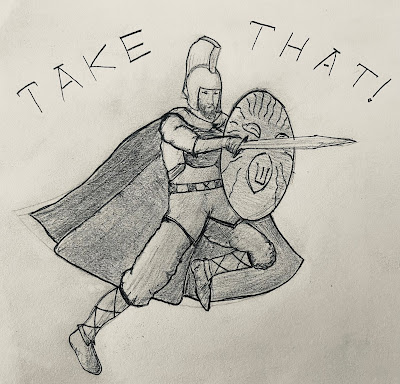
TAKE THAT! Another drawing, and another sale

At it again! I am really trying to get a bit more drawing in these days. I've always enjoyed it, and I suppose I entertain dreams of illustrating my own hobby work someday. I'm in a funny place of being keenly aware of how much I need to improve, while enjoying signs of improvement as I go. 

For today's figure, I wanted something with more dynamic movement than in my previous (hobgoblin) picture. This guy is bonkers anachronistic - the pants and shin ties are medieval Russian, the round chest-plate is from Iron Age Spain, and I guess the cape is straight DC comics. A perfect fit for the average D&D session, then. :-) Anyway, I had fun making this fella. 


Meanwhile - while you're here, please note that DriveThruRPG.com has a big sale running on indie game products. My Brazen Backgrounds (Bronze Age character background generator) and Hunters & Highwaymen (30 interesting NPC encounters for the dark woods or the taverns in them) are both on sale (note: affiliate links), as are many, many good and helpful products by small-press authors and designers. For example, I just picked up Kent David Kelly's CASTLE OLDSKULL - The Book of Dungeon Traps, which looks like it may offer a helpfully different approach to traps tailored for different party levels (another affiliate link). 

 Thanks for all the support! Happy Gaming! 

Saturday, October 2, 2021

Hobgoblin Attacking ('art')

 I am trying to get better at drawing figures. I recently slapped out an orcy/hobgobliny figure in a few minutes, and thought it was decent, but recognized that a better anatomical awareness would have helped. Enter the magic of "Magic Poser" (what a name!), a nice free online tool for posing anatomical figures for sketching. Today I tried again. The page isn't cleaned up (you can see some erased earlier marks and what-not below) but I like this fella. Well, I'm not sure I'd invite him to my next picnic, but...


Tuesday, September 28, 2021

[REVIEW] SPACE WEIRDOS: A SKIRMISH HEARTBREAKER - get your off-brand NecroQuisitorGraveFlyWars action on!

 SPACE WEIRDOS: A SKIRMISH HEARTBREAKER is a fun and inexpensive new set of miniature skirmish rules by Casey Garske, author of the "DOOM"-like military Sci-Fi RPG hack, STAY FROSTY.  For Space Weirdos, think Necromunda-type games, but simpler. A lot simpler. The game is sold as a 16-page B&W zine in .pdf on WargameVault, sister storefront to DTRPG.com, for $4.99 USD. [Affiliate link] With purchase, you also get a 4-page supplement with some nice dedicated rules for playing solo. 

DISCLAIMERS: I received a free copy in exchange for an honest review. This review is based on reading the rules, playing two games using the solo rules, and engaging a bit with the author and the game's community on Discord. The link above to purchase the game is an affiliate link, which helps support this blog's activities at no added cost to you - thanks! 


SO ... WHAT IS THIS? 

Well, that cover art sets the tone right away: zany sci-fi action with guns and swords and hideous beasties, not tied to any I.P. line, with a decent amount of polish but lots of room for hacking in your own ideas, too. Garske's short introduction is worth quoting to sum up the game's intentions.

SPACE WEIRDOS is my "Skirmish Heartbreaker." ... a lot of old school D&D people are discovering or re-discovering miniatures wargaming and starting to write rules when they find the big name games too expensive and convoluted. So here's my heartbreaker. ...

More than anything, the goal of this game is to get your minis on the table and killing each other. Break out your oldhammer, your newhammer, your Blanchitsu and Inq28's, your kitbashed Heroclix, the weird 90's minis that you don't remember what game they're from anymore...whatever you got, and get Weird.

So that's pretty straightforward; this is another way to grab some eccentric models and get going (so, a Blood Angels Chaplain, a Wookie, and a Dalek walk into this bar...). Honestly, I think the self-effacing talk of 'heartbreakers' is under-selling the game a bit. The intro initially makes it sound a bit like Garske just discovered wargaming but knows how to do it better. :-) Except, of course, all those references to Inquisimunda-type games sort of give the truth away, right? Indeed, Garske's obviously no stranger to different approaches to pushing minis around a table. Again, from the introduction: 

Some games might aspire to minimalism and totally get rid of anything that might require a token. Some games are more simulationist, with lots of modifiers and rules for all situations. Space Weirdos is sort of in the middle, leaning towards minimalism, but not totally embracing it. There are a couple tokens to use, there is measuring, but it's easy with the sticks, and there are modifiers, but it's fun because you get to use all your D&D dice.  

Space Weirdos immediately makes me think of the venerable, original Rogue Trader that got the 40k line rolling so many years ago - but a far simpler, 16-page pamphlet...So, don't think of the stripped-down detail evoking a certain company's official product line in Grimdark Future Firefight; instead, think of Craig Cartmell's old, delightful faux-40k skirmish game, In the Emperor's Name (Space Weirdos is even less detailed than ItEN, but if my memory of ItEn holds, Weirdos is more dynamic and tactical). The use of diverse polyhedral dice reminded me of Pulp Alley (Space Weirdos omits any narrative elements baked into the rules, but Space Weirdos is less fiddly, and I prefer its combat!). Space Weirdos (as written) won't give you the campaign-able richness of (relatively) more detailed games like Five Parsecs from Home or the recent Stargrave. Space Weirdos is more suitable for hot one-shot games (unless you want to hack in your own campaign system), but what it lacks in detail it compensates for in an elegant, fast to-the-table and even faster on-the-table system. 


WELL, OK THEN ... HOW DOES IT WORK?

The first thing to know out the gate: this is a deliberately simple game offering a good and flexible chassis to support further tinkering if you want to add stuff. The game plays well RAW, but this sort of game isn't meant to offer a million bells and whistles. What impresses me about the design is how flexible and elegant some of the core design choices were. It's simple enough that I'm going to have to think carefully about not giving away the game rules in my description of them. :-) Actually, that's probably not even too much of an issue; what works best about this game isn't Rule X + Y, it's the ways the simple rules interface with each other and with a judiciously limited battery of special conditions and choices. 

The game does use points for force creation (with no pretense of perfect balance), but designing a new soldier for your gang is quite simple; in fact, as-written, the rules limit your choices so designing your team is quick and emphasizes a key concept or role over endless fine-tuning. If you don't want to mess with points, there's also a page of sample gangs/warbands suited for a variety of iconic sci-fi settings, from hard-shelled alien bugs feasting on colonial marines to battle nuns vs forces of "Xaos" in a grim future, or cyber-rigged punk ladies fighting steroid-juiced gangers (ahem...are Houses Escher and Goliath in...the...house?). If you do take the (brief) time to design your own warband, you'll find very simple but evocative key attributes to distinguish your warband from others. I mentioned limits, up above...most non-leader figures only get 1 missile weapon, 1 piece of special equipment, etc. (Isn't half the fun of these games tinkering with your squad creation? Sure, but Space Weirdos opts instead for more iconic warbands that will actually get on the table sooner and feel different in play). Well, a Cyborg gang can choose an extra piece of equipment per figure. A gang of Soldiers get Heavy Armor, Grenades, or Medkits for free. Lots of different ways to create diverse gangs, quickly. Your limited weaponry choices will have real effect, however, with (for example) one kind of gun being more reliably accurate, while another hits harder. 

Depending on the size of scrum you want to play out, you'll end up with a small handful or a large handful of these 'heroes.' Here's what a 'character sheet' looks like: 


The use of polyhedral dice stands out at once. Stats are rated at d6, d8, or d10, but a variety of tactical effects and command choices can raise them up to d12 or drop them down to d4 during your turn. Worth noting: you need two of each of these, but combat rolls are opposed, so convenient play calls for at least 2d4, 2d6, 2d8, and 2d10 per side (along with a single d20 for AI activation, if you use the solo rules). 

2x2' or 3x3' is adequate for a battlefield (I used one of the new Warcry 22" by 30" battlemats). 

Speed and Actions are nicely done; all figures get 3 activations per turn, and Speed tells you how many of those activations can be used to move; Actions describes, basically, the rate of fire of each weapon (so the auto pistol listed above could fire three times, should Velda Dark spend her entire turn blasting away at someone in LOS). All movement uses 5" sticks (though if you already have 6" sticks lying around for another game, as do I, it shouldn't hurt anything to use them consistently instead). Weapon range is essentially unlimited (I am so glad to see this becoming more common in skirmish shooter game design), though a few smaller weapons do have a penalty to shoot past 1 movement stick. 

No IGO-UGO here - except for the solo rules, kinda; in the normal competitive mode, players roll off to win initiative, and then take turns with alternating figure activations. So you'll need to stay at the table instead of going for more chips and calling your Mom during the enemy turn. In fact, stay as close to the table as possible, because gameplay is dynamic. Combat rolls are opposed (roll to hit, then roll on a hit effect table that can be modified by really high to-hit rolls, but can also enable enemies to fire back in a little firefight!). What's more, each commander has a very small pool of command points. 

I really liked the way the game uses command points. 

I am increasingly dissatisfied with any shooter skirmish ruleset that ignores things like overwatch or suppressing fire. No need for perfect simulation (!?!?) but let's try to include some element of that, no? Well, Space Weirdos lets players spend a command point to take a shot on overwatch. In other words, every one of your figures is ALWAYS potentially on overwatch, as long as you've got command points left to spend that turn. This keeps an important tactical element in play, without any need to sit around thinking, umm, should I put this guy on overwatch, or that guy? But it's a tradeoff, because those command points are good for lots of other things, too. Dodging into cover; pushing to move just a little bit faster; shooting a little straighter; etc. Or, if you've finished the turn and never found the right way to spend 'em, you can cash in any remaining command points to better your chances at seizing the initiative on the next turn. Your pool of command points is quite small, making each use a deliberate and precious statement about your tactical priorities. All this means a really simple, one-brain-cell command and control system that nonetheless keeps the player engaged in meaningful decision-making throughout every part of the turn. Nicely done, Garske. 

Oh...except that if you're playing the solo rules, and the enemy have a psychic champion who is out of LOS and keeps rolling well and keeps stealing your command points with a psychic disruption cloud...then you just gnash your teeth. No bitter personal experience there. Nope. 

Yeah, there are psychic rules. Or should I say rules for psykers? Like everything in Space Weirdos, those rules are compact and limited, but also effective and highly evocative. Psychic powers are really fun and powerful, but also risky; roll too low, and face a psychic backlash on your own figure. 

Tokens: yeah, the game uses some tokens, but I think the author's claim is accurate: it uses just enough of them. Mainly, these track movement rates (this felt a bit fiddly at first, but the tactical payoff of tracking movement becomes clear as soon as you break into combat). Downed and Staggered markers also help keep track of wounds (but also incorporate a very basic Suppression system). 

The game includes three different scenarios (and four in the solo rules). Of the solo scenarios, some options keep a fixed number of opponents on the board, and others allow for enemy reinforcements to keep cycling into play. That offers a range of play-styles, but do be aware that scenarios with enemy reinforcements can take longer and become a bit of a grind (that's no fault of this ruleset, but in my experience, it's just a consequence of that kind of scenario. They just take longer to play out). 

So about those solo rules...  The dedicated 4-page solo expansion offers a LOT more than just "um, try to think about the best move for the baddies." The solo rules rework a few of the core game's rules, offering a different turn structure (figures near your leader move, then the opponents go, then the rest of your force activates). They also rely on 7 different kinds of Bad Guys - 'classes' if you will - ranging from grunts and goons to "bigguns," "big shooters," and "psychics." The game's Discord page includes sample themed warbands created by fans - like a Tyranid list and a Chaos Cultist list with stats for troops in each of these 7 categories. The best part of the solo rules comes in a page of dedicated activation tables, one for each of the 7 Bad Guy types. When you need to activate an enemy figure, check whether it's in LOS, out of LOS, or in contact with one of your figures; then roll a d20 on the relevant table, and follow the instructions. Those instructions are tailored for each troop-type's expected range of behaviors, and they offer a pleasing range of unpredictable but basically plausible AI actions. That cultist around the corner might hunker down, cowering, or it might rush around the corner in a sudden charge...or something else again...

For my two games, I actually used the solo rules for cooperative play, by splitting a pool of 3 command points among 3 friendly players. It worked fine. 


SOME ASPECTS THAT STOOD OUT TO ME...

- Again, the gameplay feels very dynamic and tactical. You're always involved (dividing the force in 3 for co-op play weakened this aspect a bit, but not too much), and command points elegantly handle things like overwatch. Suppression is kind of handled by the fire effect tables (there's some small chance of returning fire, too). Gameplay is really fast. In our first game, we actually killed half the enemy force by the end of Turn 1, but the process felt engaging and meaningful (and then we started taking heat thereafter, anyway; it seemed a good sign of the game's tactical potential that one of my kids concluded we were too cocky after Turn 1). 

- modest range of ability levels and potential for lethality: you'll be running figures with d6/d8/d10 stats. That really amounts to "low, average, or high" ability scores - which is not a finely nuanced scale! The different weights definitely make a difference, but there isn't a tremendous discrepancy in power levels between your grunts and your dudes in power armor. Since in-game actions and choices offer ways to boost or lower the dice ratings, you'll regularly find that the lowest guys do have a real chance of threatening their top foes, and even elite troops can miss. This brings a more gritty, perhaps realistic flavor to the world of blasting evil space thugs. So, while this game looks a lot like a 40k-lite wunderkind, it evokes (for me) the kind of "Vietnam in Space" ethos of the original Rogue Trader. This isn't a great game if you insist on commanding unstoppable warrior dudes who reliably scoff at any hail of gunfire. Potentially, all it takes to kill your figures is one shot each, though you're also just as likely to pull off amazing lucky breaks under fire. 

- addictive Weirdo-gang construction: choosing and statting up new figures and gangs doesn't take a lot of effort, and you don't need many figures to play, so once you start working with these rules you also start daydreaming up new warbands. The Marine in Terminator armor and close combat claws, with a Teleporting ability, backed up a fireteam of tactical Space Marines? Check. My little squad of kitbashed armored tactical troops? Check. A patrol using my son's skitarii? Check. For another kiddo, the killer robot with his power-armored ally and their sharp-clawed, bug-eyed alien monster pet? Check, of course. They're Space Weirdos


ANY CRITIQUES?

Enough gushing, Gundobad! The game isn't perfect. I had some quibbles, though they are pretty easily handled.

- As written, the game doesn't clarify adequately the limits for activating Downed figures (they can't take any actions until they spend one to Get Up). The rules implied that, but I had to write to the author to confirm my understanding was correct (it was). Casey Garske's quite active on the game's Discord page, and getting an answer to the question was quick and painless. :-) 

- The solo rules' activation tables for enemies are great. Mostly. In our second game, I found that some of the entries really don't make sense; nobody in the "no LOS to a foe" column should be receiving an order to spend their turn blazing away at foes. These situations are easily fixed by a little judicious ruling on the spot (and in solo play, what's really at stake?) but it was irksome to have what looked like a well-oiled activation machine occasionally spit some of the oil back at me. 

- The game has a one-page summary sheet that is helpful and visually appealing. Unfortunately, it omits the short list of modifiers to Shoot/Fight rolls. They can be written down by hand on the side of the sheet, but...

- Climbing! "Climbing a terrain piece as tall or slightly taller than the model generally costs one action. Use your judgment." Although I applaud the empowering spirit here, vertical terrain adds so much to Necromunda-style games that I'd love to see a more defined stance here. At any rate, this too is easy to rule to your own taste. At our table, we just decided, somewhat permissively, that a figure can climb up to one-half-movement-stick in an action, so long as they can end on a flat surface that supports the model. 


The setup for one of our games. Lots of terrain and lots of stuff to climb over. Does it look like fantasy skirmish terrain? No no, silly, xenoarchaeologists have uncovered an old ruin and now space thugs are en route to claim the loot...but don't worry - the good guys are hidden, deployed behind the walls at left.


Wow, what a crippling and exhaustive list of critiques. Not really. To sum up, in fact, the main thing to critique is also one of the main things to praise: this is a nice, dynamic chassis that will get you down the road, while allowing and perhaps calling for whatever add-ons you want to hack in on top for your own purposes. 


SUMMARY AND FINAL RECOMMENDATION

Some games get labelled Beer & Pretzels gaming. To me, Space Weirdos fits in the category of "Beer & Pretzels, but with microbrewery beer and gourmet pretzels." It effectively evokes the experience provided by more complex game systems, in much less time; enjoyment of the game will likely depend on whether one wants a quick hit of that experience, or the full deal, with all the labors and time required. 

Therefore, I definitely recommend this - strongly - to a certain kind of gamer. 

WHO SHOULDN'T GET THIS? Gamers interested in a light game but with closer and more detailed adherence to a certain British company's IP may enjoy Grimdark Future more. Gamers desiring a complete and detailed simulationist toolkit won't find it here. Anyone wanting a 'tournament tight' way to challenge Bob in Accounting should look elsewhere. Those looking for extensive campaign development won't find it (or they'll need to borrow or make a fan-built version; I've seen one simple offering on Discord). Campaign-focused sci-fi gamers might check out Five Parsecs from Home or Stargrave instead. 

WHO WOULD ENJOY THIS? Gamers with a variety of figures, eager for narratively flexible action in sci-fi settings of their own imagining, will find a very useful basic toolkit here, for 5 bucks. Gamers who want decisive, quick-playing gameplay that demands meaningful decision-making throughout the game can pull in here. Anyone who wants the experience of tailoring their own warband and then trying it out in action without that process taking much time should like this. 

RECOMMENDED

Happy gaming. 


Monday, September 6, 2021

Are reddit self-promotion policies inadvertently hampering the creative RPG blog community?

[EDIT: I asked for discussion, and I got it! The conversation has helped me assess the points I made. I stand by my blogger's perspective-points (as have a number of you in commenting) but I can see too that our points are counter-balanced by equally valid concerns about spam that could have an even more negative effect on idea transmission. I'm noticing that many bloggers seem to be agreeing heartily whereas many primarily-redditors aren't. :-) There are places online in the hobby that I think are excessively restrictive for responsible bloggers, but at r/osr, the status quo is probably a workable balance/necessary evil between different pitfalls. So take my complaints with a grain of salt, but please also hear the bloggers' perspectives described here, too. Thanks, all, for weighing in, and thanks for supporting a healthy blogosphere, however you do.]

I seem to be snarky today. 

So, grain of salt, etc. All that follows is offered with constructive intent. I'm sort of on the fence about posting this at all. But...oops! 


One often hears that OSR blogging is not what it used to be (note a recent, popular r/osr thread listing numberous helpful blogs that have fallen silent or 'dead' over the years). Of course, many of us only started blogging in the few years since G+ went away...there might even be something of a blog resurgence going on in some quarters. That being said, I think most would agree blogs are important and useful for the health of the OSR community, and many would agree that blog culture isn't always easy to maintain, and could be stronger than it is today. 

In fact, blogs may be THE BEST place for long-form, sustained, deep consideration of creative ideas for our hobby (or, perhaps, tied or just behind published long-form games and resources in terms of their impact and usefulness). There is certainly an important place for short, snappy conversations about gaming questions on more fleeting social media, but blogs contribute something that shorter media just...won't. 

So, blogs matter, but many of us carry out much of our online rpg-community interaction these days on sites like Reddit or Discord (or MeWe or Discourse or...ahhh, gasp for air!!!!). Are those sites helping blogs stay creative and active, or not? Discord...look, I've had some great conversations there, but the thing is a total nightmare for asynchronous conversation. Someone might drop a really killer idea and then 7 hours later, when I wake up in my different time zone and idly check the boards, that idea has been submerged in an 87-comment string because someone else LOL'd on something else. Or if I picked that week to try to be a healthy person and not obsessively follow social media every four hours in Fear of Missing Out, it's essentially an entirely lost cause. 

So, Reddit...I may be wrong, but I believe that Reddit is the most active and rambunctious single site (off Discord) for advancing new OSR-related ideas. 

Now here's where I want to advance a contentious idea: 

I think r/osr's current self-promotion policies may be detrimental to blog culture, and therefore detrimental to the vitality of the entire OSR community. 

Before anyone takes my point as overly hostile, let me clarify that I don't think this reflects some failing among our r/osr moderators! In fact, the same issue affects other gaming subreddits, too. Frankly, this isn't an OSR issue at all; I think it's about the peculiar dynamics of subreddits in general. I also don't have any particular beef with the idea of regulating conversations or keeping microphone-hogging off the threads. But I do think there are some inadvertent, unintended negative consequences at work for the blogosphere.


WHAT AM I TALKING ABOUT? SUB-REDDIT POLICIES

Two years ago, r/osr got a top-pinned post containing rules for self-promotion. Interestingly, the top-level stated intent was "so we [moderators] don't get overwhelmed by 'this is spam' alerts for things that aren't really spam." In other words, as I read this, the mods were getting bombarded with unnecessary, unjustified complaints about legitimate posts, to the extent that they articulated clearly what was acceptable, so complainers would leave them alone (and, of course, it is obviously helpful to have clear expectations to prevent any of us from actually abusing the system, too). 

IIRC, however, this new guidance didn't shut down complaints. I vaguely remember reading a commenter pointing to this new guidance while again complaining about behavior that was perfectly fine according to the guidance. 

The guidelines cover a lot of things (Kickstarter and product announcements, for example), but the piece I'm thinking of here now is the rule that one should only post their own blog content once per week. R/osr also now offers a dedicated blogroll for collecting/boosting blog posts. In a section below, I'll address why this might be hurting as much as it's helping. 

Again, I want to make this painfully clear: I've no beef with our mods. 

Mods, thanks very much for the work you put into such a fun and often helpful resource. 

My beef is with ... the unintended consequences of choices we're making to manage chaos together. My argument today is that the unintended consequence  = blog culture is hampered under the current system. 

Two hot-takes follow, one from my own point of view, and one quoting voices from a completely different RPG sub-reddit.


IMPACT: FROM A BLOGGER'S POINT OF VIEW 

Whew...at risk of sounding like a whiner, I just want to say that blogging sometimes feels like a lot of work alone in an echo chamber. 

Whaa, poor me. In my own experience, Reddit is very useful for getting people to engage with blog ideas. To talk turkey, there is something of a familiar cycle...if I make a dedicated post on a couple of relevant Reddit boards about a new blog piece, traffic to that blog post increases significantly, and every now and then it just explodes. This tells me that people are, in fact, finding what I have to say relevant and worth reading. But if I just drop a new blog post and trust in the blogrolls to advertise for me, things generally stay pretty quiet. 

So there's an obvious incentive for me to advertise my blog posts on Reddit. Yet, in the past year, I believe I've only announced 5 of 24 blog posts in top-level r/osr posts (to be clear, I've also mentioned some in comments, when they seemed on-point for existing discussions). Some of that's because I used the blogroll (but, again, see below), and some of that's because the content didn't seem particularly suitable to r/osr in particular (as opposed to some other RPG sub-reddit). But some of them, too, have been because I had advertised another blog post recently, or because I just didn't feel like counting up the days since my last posting, worrying about whether I was complying with the self-promotion policies, or what have you. 

But the real kicker, for me, is this: there have been times (including this morning) when I thought:

Me: hey, self, I've got some time available to write for the blog! And check out these cool ideas I have for some new blog posts!

Self: ok, sure. But cool your jets, pal; you can only advertise one of them this week. Better postpone the others.

Me: oh, yeah, thanks. Which ones should I delay? Boy, that's kinda discouraging. Um...just never mind. 

Given that blogging already too often feels like an echo chamber, it's a drag to feel that the audience tailor-made for each new blog post prefers those who write for them to make blog posts less visible (but more frequent! Always more frequent!). So sometimes I just postpone writing at all, and we all know how procrastination is a friend to creative writing, right? 

For example: I'd like to write a blog post today about the wonderful campaign send-off we finished last night, in which we used a mashup of Matrix gaming and FKR 'rules' to play out the domain-level multi-season conclusion to a mid-level campaign, which ended with two characters ruling their own kingdoms and the political map of Mystara re-drawn. Sure, I'd like to write that, but I've also been sitting for ages on ideas for a long-form piece about why Merovingian Francia (as opposed to later feudal societies) might offer an outstanding alternate template for a 'vanilla' D&D sandbox, but then again maybe I should type out a micro-setting illustrating that concept, blending some real Oldhammer fun with real late antique history; or, alternately, I could tell you more about the fun co-op swashbuckling skirmish rules that I might co-publish this coming year. I could, sure, but what really got my goat today was thinking about blog culture in general (thanks a lot, DwhizKhalifa!). So I wrote this. And that means that I can either just publish it and consign it to ignominy in the blogrolls, or I can promote this post via reddit, and delay all that other cool stuff for some other day when my time and inclination to blog have aligned once more. 

I guess they'll have to wait. 


IT'S NOT JUST AN OSR ISSUE

Part of the reason this is on my mind is that I just read a discussion of similar issues on r/DungeonWorld. They've got a top-pinned, 6-month-old post discussing new community rules. They initially banned memes, and then took that back after protest. But they also implemented a rule that blogs should only be posted to their subreddit once every 30 days. 

That led to some discussion. Jeremy Strandberg, one of the really prominent creatives in the Dungeon World-adjacent community today, pointed out (see link above) that:

I'm obviously biased, but I feel like links to blog posts--at least ones that are directly relevant to Dungeon World--are a different beast than links to Kickstarters, Storefronts, DrvieThru RPG pages, etc. If I'm posting something on my blog and sharing it here, it's a invitation for discussion, or a resource for folks to use, rather than shilling product.

A mod sort-of agreed, but argued that many blogs aren't inviting discussion. Huh. 

So, there was talk of creating a recurring monthly thread for people to discuss what they're up to (but apparently distinct from blog content?). Comments on that idea included these criticisms:

Except monthly threads like that tend to just die and have a ton of unanswered top level comments. It's basically just reinventing reddit, on reddit.

... 

I hate single threads. I can’t tell what is in the thread without digging through and I don’t know if I want to dig through with knowing what’s in it. I would rather scroll past individual posts on the main page than war through a single thread. All the single thread does in create the appearance of organization by hiding everything in the closet of a single thread. 

Reinventing reddit, on reddit. Hmm. I think there's something to that. I also think there's some parallel here to our practice at r/osr. Blogs are generally funneled toward the blogroll, which will either limit discussion (who wants a 14-thread response to a single blog in the middle of the community blogroll?) or STILL divert traffic away from Reddit. I realize that reddit communities shouldn't be super-keen on existing merely as a springboard to other websites, so the optimal reddit placement for a blog post should welcome discussion right there on reddit. But wouldn't the best way to interact with a blog post on reddit be a dedicated thread on reddit, that disrupts nobody who chooses not to click into that thread, while allowing the motivated to engage at length in related conversation?


SO WHAT MIGHT WE DO INSTEAD? 


So on the one hand, I feel there is a constant drumbeat of pressure from the community to blog more often (which is great, but bloggers have a lot of other things to do too). On the other hand, one can sense a subtle recurring message that sharing creative ideas on social media specifically dedicated to the games we're working with is somehow self-indulgent and insulting to other readers if we came up with those ideas ourselves. So what are we visiting reddit for, if we don't want to encounter other people's creative ideas? Is the problem self-promotion, or is the problem frequent promotion of ideas that aren't really contributing anything new to the RPG community? 

But, by flagging self-promotion as the tag that defines content that should be limited, what have we ended up with instead?

There are many, MANY useful threads on reddit. I've seen some really thought-provoking ideas and inspirational comments, pieces of art, and discussion there. Please take what I'm saying with a grain of salt; I seem to be in a snarky mood today. 

On the other hand...the more the blogs get squeezed out of the limelight, the more an average week on r/osr starts to fill up with repeat cycles of the following:

Folks, I'm new here. Does 'little brown books' mean the same thing as 'rules cyclopedia?'

Look, I took a photograph of the hardcover game I'm running/reading/found at a yard sale! 

If U don't luv BX moar than BECMI UR STOOOPID, lol [ok, maybe this one's rarer, but it shows up]

I'm running a Lvl 1 session for newbies in 13 minutes. Recommend a dungeon? Oh, TotSK? Thanks! 

There is a rightful place for every one of these. I've contributed to conversations just like those, and might again soon. Not too many years ago, I was the one needing clarification on what differentiated weird terms like Holmes, BX, BECMI, ODD, 1e, 2e, 3.5 etc. (I cut my teeth long ago on BECMI and 2e, but didn't really carry around that language). 

But, I can't understand why the door is wide open to things that aren't adding new depth to our conversations, while we build a hedge around the medium that regularly produces new ideas - blogs. 

So, let me end this rant with a hopefully constructive list of questions.

+ Am I missing something here? Why are redditors pushing blogs to the (functional) margins? Is there something we bloggers need to do better at?

+ Am I out to lunch? Fellow bloggers, does any of this match your experience/perspective? Or have I made Mt. Doom out of a Level 1 5-room dungeon? 

+ Should we consider revising self-promotion guidelines? Might we better distinguish between "self-promotion" and "promotion of ideas you came up with yourself"? Should, perhaps, we have policies *encouraging* blog discussion on reddit, but requiring such posts to invite and facilitate discussion right there on reddit? (As a blogger, I'd have no problem including a comment on my own blog post page with a link to an ongoing discussion on reddit). 

Thanks for hearing me out, and best wishes to all. And, really, thanks again to the mods; I don't envy their task. 

Happy Gaming, and - sure! - happy redditing!