Wednesday, March 22, 2023

Swordsman sketch and Song of Ice and Fire minis

 We recently designated Wednesday evenings as 'family art night' chez Gundobad. Although my sketches won't be winning prizes anytime soon, I enjoy developing my drawing eye/hand. I decided to use a recent miniature purchase as a posed model - that sure helps!


The dude's left foot is ... a big plaster cast? Yeah, um, moving on. But I am pleased with him overall. I am starting to experiment with inking fine-liner over a pencil sketch, and then using the ink for shading via hatching. 

Worth mentioning, since this fella is guest-starring: this is an "Unsullied Swordsman" from the Song of Ice and Fire (Game of Thrones, yo) miniatures wargame. We discovered these box sets a few months ago - some of the sets in this line make great proxies for various Warhammer or other fantasy minis, at a decently lower cost. And they're already assembled... 


Monday, March 13, 2023

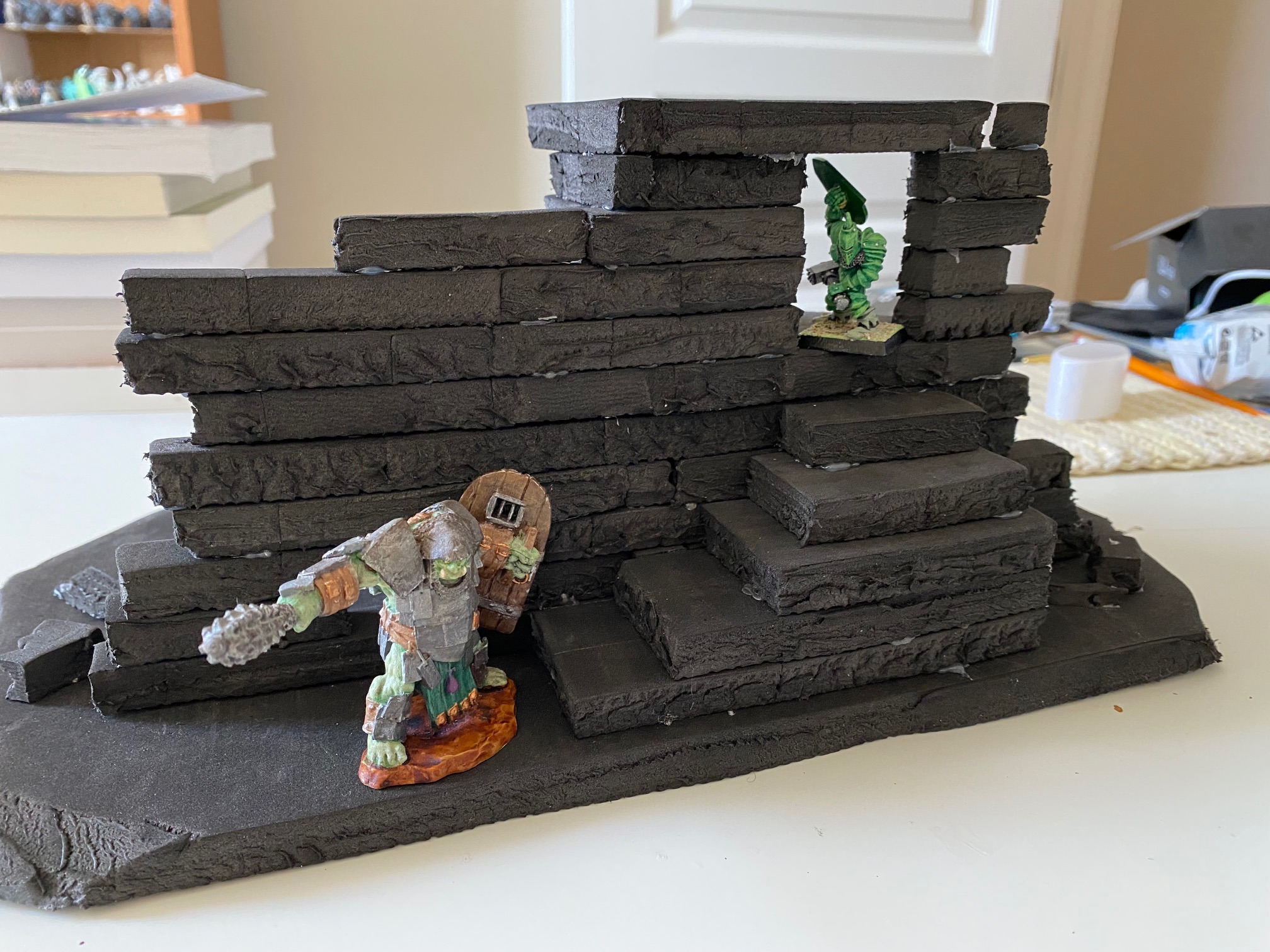
EVA foam DIY terrain ruins


Wow! I recently watched a Youtube tutorial on making 'corner ruins' wargaming terrain out of EVA foam - not that 'pink stuff' but the even more accessible, if a bit less rigid, material used in 'jigsaw-puzzle' interlocking floor tiles (for gyms, baby rooms, etc.). I have really had a hankering to try it out, and I took the plunge yesterday. Although this took me a while (most of the afternoon), I aimed to be more ambitious than the tutorial video, and produced something that I absolutely love for a first-time product. This is light, resilient, and stays just fine if dropped. It lacks the fine detail of some of my other (= 'more expensive') terrain, and it isn't painted yet, but I already like it a lot. 


I may just whip up a table's worth of this stuff...and since making this only took up about $2 CAD of the supplies I bought (from a $16 pack at Wal-Mart), I have lots more cheap stuff on hand. That's good, as I have more ambitious designs in mind (along with some more basic scatter terrain). 


These ruffians approve.

If you enjoy making wargaming terrain, I heartily recommend you check out this method. 


Wednesday, March 8, 2023

Party Stances for Dungeon Turns (a Dungeon Procedure idea)

 I've been noodling at some thoughts about dungeoncrawl procedures, turn tracking, resource management, etc. The recent hubbub around the new Shadowdark game, which uses 1 hour of real-world time to track each torch, got me thinking. I don't think that's a solution I favor, but it's not a bad idea to keep thinking about creative ways to handle some of the ol' sacred cows in dungeoneering. 

So I've been scratching at some new (to me, at least) combinations. I haven't tested these out yet and I suspect they still need some work, but I like this approach in concept. There are a few key ideas mashed together here. One is that resource management is important in dungeoncrawling, but I don't really see a TON of regular utility in tracking torches and rations; it's more like a tax to keep the threat of running out part of the game. But actually having the players just sit there in the dark doesn't sound as fun. :-) Are there any simpler ways to handle all this, without giving up resource management completely?

The other idea I'm working with is inspired by Pathfinder 2e's dungeon exploration activities (of all things!). This is an idea that caught my fancy when I started running PF2e, though in practice I'm finding them a bit less awesome than I'd hoped. My intent here is to salvage something of the core approach, while hopefully improving a bit on the experience. 

Again, this is all a bit work-in-progress, but here goes. 


DUNGEON EXPLORATION STANCES

You know how some games let players choose a combat stance, usually applying Advantage to attacks and Disadvantages to defense (or the opposite)? This is kind of like that; each dungeon turn, while exploring, the party chooses a posture. This commits them to excelling at a particular kind of dungeon activity, while imposing some liabilities in other areas. It's important to note that this shouldn't prevent players from attempting certain kinds of activities; this just makes them a bit better at X than Y. Also, I thought about allowing a 'Neutral' base stance, but I kind of like the idea that dungeoncrawling is always risky, and every moment requires you to gamble focusing on something over other things. There is no 'casual tourist mode' in a lethal dungeon. 

In what follows, I'm thinking in Into the Odd-ish terms, albeit with room for standard fantasy class/heritage hacked in, so adjust accordingly to suit your favored mechanics. 

First: the party carries Supplies, an abstract measurement of their consumables (water, torches, and rations). The assumption is that every available inventory slot not filled with something else at the session's start is filled with Supplies, but no more. 

Each (approx.) 10-minute turn, the party (by default, as a whole, but see below) chooses to operate in one of the following stances. To switch to a different stance (usually at the beginning of the turn), somebody in the party must spend one slot of Supplies (this incentivizes staying in a stance longer, so players have to push their luck and think about their options). 

The stances are:

+ ALERT: The party automatically wins initiative rolls and passes WIS Saves against being surprised. But, DOWNSIDE: the party's militant demeanor imposes a penalty on NPC reaction rolls! 

+ HASTY: The party moves twice as fast, but DOWNSIDE: the hurried party loses Initiative rolls and automatically fails Saves against being surprised. 

+ DECLAMATORY: Now is a time for bold and encouraging words! The party gets advantage on NPC reaction rolls, and the encouraging pats-on-the-back and dramatic pep talks give each PC Advantage on their first Save rolled this turn. But, DOWNSIDE: the party automatically loses Initiative. 

+ STEALTHY: players get +Advantage to rolls to be sneaky. Anyone who would already get +Adv for such rolls due to some cool class hack gets an EXTRA bonus roll. Yowza! But, DOWNSIDE: if you're in a dark area, lugging a lit torch around will instantly give away your position, so sustaining a STEALTHY posture requires accepting some low-light consequences: penalty to NPC reaction rolls if discovered, and PCs inflict Impaired damage if they get in a fight. 

+ INVESTIGATIVE: the party slows down to check out an area in more detail. Each PC automatically detects their class/heritage detection items (see below), but DOWNSIDE: it costs TWO Supplies to enter this Stance instead of one. 

+ RESTING: The party may hunker down and take a Short Rest, gaining its benefits, but DOWNSIDE: it ain't a rest if you aren't resting, and if you're resting when something goes wrong... the party automatically loses Surprise Saves AND Initiative when in this posture. 

+ STAND GUARD: the stances above apply to the entire party. For an additional cost of one Supply per PC, one or more PCs may pay to adopt a separate individual stance of ALERT or STEALTHY, although the rest of the party is in some other stance. The PC standing guard gains the benefits and drawbacks of ALERT or STEALTHY and does NOT gain whatever benefits the rest of the party is enjoying (a party might use this rule to have a healthy PC stand guard on ALERT while the rest of the party takes a short rest, for example). 

+ RUNNING OUT OF SUPPLY: if the party has run out of points of Supply, then we can assume that either they are actually groping in the dark, or (let's say instead) they are down to a few desperate candle nubs, burning sheets of paper and spare socks to keep the fire going, etc. This means we don't have to disrupt play massively at this point - but there is still a real cost to mis-managing the resource game. When a party has run out of supply while operating in a dark underground environment, the following apply to all PCs: PCs inflict Impaired damage, penalty to NPC reaction rolls, and ... maybe ... Disadvantage on all Saves? For a mechanically interesting but perhaps too generous alternative, just say that the party can (and MUST) still select a Dungeon Stance, but they ONLY get that stance's DOWNSIDE - none of the benefits. This option means the players keep having to make choices about the least of all evil options as they try to get out of the dungeon (you'd have to say you can't choose Investigative stance in this context, of course). 


A BIT MORE ON THAT INVESTIGATIVE STUFF...

I may really be out to lunch here, but how about...

When the party enters a new room, every player rolls 1d6. On a 1-2, the following happens:

+ Fighters and Halflings detect any ambushers present

+ Thieves and Dwarves detect any traps or secret doors

+ Magic-Users (all kinds) and Elves detect magic 

When in Investigative Stance, the above detections happen whatever the player rolled. 

The idea here is to hand the players more information, inviting them to focus on the bits that really push toward choices in play. So secret doors should still require some engagement - as I've suggested before, make the door easy to find but challenging to open. Traps should follow Chris M's suggestions: easy to spot, but trickier to circumvent if you need to do so in a hurry. 

With all these stances, of course, it's important not to nerf an action that any PC should be able to do at any time. So Investigative stance isn't the only stance in which, say, a PC can mess with a treasure chest for information: it's a way to mechanically make the players more confident about certain pieces of information, but at a known mechanical cost. 


Anyway. Whaddaya think? Any thoughts on the potential utility (or otherwise) of such a system?


PARTING SHOT: THIS PARTY HAS CLEARLY CHOSEN THE DECLAMATORY STANCE. 

I DON'T THINK IT'LL HELP THE REACTION ROLL. 


Thursday, February 2, 2023

A map (WIP) - my "Fauxhammer" project

 This is a work in progress (WIP), a thing I've been noodling at for fun. It needs more work (and the work already done needs more cleaning and processing) - but I'm having a great time with this big map spread. 


This is an alternate, homebrew setting for my own Warhammer battles - a place closer to really old sword and sorcery Oldhammer, with its Moorcockian, Appendix-N, almost science-fantasy vibes, instead of the faux Renaissance feel of WFRP - or the almost mindbogglingly large scale of the current Age of Sigmar setting. It's a nod to the vague but deeply evocative thing that Warhammer once was - during my youth, and to the many "jeweled thrones" of Conan's Hyboria. The setting, as presented here, also draws on some of the "Middle Earth/Warhammer" mashup I toyed with last year, along with a bit of inspiration from the "howling emptiness" of parts of the old Greyhawk setting. I'm having lots of fun imagining the various petty rivalries and histories that have shaped this map. It's a setting not threatened by one Dark Lord, but by many (who wage jealous war upon each other, too); defended not by one alliance of the free, but by many, who just as often suspiciously eye their neighbors' ambitions (if they're lucky enough to have neighbors). The central subcontinent was once three kingdoms, then one great realm, and then -- after shocking betrayals and setbacks -- it became the fragmented (and in some regions the really points-of-light) setting represented here. 


One thing's for sure: I've got loads of ideas for narrative-based fights on this map, from mass battles pitching cursed (but still 'good') undead against the deceptive Enchanter's hordes, or the Silver Legion's greedy mercenaries against trade-rich Toharon ... to small-scale skirmishes -- perhaps a band of funeral singers holding off cultists in the Azure Necropolis, dwarves trying once again to infiltrate the Darkmount so they can pacify its feral elemental energies, or rival adventuring bands squabbling over treasure in the shattered ruins of the once-mighty central capital. 


Thursday, December 22, 2022

Procedures for an OSR- and PbtA-influenced Pathfinder 2e sewer-crawl!!!!!

 So, last night's session in our PF2e campaign ended in a hideous TPK against a Black Pudding (as discussed here). Urk! That aside, the evening was separately interesting, too; I tried out a new approach to large, winding dungeons in Pathfinder 2e. In short, the PCs needed to explore an ancient sewer complex, looking for guarded halls holding stone keys that could open an underground archive door. Ok, great. 

However, PF2e -- which is excellent for running fun, tactically-minded encounters -- can be a little bit of a beast for 'traditional' dungeoncrawling. Fights can take a long time (an issue I discussed recently, here), and the resource-management game doesn't seem to fit very well with PF2e mechanics (my mid-level party has Light as an at-will cantrip, and many of the standard OSR-style resource counters just don't do much to a group like this). 

But I wanted to highlight the experience of pushing your luck while exploring a really large, winding dungeon - without taking FOREVER, and without just hand-waving past the exploration to the fight scenes. (The campaign that just ended had a vast dwarven-hold on the forecast, so this was a bit of an experimental prototype with a really large dungeon in mind). Note, PF2e does include its own Exploration rules, which are alright, but I wanted something a bit different, a bit meatier, and a bit closer to the OSR- and/or PbtA-system games that I'm more accustomed to for handling the dungeon as a threatening/promising, vast space.

So, drawing on influences ranging from OSR/NSR-style dungeons, to the various forms of Jason Cordova's PbtA Labyrinth move, I put together some rules, which I'm pasting below in case they're of use to anyone else. 

The key concepts to note here:

+ There are probably widely applicable ideas here, though the current form is tailored closely to a unique environment - the sewers are flooded perpetually by magical pitchers of everlasting water, and then drained by a pressure-gate into an underground river. Much of the punch of this dungeon, and these rules, involved the cycles of waxing and waning danger as the tunnels fill and empty. To apply these procedures to a different dungeon, you'd need to think carefully about some analogous source of time-sensitive pressure and risk (sentry patrols, sleep cycles of drowsy monsters, etc.). 

+ I wanted RANDOM ENCOUNTERS, but actual random fights in PF2e would slow things down like treacle in your gas-tank. PF2e's HAZARDS and HAUNTS rules fit the bill, however! I just ran with "Simple" Hazards (no Complex Hazards), which pitch a quick Saving Throw against the risk of some kind of consequence - either a lasting Condition (Fatigue, Drained, etc.) or some Hit Point loss.

+ Our PF2e characters could nerf most HP loss with a few ten-minute rests, so I added a significant set of time pressures; flooding tunnels that made exploration harder and more dangerous in 100-minute cycles, and then "above-ground-world" political shenanigans to make overnight rests more costly.

+ I wanted to keep everyone involved and give at least a nod to the narrative implied by dice rolls, so I made two players roll skill checks each turn, tied to narratively justified exploration tasks on a continually-narrowing field of eligible actions. Two skill rolls each exploration turn allowed a PbtA-style "2 successes, 1 Success with a consequence, or 0 Successes and a Consequence" structure that helped add tension to the exploration. 

Ok, here it is.

+++

SEWER-TUNNELS AND ARCHIVE BENEATH THE TOMB-CITY - DEC 2022 PF2e CAMPAIGN


TRACK:
WATER level; Time spent (6 turns = 1 hour); Skills used; PROGRESS. 


Each 10-minute turn…


1) raise the water level by 1 at the start of the turn (this runs from 1-10)


2) party chooses to REST for ten minutes (can recharge focus points, etc.), PRESS ON, or RETREAT


3) Before rolling, party chooses/updates their Exploration stances


+ To PRESS ON: 2 different players each choose one dungeon-appropriate skill check, vs. DC 22 PLUS the current water level as the DC. 

⁃            with 2 successes: players gain 2 progress to find another Hall

⁃            with 1 success: players gain 1 progress and have 1-in-3 chance of an 

                   Encounter

⁃            with 0 successes: players gain 0 progress and have a random encounter


+ To RETREAT: all players choose a known safe/dry destination (the starting hall or another discovered dry hall) and then roll against a dungeon skill check of their choice from the list. 

⁃            Critical Success: this PC safely reaches their destination, and may raise one 

                   other PC’s result by one level (up to Success).

⁃            Success: this PC safely reaches their destination

⁃            Failure: this PC fails to reach their destination. If water level is at 10, trigger 

                   drowning procedure.

⁃            Critical Failure: as Failure, but raising safely will take 2 Critical Successes. 


+ RANDOM ENCOUNTERS:


1: Exhaustion - all PCs make DC 25 Basic Will OR Fortitude Save, or gain Fatigued 1 (Fatigued 2 on Crit Failure)

2: Swarm of water-snakes: all PCs make DC 24 Basic Reflex Save vs 4d8 + 18 dmg 

3: Ghostly specters seeping from drain-pipes: all PCs make DC 27 Basic Will Save vs. 2d8+9 dmg, 1/2 dmg on Success, Drained 1 on Failure, Drained 2 on Crit Failure. 

4: Large Electrical Eel discharges - all PCs make DC 24 Basic Fortitude Save vs 6d6 damage

5-6: Green Slime drops on 1 random party member (Lvl 9 Hazard)


Lvl 6 SIMPLE HAZARDS (see GM Guide p. 76)

+20 Attack vs AC - or - 24/27 DC (High/Extreme) - 4d8+18 dmg 


In most cases, the failed roll that led to an Encounter counts in lieu of the failed Perception or Initiative roll - move right to the encounter trigger. For some, may ask PCs to make a fresh Save or Skill roll as relevant for one last chance to perceive a trap.  


+ Eligible Dungeon Skill Checks (each time one is attempted, cross it off the list of eligible Skills. Reset the list when all have been attempted):

⁃            Acrobatics … you move out along a very slippery, narrow ledge as you scout a 

         way forward…

⁃            Arcana … you observe very, very old arcane symbols carved into a walls; a 

         flash of insight about their likely meaning helps you use them to find your 

         way. 

⁃            Athletics … a pile of rubble nearly blocks your way. Will it? 

⁃            (Forerunners Lore – Tullem only…)

⁃            Nature … You’ve some experience with caves and underwater rivers, which 

         helps you stay focused and oriented now. 

⁃            Occultism … you’ve read rumors about the obscure logic of this ancient 

         civilization’s constructions. You use that knowledge now to hazard a guess 

         about the right direction. 

⁃            Religion … faded but uncomfortably bizarre religious carvings on the tunnel 

         walls dimly suggest a directional orientation in line with very ancient creedal 

         constructs. 

⁃            Society … You remember a nugget of historical information about the fey 

         architects’ language. Can it help you decipher the directional symbols carved 

         on the wall before you?

⁃            Stealth … A noise - is something creeping nearby? Try to lead your party 

         sneakily away. 

⁃            Survival … The rising water is cold, and its ever-gurgling echoes are 

         disorienting. But you’ve been in tough spots before; can you keep the party 

         moving, warm, and focused? 

⁃            Thievery … the way ahead is blocked by an ancient lock, or threatened by 

         what looks like a very old trap meant to cull large vermin. It could still pose a 

         problem for you and your friends. Will it? 


+ Flooding and Drowning: the under-sewers are filled, flooded, and cleaned by an ingenious arcane system: far away in the bowels of the narrow tunnels lies a chamber eternally filling with water from a great many Ewers of Endless Water; elsewhere in the tunnel system is a similarly-remote chamber with a pressure-activated, resetting release gate. Every 100 minutes, the whole tunnel system floods completely and then drains (into an underground river) in a great rush of water. (Locating either the water-supply or water-draining rooms should be nigh impossible, but if the party insists, set a 12-Progress clock specifically dedicated to finding each room). 


Mechanically - the Water Level count goes up to 10, at which point the entire complex except for the Halls is flooded to the ceiling. If any PCs end an Exploration Turn in the tunnels while they are at Water Level 10 (before they reset to Level 1 on the next Turn), those PCs are at severe risk for drowning. As there is a double risk present - running out of air, AND being dragged and smashed along the walls - having access to an air supply still requires a roll, but grants a +10 bonus. Sharing an air supply (like the Air Bubble spell) cuts the bonus in half for each extra person sharing the supply. 

Roll a Fortitude Save, DC 32 (this includes the Water Level penalty): 

Crit Success: Almost mathematically impossible…but you survive, and suffer no lasting ill effects. 

Success: Miraculously, you find a few pockets of air in hollows in the ceiling, and just barely survive, though you feel like trash. Take condition Drained 1. 

Failure: The fact that you aren’t dead is almost inconceivable. Take the condition Drained 4. 

Critical Failure: your character dies. 

You may spend all your Hero Points to escape death - either from damage caused on a Failure, or the straight fatality on a Crit Failure. However, doing so from a Crit Failure ‘upgrades’ you to a Failure, so you are Drained 4. 


The Halls - it takes 6 PROGRESS to locate a new hall; roll randomly to find which hall is discovered next, as the party wends through the twisting underground labyrinth of the tomb-city’s under-sewers. 


+ Entrance Hall (lone shabti who can explain some of what’s going on) … uh-oh…do they only speak the ancient tongue? 


+ Hall of the First Keeper:
one glass golem with an Archive key in a hinged, clear glass compartment/box on its hip. (could be combat OR thievery encounter)


+ Hall of the Second Keeper:
one glass golem (as above), along with 2 Shabti who will warn the golem if they observe a theft in progress. Need to flesh out this encounter. (could be combat, thievery, and/or social encounter the shabti are upset about the destruction of the iron golem in Room 3…they don’t want anything to happen to their golem ‘friend’ here, and they care more about him than they do about the silly key he carries. They will warn him of a theft attempt in progress, UNLESS the party destroys the horror in the Third Hall. Ah - maybe the shabti are on the approach to a raised pedestal where ‘their’ golem is (they visit him daily in a mock ritual). They will see and warn the party. 


+ Hall of the Third Keeper:
few remnants of an iron golem, along with the Black Pudding that dissolved it. The stone Archive key is here, half-in the pudding. 


+ Hall of the Archive Gate:
a large round portal, bearing three large key-holes, and sealed by ancient, eldritch magics. It won’t open without the three Archive keys turned together. A winding stairway leads up to a distant locked door. Beyond it, horrible moaning sounds – death clearly awaits on the other side (ca. 20 Wights)

T - P - K !!!!!! Or, attack of the Christmas Pudding...

 Yeah, so...

Another TPK (Total Party Kill). 

Last night we got back together for the further exploits of our party of Pathfinder 2e heroes, veterans of The Evils of Illmire, The Black Wyrm of Brandonsford, and various awesome acts of derring-do in another region of my own devising (in their previous adventure, the PCs had assaulted a Strix-held, cursed, flying dwarven citadel loosely inspired by the dwarven sky-tomb in Dragons of Desolation). 

And then, in this last session, they ventured into the labyrinthine sewers beneath an ancient tomb-city, a place long abandoned by its original builders and then re-used as a funereal necropolis by later settlers. They went underground in search of a lost royal archive rumored to lie hidden beneath the city. This required a (rather interesting, if I may toot my horn) home-brewed OSR- and PbtA-influenced set of rules for crawling sewers that magically fill, flood, and drain every 100 minutes.

It was an epic evening! The PCs needed to find and secure three magical stone keys in order to unlock the archive door. They found two in pouches on the hips of powerful golem guardians - but the party Rogue quite daringly slipped in alone in each case, and successfully pick-pocketed the golems, completely avoiding what could have been quite dangerous combat encounters. 

Ah.

But then came the hall with the Black Pudding, a magical stone key protruding from its muck...


https://2e.aonprd.com/Monsters.aspx?ID=323


And a number of poor rolls and, frankly, bad tactical decisions later, the entire party lay unconscious in the deadly grip of ooze. Gloooop...glooop...buuuurrp. 

I believe this is my second TPK in about three years or so. Getting a TPK comes with mixed feelings for me as a GM. On the one hand, I genuinely liked the Player Characters and was invested in their stories. There's a real "oh NO!!!" feeling. On the other hand -- in a truly non-adversarial way -- there's a sense of pride that comes along with a TPK, for me. Not at all pride at 'beating' my players, or anything like that. Rather - the sense that yes, I'm still clear on my values as a GM: my job is to make a fascinating, serious, and deadly world for my players to enjoy. The stakes here are real, and I will not just pull my punches to bail them out of trouble - even if I need to kill them all. Time for some new PCs, and maybe even a new campaign.  

That's an oddly satisfying thing to remind yourself, and I'm delighted that my players and dear friends get it, too. 

Now, to wipe the blood and acid off my dice bag...

Saturday, November 19, 2022

On Running Very Different Types of Games

Prepare ye for some musings on the philosophy of gaming... 

I used to spend far too much time, not too long ago, trying to figure out my 'perfect game system.' You know, that one, elusive RPG rules-system -- whether about to be published, somehow already published but not on my radar, or the pending product of my intensive house-ruling and hacking -- that finally would usher in a blissful millennial regime of perfectly satisfying game-play.

Yeah, um, about that...I'm pretty sure gaming doesn't work that way... 

...mainly because I don't think life itself is supposed to work that way. Pre-conditioned by a consumer-driven society to always lust after something else, anything else, just not one of the 5,000,000,000 gaming .pdfs already sitting on my hard drive, my flirtations with (one hopes!) middle-aged maturation point me towards greater contentment with what I've got ... or at least with a more realistic view of the point of getting new games. To be clear, I still love me some new gaming action, and I've got my beady eyes now on a few choice titles on the horizon ... but I'm trying to be a bit more deliberate and thoughtful about it all. 

Perhaps ironically, fixating less on the pursuit of 'that one perfect game' has helped me recognize more clearly how very different systems have lots to offer just as they are, for a particular niche. That tired old debate - "system matters! no, you dolt, system doesn't matter!" - like any (false) dichotomy, obscures the grain of truth on each side of the argument. A creative, flexible, experienced GM can make almost any RPG system do wonderful things, but of course system directly impacts the experience of gameplay. 

A while ago, I made a list of different niches for rules systems - different types of games that I find appealing at different times. What, I then asked, might be my preferred rules systems for executing each kind of game? It proved helpful to me to think not in terms of genres, but in terms of the experience of different play-styles. Here was my list of categories: 

  • OSR - more complex/substantial
  • OSR - less complex/rules light 
  • PbtA (Powered by the Apocalypse games - I'd add Forged in the Dark games here too)
  • Solo or Cooperative games
  • Tactical RPGs
  • Games with High-Powered player characters 

There's a lot of potential for overlap between some of those categories, though each one has its own distinct play-style or experience. As I worked to articulate what systems might best suit my preferences in each category, I noticed some games that I like fitting in multiple categories, while others obviously had more limited roles. Somehow, breaking things down like this also gave me some clarity about the kinds of gaming I wanted to do for the present season. For example, I realized that - at least for now - the 'more complex OSR game' wasn't really where I wanted to land. On the rules-lighter side, I absolutely love Into the Odd, but I can get disenchanted with the real limitations of its ultralight framework. What I realized, however, is that I'd rather accept ItO's intended niche and use it to run a freewheeling, rules-light OSR/NSR game ... or if I wanted something with more heft, I'd rather use something crunchier than most of my 'centrist' OSR systems (I had looked in earnest into Low Fantasy Gaming for a while, for example, before settling for...something else. More below).

After shifting from a science-fantasy campaign using Dungeon World, I had been running a campaign using a house-ruled Knave-based system. Knave is great! We played through most of a mash-up of The Evils of Illmire and The Black Dragon of Brandonsford that way. But I started feeling that Knave wasn't delivering the experience we wanted for the time being (see, it's a great system - but wasn't right for the moment). On the one hand, some of my players really longed for more detail and agency for custom-tailoring their characters during advancement. And as GM, I was getting bored with the monsters-as-lightly-flavored-bags-of-hit-points phenomenon that (like it or not!) can stand out in OSR games when compared to crunchier systems (yes, yes, I know; there are ways to address that with GM creativity. But system doesn't matter, except when it does). I wanted critters that were more mechanically interesting to throw at my players, and I wanted a little more tactical specificity in the rules so I could lean hard in combat without constantly breaking the PCs - or pulling my punches. (I doubt it's a spoiler to note that The Black Dragon of Brandonsford has ... a black dragon in it. The fight with that monster, under Knave rules, was memorable, but I came away feeling that I was always one or two GM-fiat choices away from a cakewalk or a total party kill. I wanted to play hardball, without being arbitrarily cruel!). 

For a variety of reasons, we switched the campaign over to Pathfinder 2e. 

It would not surprise me to learn that I'm one of few (or the only?) GMs out there to have converted situations and encounters from the thoroughly OSR-ish Illmire and Brandonsford into PF2e! Or to have multiple recurring villains in an ongoing PF2e campaign who started as NPCs in those modules. I integrated them into a new region 'just across the mountains' and started up a very faction-heavy, situation-based campaign that draws on a lot of old-school resources despite the very modern rules system. (Gotta say - I am digging playing in my own sandbox full of conflicting, home-made factions). 

Well, how's it going, and what have I learned?

Here again, I'm seeing how different rule systems can offer so much while simultaneously imposing their own kinds of limits. Despite turning up my nose for years at Paizo's flagship system, I'm now finding PF2e a really excellent base for gaming centered around tactical combat. Pleasantly, I've found the system works well, too, when I set aside 'the grid' and run a much looser battlefield - in fact, it's almost easier and more fun that way. One of our favorite fights in the campaign so far used abstract zones on a vertical, side-facing cutaway color diagram of a dilapidated slum tower - from a Warhammer Fantasy RPG supplement - instead of a top-down gridded map. I ran another fight (near "Illmire") using a handrawn rough sketch of a swampy battlefield about 100 meters across that took about eight seconds to draw. Balanced fights are really easy to plan and run, and monsters generally feel distinct and interesting and often pose mini-puzzles for players to crack during combat. Several of my players are reveling in the greater customization and control afforded by the system. So, huzzah!

On the other hand ... our pace has SLOWED down!!!  

Right now, the party is exploring a floating dwarven citadel (thanks, inspiration from Dragons of Desolation!). They got there on a flying dwarven skyship, seeking clues to the reason the castle got torn skyward centuries ago, and also to recover a relic axe (the PCs are trying to help a group of dwarves boost recruitment for an army to retake their halls from a dark Duergar cult; recovering the axe should give them the P.R. boost needed to swell the army with fresh recruits - while causing some indirect problems with other factions that the PCs will have to deal with, too). 

Due to various real-life factors, our sessions of late have been limited to about 2-3 hours most weekends. Two sessions ago, we got through a bit of freeform roleplaying and lore-dumping to set up the mission, and then the PCs were dropped off on a balcony (under fire from angry Strix birdmen) and fought their way inside, finding a treasure-laden workshop guarded by several dwarven-crafted automata. The resulting fight took up the rest of the session. Then, in our most recent session, the party left that room, climbed a central stair-shaft, dealt with some brown mold on a kitchen cabinet, had a big fight in a haunted banquet hall, climbed more stairs, and entered another room where they'll obviously face a big fight - and time was up for the session. So, basically, one complex fight, and two 'empty' but trapped spaces - in a full session. 

That is kind of frustratingly slow compared to the pace of other campaigns I've run (a few years back, we used Dungeon World to roll through B10, Night's Dark Terror, and X1, The Isle of Dread. We got SO MUCH DONE some nights in those campaigns! Not to mention the night we played what would normally be an entire campaign's story in a single night using On Mighty Thews...). Right now, the slower pace required by the more detailed, crunchy combat mechanics and turns in PF2e is pushing me to focus on designing memorable, interesting encounters, but at the cost of flexible, more open-ended play. I feel like a technician instead of an artist: checking moves, maintaining order, applying rules, tracking mechanics (and that's even with a willingness to just make rulings when I can't find the 'proper' PF2e way quickly). I'm really missing the playful, creative sense of surprise that I get when GMing a less crunchy and more open system. 

So...hmm...what's a GM to do?

An earlier version of me would probably be screeching to a halt already, deciding that 'this isn't THE system, after all', and moving on in search of greener pastures. But the shift in my thinking in recent years, as described above, has me looking for a different solution. PF2e is a GREAT engine, FAR better than many other games I've run at doing certain things. But it's also slower and more cumbersome when compared to many other games I've run.  

Instead of jumping ship and looking for 'something better', I'm trying to focus on celebrating what we are gaining from using this system at this time, while thinking clearly about what else I might like at an appropriate - and maybe other? - time. 

I do think I want to tweak something, but I suspect the answer might lie in budgeting time for something else while persisting to do this current campaign real justice. I'm thinking of a few ideas ... like maybe committing to run something much more freewheeling for a break in a few months' time. Forged in the Dark systems are really calling my name right now (in fact, I've got some thoughts I hope to share soon about FitD rules-light options for 'domain play' and mass combat). Alternately, maybe the answer is to switch back and forth - maybe we could run two concurrent campaigns, with something like Blades in the Dark one week, and PF2e the next? That might scratch the right itch for everybody (I've got one player in particular who really misses the system of Dungeon World). 

Whatever I do, though ... I want to be mindful and content if I'm going to run something. I'm not afraid to abandon a campaign that isn't going well (I've done that before), but I don't think that's where I'm at right now. Instead, maybe the right approach now involves being aware of the different kinds of play that I like, celebrating the ways I'm getting some of that, and waiting patiently and flexibly to try other styles at the right time. 

Hmmmm. Thanks for bearing with these musings ... hopefully they provoke a few useful insights for somebody else, too.